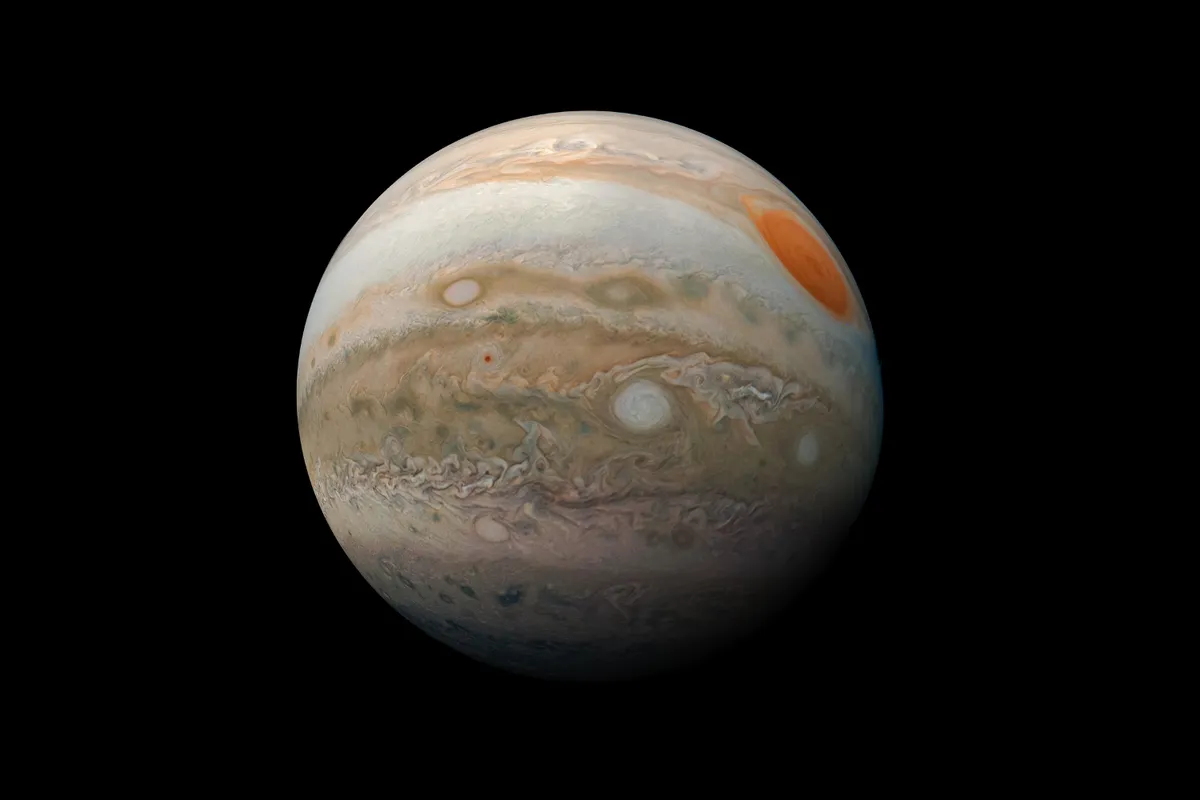
For nearly 50 years, we've had the wrong measurements for Jupiter. Not by much—15 miles along its polar axis, 5 miles around its equator—but enough that it's forcing planetary scientists to rethink how the solar system's largest planet actually works on the inside.
The old numbers came from the Voyager and Pioneer missions in the 1970s, which used radio signals to probe Jupiter's atmosphere. Those signals bent and slowed as they passed through, revealing clues about temperature, pressure, and density. It was clever work. But there was a problem the scientists didn't fully account for: Jupiter's wind.
The gas giant doesn't have a solid surface. It's all atmosphere, with winds that can reach 400 miles per hour. Those winds shift and compress the planet's shape constantly, which means the old measurements—taken from just six different angles—were picking up snapshots of a moving target. It's like trying to measure someone's height while they're jumping.
We're a new kind of news feed.
Regular news is designed to drain you. We're a non-profit built to restore you. Every story we publish is scored for impact, progress, and hope.
Start Your News DetoxNASA's Juno spacecraft, which has been orbiting Jupiter since 2016, gave researchers a chance to do better. The probe followed a new orbital path that allowed it to send radio signals from behind the planet as seen from Earth. That meant 24 measurements instead of six, taken over several years, with better tools and a clearer understanding of what they were looking at.
The revised numbers—83,000 miles along the poles, 89,000 miles at the equator—might seem like a minor correction. But to planetary scientists, those small differences unlock something much bigger. "It's not about just knowing exactly where the radius is, but it's really about understanding its internal workings," says Oded Aharonson, a planetary scientist at the Weizmann Institute of Science. Jupiter's interior is almost completely hidden from us. We can't see inside it, can't send probes deep enough to touch its core. The only clues we have come from measuring its gravity and shape, then working backward to figure out what's happening beneath the clouds.
When Eli Galanti and his team at the Weizmann Institute plugged the new measurements into their computer models of Jupiter's interior, something shifted. Models that had struggled to fit both the gravity data and atmospheric measurements suddenly aligned. "Shifting the radius by just a little lets our models of Jupiter's interior fit both the gravity data and atmospheric measurements much better," Galanti explains. That's not a small thing. It means we're getting closer to understanding what Jupiter is made of, how dense its core is, and how the whole system came together.
There's another ripple effect. Scientists use Jupiter as a reference point for understanding gas giants around other stars. When we spot a distant exoplanet that looks similar to Jupiter, we compare it to what we know. Better measurements of Jupiter mean better understanding of thousands of planets we can't directly observe. As geophysicist Yohai Kaspi puts it: "The size of Jupiter hasn't changed, of course, but the way we measure it has."
The study, published in Nature Astronomy in February 2026, is the kind of work that doesn't make headlines but quietly reshapes how science works. Textbooks will be updated. Models will be refined. And the next generation of planetary scientists will have a clearer picture of the giant that dominates our solar system.