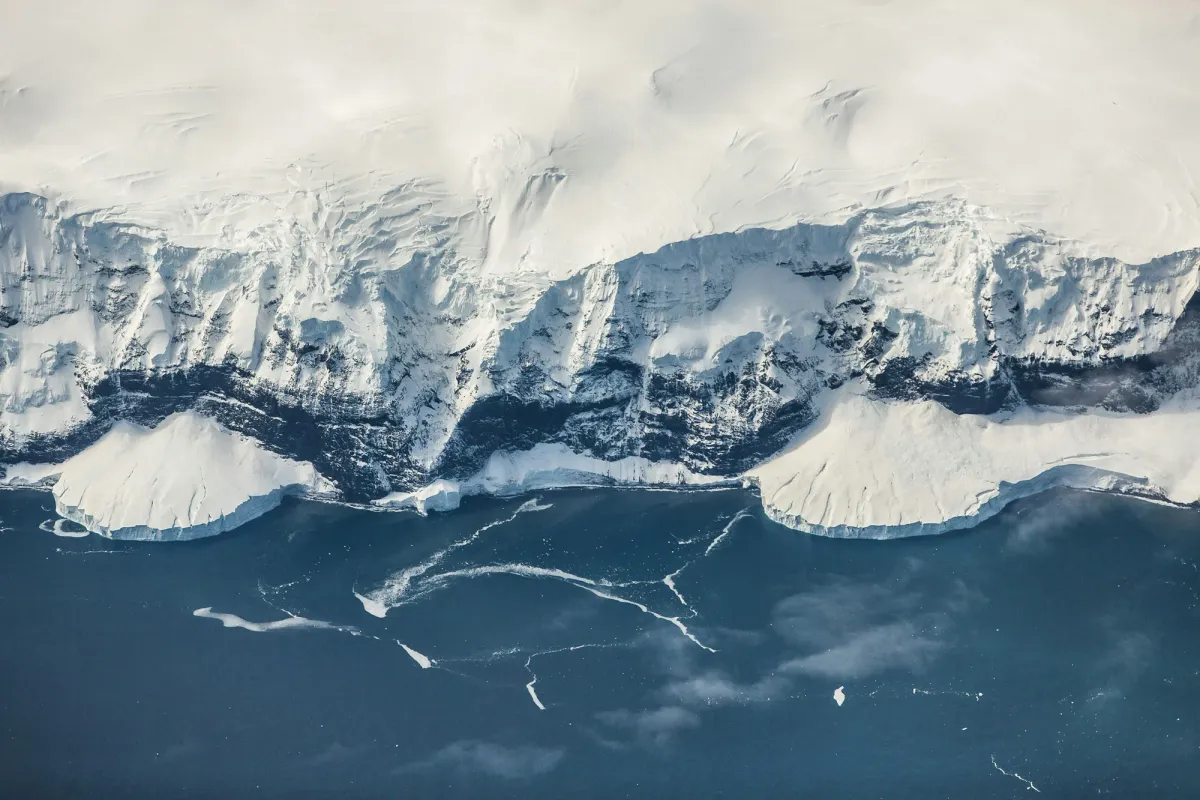
Antarctica's first ice sheet likely started with a geological boost deep within the continent. Millions of years ago, long before the Northern Hemisphere froze, forces inside Earth lifted East Antarctica. This created a vast area of mountains and plateaus.
This higher land became cold enough to keep snow frozen. This happened even when the planet was about 5°C (9°F) warmer than it is today.
How Antarctica Froze First
New research in Science explains why Antarctica froze about 34 million years ago. The Arctic, however, remained mostly free of large ice sheets. This difference comes from a slow change in Antarctica's landscape.
We're a new kind of news feed.
Regular news is designed to drain you. We're a non-profit built to restore you. Every story we publish is scored for impact, progress, and hope.
Start Your News DetoxThe process began much earlier when the ancient supercontinent Gondwana broke apart. When Antarctica and Africa separated during the Jurassic Period (about 201 to 143 million years ago), it disturbed the hot, slow-moving rock beneath Earth’s crust.
These disturbances created waves in the mantle. These waves gradually stripped material from the continent's deep roots. As this heavy material sank, the surface above it rose. This lifted East Antarctica over tens of millions of years.
Over time, East Antarctica developed a steep coastal cliff, a high plateau, and the Gamburtsev Mountains. Today, these mountains are mostly hidden under 1 to 3 km (0.6 to 1.9 miles) of ice.
Thomas Gernon, a professor at the University of Southampton, explained that Antarctica's land was slowly lifted. This made it possible for ice to stay permanently. This happened even though the surrounding oceans and global temperatures were still quite warm.
Reaching the Tipping Point for Ice
Gernon and his team used computer simulations to reconstruct over 100 million years of landscape changes. Their models connected the breakup of tectonic plates with changes in the mantle. They also looked at surface erosion, mountain growth, and the eventual arrival of permanent ice.
By about 45 million years ago, large parts of East Antarctica had risen above a key height of about 2 km (1.2 miles). At these elevations, temperatures were low enough for mountain glaciers to survive the summer. They grew year after year and eventually joined together.
Dr. Thea Hincks, a co-leader of the study, noted that their models accurately showed how the two-kilometer-high coastal cliff, plateau, and inland mountains formed. These features eventually seeded the East Antarctic Ice Sheet.
This elevated land gave Antarctica an advantage the Arctic didn't have. Even though atmospheric carbon dioxide (CO₂) levels were dropping, this alone couldn't fully explain why one pole froze so much earlier.
Gernon explained that if only CO₂ levels were responsible, both poles would have responded similarly. Instead, Antarctica got a big head start because geological processes raised its land to higher, colder elevations.
Mountains Crossed a Critical Height
A small change in altitude can make a big difference between lasting snow and summer melt. Dr. Guy Paxman, a co-author, said that topography is crucial for glaciation. Air temperatures can drop by up to 1ºC for every 100 meters of altitude gained.
Before 50 million years ago, most of the Gamburtsev Mountains were below 1.5 km (0.9 miles). By the time Antarctica's major glaciation began around 34 million years ago, almost half of the range had risen above 2 km (1.2 miles).
This increase allowed snow to stay through the summer and build up into permanent ice caps. Glaciers then spread down the mountains and across the plateau. They eventually merged into the East Antarctic Ice Sheet.
Climate Feedbacks Locked Antarctica in Ice
Once the ice started to spread, it created conditions for even more ice. Dr. Philip Goodwin, a climate physicist, explained that as the ice sheet grew, its bright surface reflected more sunlight back into space. This cooled the region further.
This "ice-albedo effect" lowered global temperatures by about 1°C (1.8°F). However, this cooling wasn't strong enough to create similar ice sheets in the Northern Hemisphere. Much of the Arctic land remained at lower elevations.
Antarctica's cooling also dried the atmosphere. Cold air holds less water vapor, so there was less heat-trapping gas to insulate the planet. This weakened the atmosphere's warming effect and allowed temperatures to fall further.
Goodwin added that these feedbacks allowed the Antarctic ice sheet to spread from the mountains across the continent, eventually reaching the coast. In contrast, the Northern Hemisphere didn't develop extensive ice sheets until about the past five million years. This was nearly 30 million years after Antarctica's transformation.
Earth's Interior May Trigger Ice Ages
These findings suggest that the start of an ice age involves more than just atmospheric changes. Plate tectonics and activity deep inside Earth can reshape continents. This happens long before a climate threshold is crossed. It determines where snow first survives and where an ice sheet can form.
Gernon explained that Earth's interior prepares landscapes for glaciation. It determines when and where major climate shifts, like Antarctica's glaciation, become possible. This is vital for understanding Earth's ancient ice ages and future climate tipping points.
The East Antarctic Ice Sheet is now the largest on the planet. If it melted completely, it holds enough frozen water to raise global sea levels by about 52 meters (171 feet).
Deep Dive & References
Continental breakup–driven uplift instigated East Antarctic Ice Sheet formation - Science, 2026