MIT researcher Admir Masic spent years puzzled by a contradiction. Ancient Rome's concrete had survived earthquakes, volcanoes, and two millennia underwater. Yet the famous Roman architect Vitruvius described a construction method that shouldn't have produced something so durable. Something didn't add up.
In 2023, Masic published his theory: the Romans used a "hot-mixing" process that trapped highly reactive lime within the concrete, creating a material that actually strengthened itself over time. But theory needed proof.
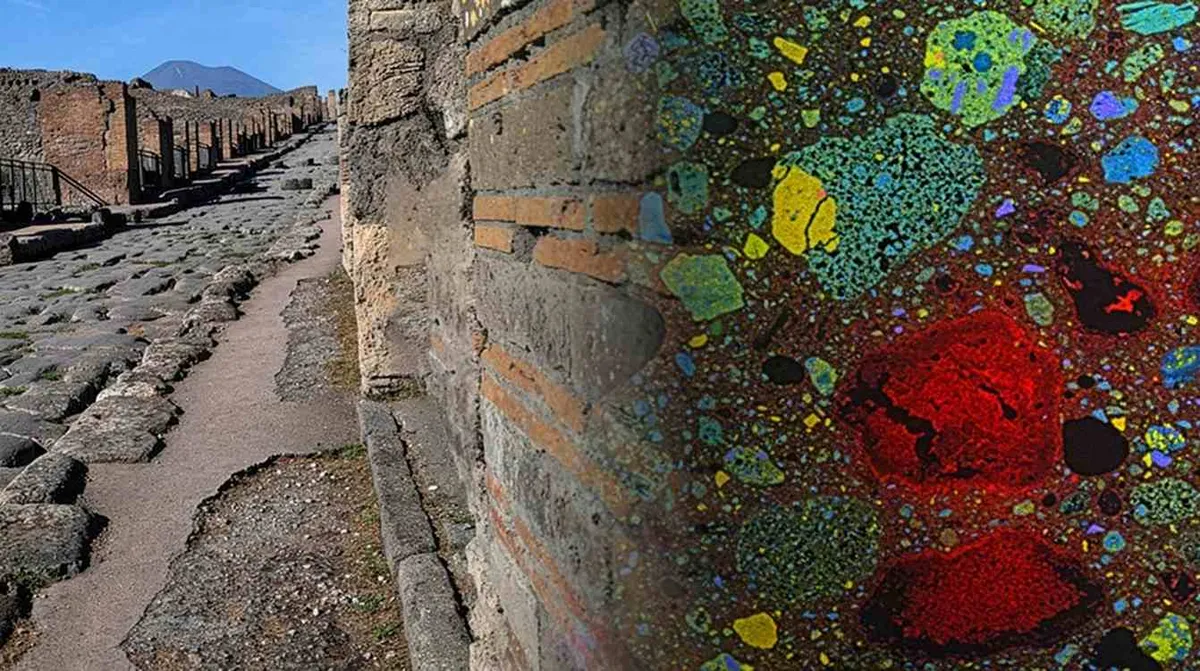
Then Pompeii handed him the evidence he needed. An active ancient construction site, preserved by volcanic ash, contained exactly what Masic's team was looking for—intact quicklime fragments pre-mixed with dry ingredients, the telltale signature of hot-mixing. The volcanic ash itself told another story. As it chemically reacted over centuries, it filled the concrete's pores through a process called recrystallization, essentially healing the material from within.
We're a new kind of news feed.
Regular news is designed to drain you. We're a non-profit built to restore you. Every story we publish is scored for impact, progress, and hope.
Start Your News Detox"This material can heal itself over thousands of years," Masic explains. "It has survived earthquakes and volcanoes. It has endured under the sea and survived degradation from the elements."
The implications are hard to overstate. Modern concrete is the world's most-used material, responsible for roughly 8% of global carbon emissions. Most of it cracks, degrades, and requires constant repair. Roman concrete, by contrast, gets stronger with time.
From Ancient Technique to Modern Problem
Masic didn't stop at publishing his findings. He co-founded DMAT, a company building modern concrete using Roman principles. The goal is straightforward: create materials that regenerate themselves rather than slowly crumble.
"We want materials that regenerate themselves," he says. The volcanic ash component—the self-healing secret—is particularly promising. By understanding how those pores refill through recrystallization, Masic's team can engineer similar processes into contemporary concrete mixes.
This isn't nostalgia dressed up as innovation. It's recognizing that an ancient solution might solve a modern problem that affects everything from infrastructure to climate impact. The Pantheon's concrete dome, built in 126 AD, still stands. Most buildings constructed in the 1960s are already showing serious structural wear.
The next phase is scaling from laboratory confirmation to commercial production—translating what worked for Roman aqueducts into concrete that can support today's cities. If it works, the implications ripple outward: buildings that last centuries instead of decades, infrastructure that strengthens rather than weakens, and a massive reduction in the carbon cost of constant reconstruction.