Two skeletons unearthed in southern Italy over 60 years ago have finally revealed their story — and it's a window into how prehistoric communities cared for their most vulnerable members.
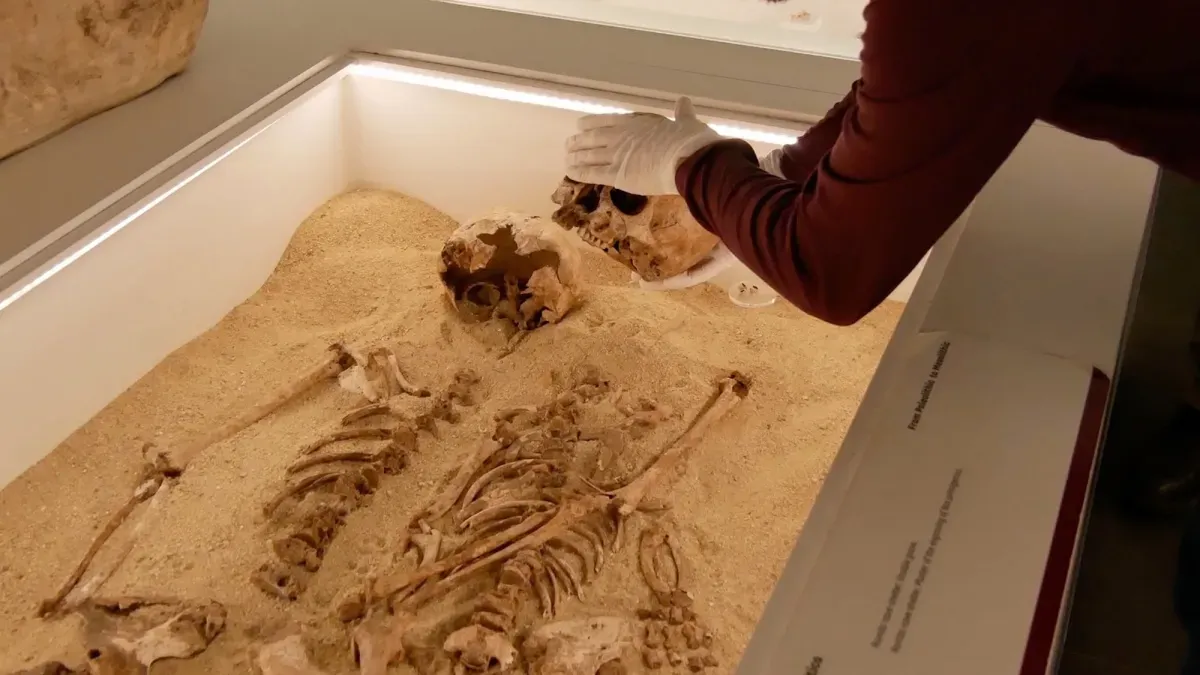
In 1963, archaeologists working in Grotta del Romito discovered two bodies buried together in an embrace, their remains preserved in the cave for over 12,000 years. Both had noticeably shortened limbs. The woman stood around 4.75 feet tall; the younger individual, just 3.6 feet. For decades, researchers debated what connected them and what caused their distinctive physical features. Now, genetic analysis has provided answers that reshape how we understand Stone Age family life.
A study published in the New England Journal of Medicine confirms that the two individuals — a mother and her daughter — both carried acromesomelic dysplasia (AMD), a rare genetic disorder affecting bone growth. AMD is strikingly uncommon: only about 10 million people worldwide carry the altered NPR2 gene, and roughly 3,500 actually display its effects — shortened limbs, curved spine, stiff joints.
We're a new kind of news feed.
Regular news is designed to drain you. We're a non-profit built to restore you. Every story we publish is scored for impact, progress, and hope.
Start Your News DetoxResearchers extracted genetic material from bone samples at the base of each skull, an area that preserves DNA particularly well. The analysis revealed the mother carried a heterozygous mutation (one altered copy of the gene), which produced milder physical effects. Her daughter inherited the homozygous variant (two altered copies), resulting in more pronounced shortening. Yet both survived well into late adolescence or adulthood — a fact that speaks volumes about their community.
"The older woman's milder short stature likely reflects a heterozygous mutation, showing how the same gene affected members of a prehistoric family differently," said Daniel Fernandes, an anthropologist at the University of Coimbra. "Identifying both individuals as female and closely related turns this burial into a familial genetic case."
In a modern context, people with AMD typically live normal lifespans. But imagine navigating a Paleolithic hunter-gatherer existence — foraging across difficult terrain, competing for resources — with significantly shortened limbs and limited mobility. For both of these women to reach adulthood suggests something remarkable: sustained, deliberate care from those around them. Food had to be shared. Movement had to be accommodated. They were worth the effort.
This discovery has ripples beyond archaeology. Understanding that rare genetic conditions have existed throughout human history — not just in modern times — may help contemporary medicine recognize and diagnose these conditions in people today. What we learn from these two women, buried together in a cave 12,000 years ago, could improve care for patients right now.