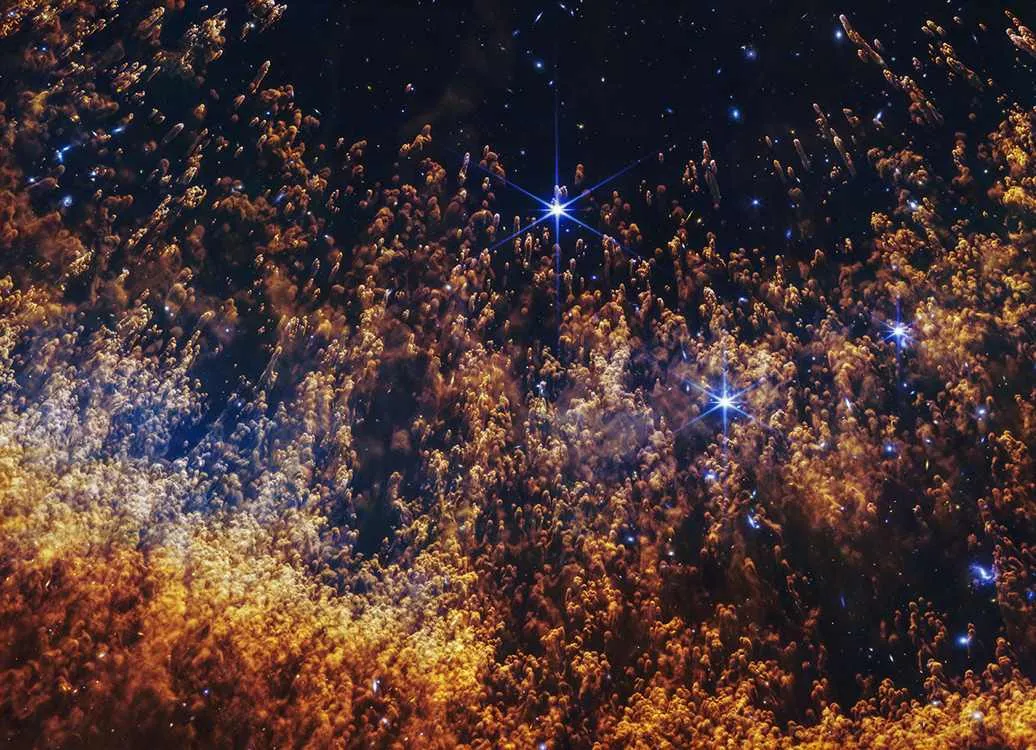
A star 650 light-years away is exhaling its last, and the James Webb Space Telescope just caught it in the act. The image reveals the Helix Nebula in a way no telescope has managed before — layer upon layer of gas and dust, each one telling a different part of the story of stellar death.
For 200 years, ground-based telescopes have watched this nebula. Its circular shape, ringed and intricate, earned it the nickname "the Eye of Sauron" from those who saw the resemblance. But Webb's infrared vision sees something ground-based instruments miss: the mechanics of transformation happening in real time.
The star at the heart of the nebula is a white dwarf — what remains after a star like our Sun exhausts its fuel. As it cools, it sheds layers of material into space. Webb's near-infrared camera reveals streaks of ionized gas colliding with rings of cooler material. The hottest regions glow blue. The coldest fade to red. In between, hydrogen atoms fuse into molecules, painting the nebula in deep orange.
We're a new kind of news feed.
Regular news is designed to drain you. We're a non-profit built to restore you. Every story we publish is scored for impact, progress, and hope.
Start Your News DetoxAt first glance, the gas streaks look like columns of projectiles — fireworks or comets shooting outward. But when combined with ground-based infrared data from the VISTA telescope, the perspective flips. The streaks aren't launching outward; they're flowing toward the cooling gas, dispersing as a red haze into the void.

It's a subtle shift in perception, but it matters. What Webb is showing us isn't just a pretty light show. It's the raw material of future worlds. As this white dwarf's atmosphere disperses, it's seeding space with the building blocks for planets that might form around other stars. NASA described it simply: "the star's final breath transforming into the raw ingredients for new worlds."
This is why Webb matters. For decades, we've understood stellar death in theory. Now we're watching it unfold in detail, seeing how stars recycle themselves back into the cosmos. The Helix Nebula has been visible to telescopes for two centuries, but only now are we beginning to read the full story written in its layers of light.