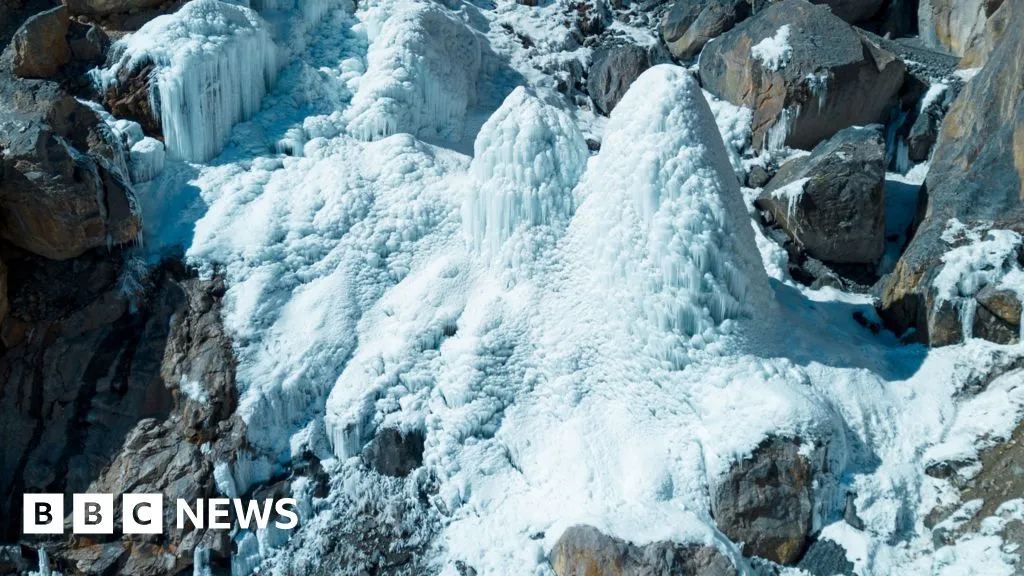
At nearly 4,000 meters (13,000 feet) high, the Himalayan village of Sakti is a tough place for farmers. Gelak Gutme, a 65-year-old farmer, has spent most of his life growing wheat, peas, and potatoes there. He describes Ladakh as a desert with an extreme climate.
Conditions have worsened due to global warming. The small glaciers that once watered their crops have disappeared. Gutme lost his entire field last year because of water scarcity.
The Challenge of Disappearing Glaciers
Lobzang Fardod, from a local water management committee, explains that small glaciers above the valleys used to act like "frozen water towers." They held water all winter and released it for spring farming. Now, these lower glaciers are gone, leaving nothing to melt.
We're a new kind of news feed.
Regular news is designed to drain you. We're a non-profit built to restore you. Every story we publish is scored for impact, progress, and hope.
Start Your News DetoxFarmers need to plant crops by May because the mountain summer is short. Without early spring water, crops won't be ready before winter returns.
In the early 2010s, some villages tried to create their own ice reservoirs. This involved piping water from higher up the mountains in winter and spraying it into the air to freeze. This formed large ice towers called ice stupas. While they provided meltwater in spring, they were difficult to manage.
If temperatures dropped below minus 20C (or even minus 30C), water in the pipes could freeze and crack them. Teams of farmers had to camp high up in the mountains during winter. They would rush to clear blockages with boiling water, often at night.
A New Solution: Automated Ice Reservoirs
Murtaza Ali, an executive engineer in Ladakh, notes that traditional water systems are failing. This has made Leh-Ladakh a hub for new hydraulic engineering.
The old ice stupa system was not very efficient. Water flowed constantly, and warmer days would melt existing ice.
Over the last few years, this method has improved with a tech upgrade. Acres of Ice, a private company, partnered with local communities to develop the Automated Ice Reservoir (AIR) system.
The AIR system also pipes water from higher elevations. The water then shoots out of a vertical nozzle on the valley floor like a "massive fountain," says Dr. Suryanarayanan Balasubramanian, founder of Acres of Ice.
A computer-controlled system manages the water flow. It uses solar panels and a battery. A weather station monitors conditions, including water temperature inside the pipe. If temperatures drop too fast or the pipe water gets too cold, the system acts. It shuts off the top valve and opens a bottom valve to drain the pipe. This prevents pipes from cracking.
The AIR system is also more efficient at making ice. Instead of continuous spraying, it releases bursts of mist. It waits for each layer of water droplets to freeze based on wind and humidity, then sprays again. Balasubramanian says AIR converts almost all diverted water into ice.
The system runs automatically using a local wireless network. Villagers also have a manual override.
This technology is making a difference. Ali says villagers report recharged groundwater and revived spring sources. They are getting water on time. A scientific study is planned to measure the exact impact.
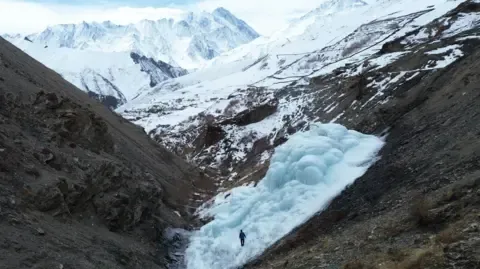
In winter 2025, Acres of Ice and the local government ran ten AIR projects in Ladakh. Balasubramanian's goal is to build many more ice reservoirs with the same technology.
Farmer Gutme in Sakti is more hopeful now. The single AIR system provides reliable water. He hopes the village will build at least two more artificial glaciers. He says, "I am a farmer, land is all that I have to survive on... all that I know today is that I have water to grow my crops." He adds that the lack of water was driving young people to cities, which would have been a disaster for the village.