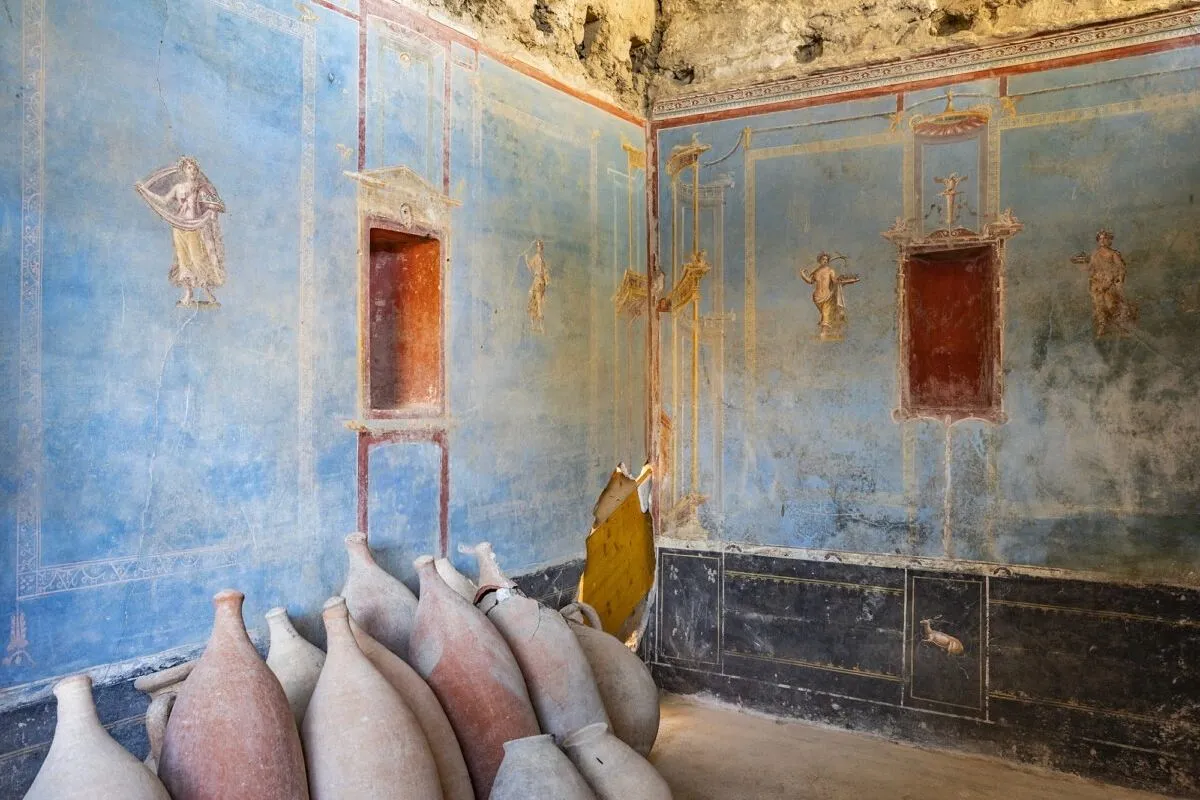
In 2024, archaeologists found a small room inside a grand home in ancient Pompeii. This room was likely a sacrarium, a place for rituals and sacred items. Its walls were painted with a vibrant blue color.
This specific blue pigment, called Egyptian blue, was popular around the first century C.E. This was when Mount Vesuvius erupted, burying Pompeii in ash. Egyptian blue was also very costly. A new study in Heritage Science suggests the paint for this "Blue Room" might have cost more than half a Roman foot soldier's yearly pay.
The High Cost of Blue
Admir Masic, a chemist at MIT and co-author of the study, told the London Times that the decoration quality is "unbelievable." He noted it's rare to find a completely blue sacrarium, showing the owners were extremely wealthy.
We're a new kind of news feed.
Regular news is designed to drain you. We're a non-profit built to restore you. Every story we publish is scored for impact, progress, and hope.
Start Your News DetoxThe Blue Room is part of a large house near the city center. This property also had a thermal bath, a courtyard, and a big dining room. Inside the Blue Room, archaeologists found 15 amphorae (jars), bronze jugs, and bronze lamps.
The bright blue walls were especially striking. Egyptian blue is the oldest known synthetic pigment. It was first made in ancient Egypt about 5,000 years ago as a cheaper option to the precious lapis lazuli.
Moujin Matin, an archaeologist at the University of Western Ontario, explained that making Egyptian blue was a complex process. It required advanced cultural and technological knowledge.
By the first century B.C.E., Egyptian blue was used in the Roman Empire. The Roman architect Vitruvius described this pigment, calling it caeruleum, in his book De Architectura. He mentioned it was produced in Puteoli, a city close to Pompeii.
A Symbol of Status
Marco Nicola, a pigment chemist at Turin University and co-author, said that "Egypt mania was rife." The widespread use of Egyptian blue showed this trend. He added that blue had become a symbol of high status.
For the study, researchers wanted to figure out how much blue pigment was needed. They used X-ray microscopy to measure the paint on the walls. They found that painters used between six and eleven pounds of pigment.
The researchers then estimated the cost using prices recorded by the Roman author Pliny the Elder. At eleven denarii (Roman coins) per libra (about 0.72 pounds), the pigment would have cost between 93 and 168 denarii.
The Blue Room's walls feature ancient paintings of women, possibly representing the four seasons. There are also images related to sheep farming and agriculture, all set against the blue background.
The study noted that the cost of Egyptian blue for the Blue Room was like buying 744 to 1,344 loaves of bread. To put it in perspective, a Roman foot soldier earned about 187 denarii per year. This means the pigment alone cost 50% to 90% of a soldier's annual income.
Painting the room also involved labor costs. Historian Francesca Bologna's research showed that Romans took almost five minutes to grind about 0.25 ounces of pigment. Grinding the pigment for the Blue Room would have taken 31 to 56 hours.
Egyptian blue has been found elsewhere in Pompeii. However, using so much of it in a private shrine within a grand house suggests the owners were among Pompeii's elite. The researchers concluded that this artistic choice fit with Roman economic trends, where luxury pigments showed off status and cultural sophistication.
Deep Dive & References
- The high cost of blue: an estimate of the pigment and labor costs of the Blue Room in Pompeii - Heritage Science, 2026