Imagine printing a tiny, intricate structure that acts like living tissue, but then, when you're done with it, you just add a little sugar water and poof — it vanishes. Scientists at National Taiwan University (NTU) have officially stepped into that future, creating a new hydrogel that's both incredibly strong for 3D printing and delightfully temporary.
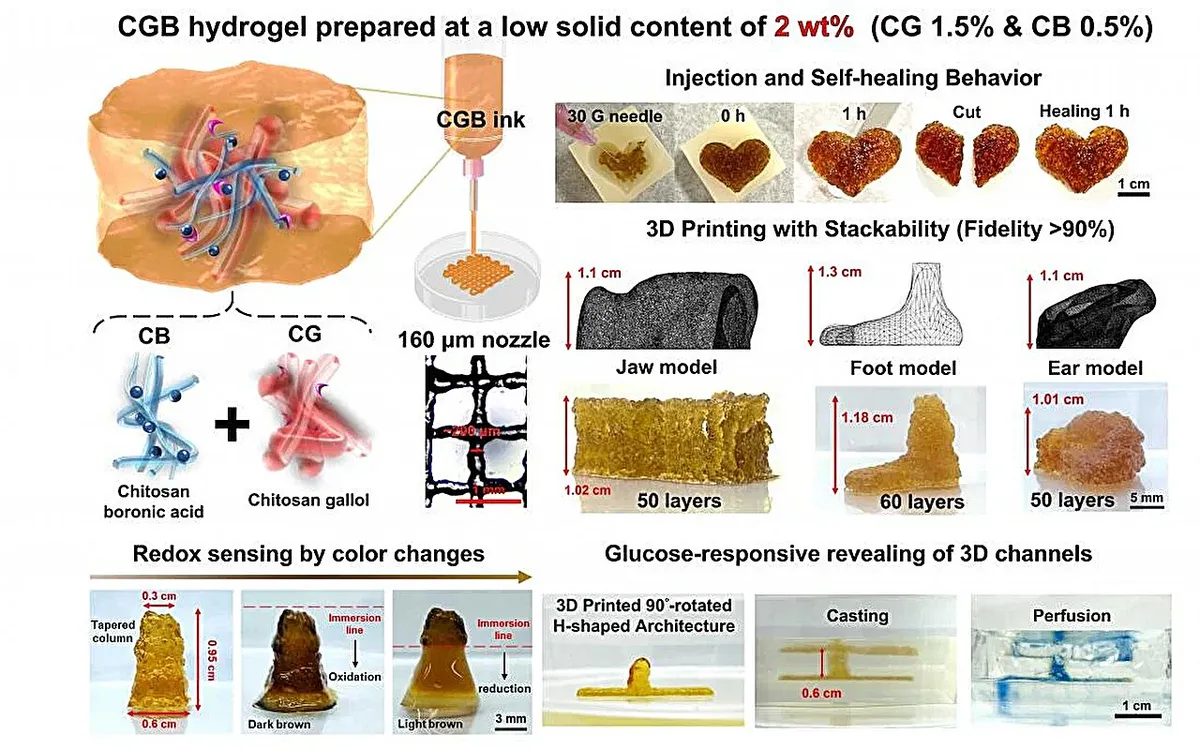
Led by Professor Shan-hui Hsu, the team engineered a material that’s like a molecular LEGO set. It uses two bio-based polymers, gallol-functionalized chitosan (CG) and boronic acid-functionalized chitosan (CB), which basically hold hands with 'dynamic covalent bonds.' Think of them as molecular high-fives that can break apart and reform on cue.
Printing with Precision (and a Plan B)
This isn't your average printer ink. This hydrogel can be squeezed through a nozzle tinier than a human hair (we're talking 160 μm) and stacked up to 60 layers high without collapsing. And it does all this while being 98% water. That kind of stability, with so little solid material, is a huge deal for biofabrication, creating a much happier neighborhood for cells to grow in.
We're a new kind of news feed.
Regular news is designed to drain you. We're a non-profit built to restore you. Every story we publish is scored for impact, progress, and hope.
Start Your News DetoxBut here’s where it gets truly clever: the CGB hydrogel is also a 'smart' material. It reacts to chemical signals like glucose. The researchers used it as a temporary mold, printing complex microfluidic channels — think tiny, intricate plumbing for biological systems. Once the channels were formed, they simply added a glucose solution, and the hydrogel dissolved away, leaving behind delicate, hollow structures that mimic natural biological tubes.
“The CGB hydrogel is more than just an ink,” said Professor Hsu. It’s got antimicrobial powers and keeps over 90% of cells alive, which, if you’re trying to build new body parts, is a pretty crucial feature. This isn't just a lab curiosity; it's a powerful new tool in the quest to make regenerative medicine a tangible reality, one dissolvable, 3D-printed layer at a time.