Imagine a world where materials literally build and repair themselves, just like living tissue. That's the sci-fi dream quietly humming in labs, and now, a team of researchers has taken a rather ingenious step closer.
They've figured out how to get two different kinds of biomolecular nanomachines — the microscopic builders of life — to team up and 'weave' DNA into complex networks. Because apparently, that's where we are now: tiny robots making tiny fabrics.
Living things are masters of self-assembly. Our bodies are packed with enzymes and molecular motors that work in concert, using chemical energy to construct intricate biological structures. Think of it as a microscopic, perfectly choreographed ballet of construction workers.
We're a new kind of news feed.
Regular news is designed to drain you. We're a non-profit built to restore you. Every story we publish is scored for impact, progress, and hope.
Start Your News DetoxScientists have long tried to mimic this, but getting multiple molecular robots to coordinate their efforts, step-by-step, has been a bit like herding microscopic cats. The main challenges? Making self-assembly dynamic and energy-driven, and getting different 'machines' to play nicely together.
The Dynamic Duo: DNA and Kinesin
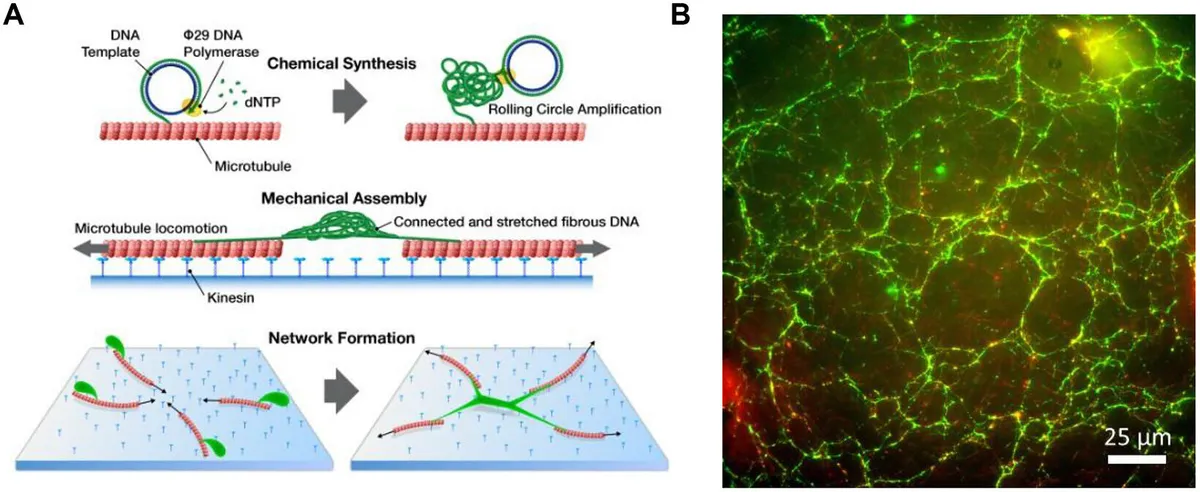
Enter the team led by Assistant Professor Shogo Hamada from the Institute of Science Tokyo and Professor Akira Kakugo from Kyoto University. Their solution, published in the journal Small, involves a two-stage process using two specific types of nanomachines: DNA polymerase and kinesin motor proteins.
First up, DNA polymerase. This little workhorse's job was to grow long, long strands of DNA. It did this by essentially unspooling a genetic blueprint and copying it over and over, creating extended DNA fibers on tiny structures called microtubules. Think of it as a super-fast molecular knitting machine.
Next, the kinesin motor proteins took over. These aren't just any proteins; they're the tiny, ATP-powered movers and shakers of the cellular world. Attached to a surface, these kinesins grabbed the DNA-laden microtubules and started walking them around. Yes, walking. When these moving microtubules inevitably bumped into each other, the DNA strands on them connected.
As the kinesin motors kept hauling their microtubule cargo, they stretched and pulled the joined DNA strands, gradually creating an ever-expanding, organized network of fiber-like structures. In essence, the DNA polymerase made the thread, and the kinesin motors actively wove the fabric.
The Power of Movement
The crucial insight? This whole operation hinged on the motor activity. Without the kinesin motors or their fuel, ATP, the DNA just sat there. No weaving, no networks. The team could even control the complexity of the networks by adjusting how many microtubules they used or how long the DNA synthesis ran.
Simulations backed this up: inactive DNA strands just folded up like a forgotten laundry pile. But with active, motor-like movement, multiple strands dramatically unfolded and connected, forming the very networks seen in the experiments.
This isn't just a clever parlor trick. It's a significant step toward creating materials that aren't just static objects, but dynamic entities that can assemble, organize, and perhaps even repair themselves, much like living systems. Imagine materials for molecular computing or robotics that can literally evolve.
As Hamada noted, coupling molecular synthesis with mechanical force is a crucial step toward synthetic materials that mimic nature's incredible building capabilities. Materials that can sustain, repair, and evolve? Your smartphone might just start growing legs and fixing its own cracked screen. Which, if you think about it, is both impressive and slightly terrifying.