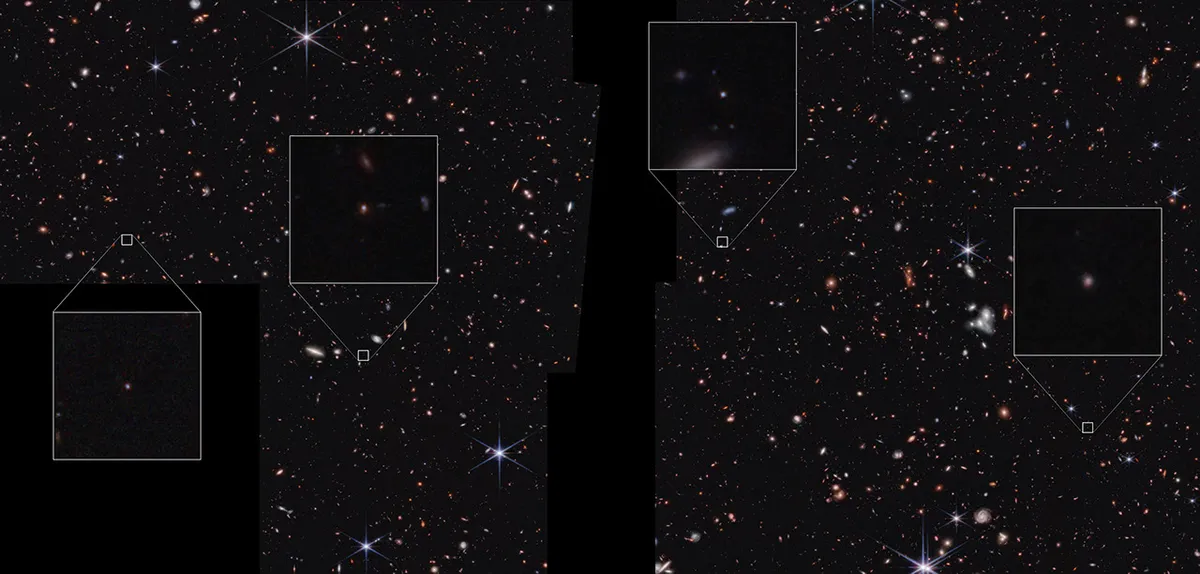
The James Webb Space Telescope has spotted something astronomers didn't expect to find: nine galaxies so odd they defy classification.
They look like points of light—tiny and impossibly compact—yet they lack the telltale signature of quasars, the brilliant objects powered by supermassive black holes that normally appear as point sources in the distant universe. It's a contradiction that shouldn't work. And yet there they are, existing 12 to 12.6 billion years ago, when the universe was barely a billion years old.
"It seems that we've identified a population of galaxies that we can't categorize, they are so odd," says Haojing Yan, the principal investigator at the University of Missouri who led the discovery. He compares them to a platypus—an animal that seems assembled from spare parts, sharing features with birds, reptiles, and mammals all at once.
We're a new kind of news feed.
Regular news is designed to drain you. We're a non-profit built to restore you. Every story we publish is scored for impact, progress, and hope.
Start Your News DetoxThe Signature That Doesn't Fit
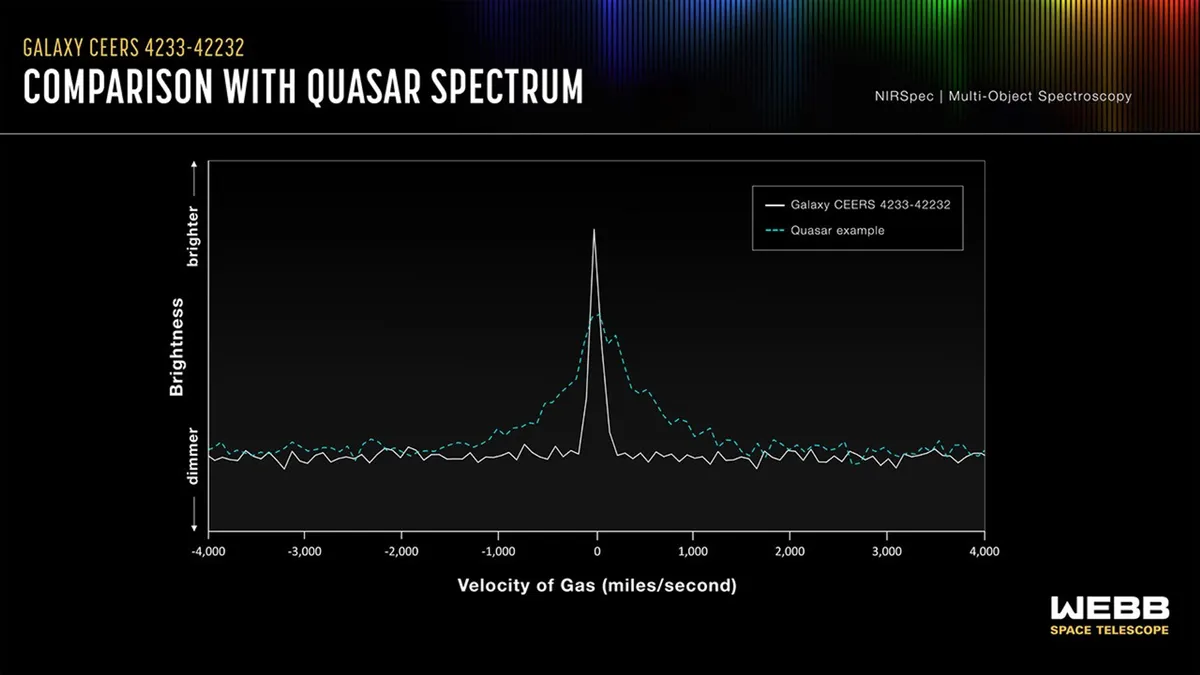
When Yan's team examined the spectral data—essentially the fingerprint of light from these objects—they found something unexpected. Normal quasars produce broad peaks in their spectral lines, the signature of gas moving at extreme velocities around a black hole. These nine objects showed narrow, sharp peaks instead, indicating much slower gas movement.
The team had narrowed down 2,000 sources across multiple Webb surveys to find these nine anomalies. Four came from the Cosmic Evolution Early Release Science Survey alone. They're too faint to be quasars, too distant to be stars in our galaxy, and yet they're compact enough that Webb—an instrument designed to see unprecedented detail in the early universe—can barely resolve them as anything other than points.
Graduate researcher Bangzheng Sun explored whether they might be star-forming galaxies, and the data doesn't rule it out. But that raises its own mystery: how can galaxies be this small and this compact while still forming stars?
Yan's team proposes a possibility that Webb was always meant to test: we're witnessing the earliest stages of galaxy formation itself. Astronomers have long understood that massive galaxies like the Milky Way grow by merging with smaller ones. But what comes before the small galaxies? How do the first building blocks form?
"These nine objects weren't the focus—they were just in the background of broad Webb surveys," Yan explains. "Now it's time to think about the implications of that."
The team will need a much larger sample and higher-resolution spectral data to answer these questions. But for now, they've uncovered something the universe kept hidden until Webb arrived: a population of galaxies that shouldn't exist, asking us to rethink how galaxies begin.