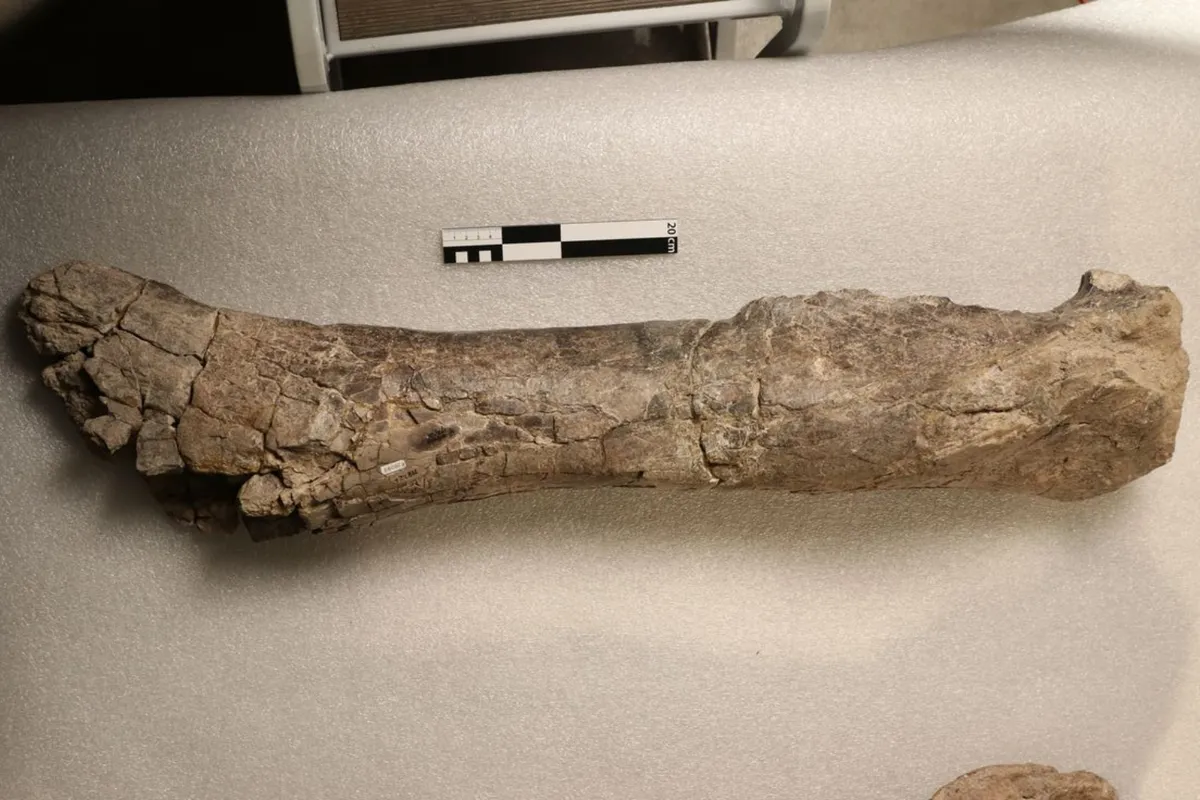
A 74-million-year-old shin bone found in New Mexico might belong to a large ancestor of Tyrannosaurus rex. This discovery could shed light on where the Tyrannosaurus genus came from. Members of this group became the biggest land predators known.
The bone was found in the Kirtland Formation, a fossil site in the San Juan Basin. Researchers believe it belonged to a tyrannosaur. Tyrannosaurs were a wide group of meat-eating dinosaurs that appeared about 170 million years ago. However, they didn't grow into massive animals like Tyrannosaurus until much later.
A Surprisingly Large Ancestor
The newly found shin bone, or tibia, is nearly 38 inches long and about five inches in diameter. This makes it more than three-quarters the size of similar bones from Sue, one of the largest known T. rexes. Sue is housed at the Field Museum in Chicago.
We're a new kind of news feed.
Regular news is designed to drain you. We're a non-profit built to restore you. Every story we publish is scored for impact, progress, and hope.
Start Your News DetoxThe fossil's age, 74 million years old, places it in the Late Campanian age. This is much older than when other massive tyrannosaurs lived. T. rex, for example, appeared about 68 million years ago. Many tyrannosaurs before then were roughly human-sized.
Spencer Lucas, a paleontologist at the New Mexico Museum of Natural History and Science, noted that this tyrannosaur was "very large for its time." He also said it was "much older geologically than anybody would have predicted."
Based on the bone's size and shape, researchers think it belonged to an animal closely related to Tyrannosaurus. They estimate this ancient relative may have weighed over 4.5 tons and been about 35 feet long. This would make it the largest tyrannosaur of its time.
Nick Longrich, a paleontologist at the University of Bath, described it as "small by Tyrannosaurus standards, but maybe 50 percent more than anything we know of from that time period." He added, "Just really chunky."
Debating the Origins
While the findings suggest this dinosaur was a direct ancestor of T. rex, a skull would help confirm this. It could also show if it was a close cousin instead. This discovery could support the idea that the Tyrannosaurus genus first appeared in North America, not Asia.
However, not everyone agrees. Thomas Carr, a paleontologist at Carthage College, suggests the bone might belong to Bistahieversor. This is another tyrannosaur genus known from the same area. He notes that tyrannosaur leg bones can be hard to identify.
The study authors believe the tibia is too big for Bistahieversor. Still, the research team agrees that more fossils of this dinosaur are needed. Anthony Fiorillo, a paleontologist at the New Mexico Museum of Natural History and Science, said they are planning to search for more material.
Deep Dive & References
A new tyrannosaurid tibia from the Upper Cretaceous Kirtland Formation of New Mexico and the evolution of North American Tyrannosaurus - Scientific Reports, 2026