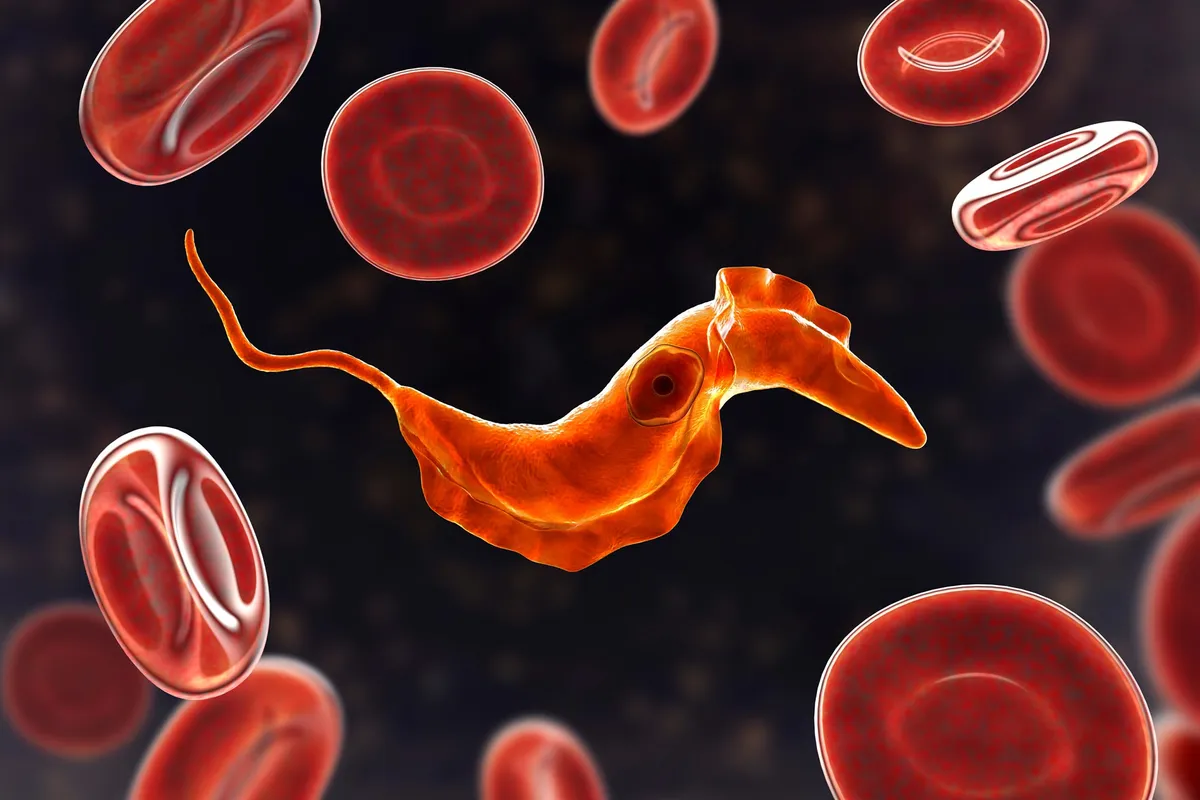
Imagine a master of disguise, so good it doesn't just put on a costume, it actively destroys any evidence it ever had another identity. That's essentially what the African trypanosome parasite does to evade your immune system.
For decades, scientists have known this microscopic villain wears a "cloak" of proteins, constantly changing its look to stay invisible. But the how of its genetic sleight of hand remained a mystery. Now, researchers have finally pulled back the curtain, and the answer is wonderfully, terrifyingly precise: it shreds its own instruction manual in real-time. ## The Ultimate Genetic Editor
Meet ESB2, the newly discovered protein that acts like a "molecular shredder." As the parasite's genetic instructions are being read to build its protective cloak, ESB2 swoops in and snips out specific "helper gene" messages. It leaves the cloak instructions completely untouched, ensuring the parasite makes exactly what it needs to stay hidden, and nothing else.
We're a new kind of news feed.
Regular news is designed to drain you. We're a non-profit built to restore you. Every story we publish is scored for impact, progress, and hope.
Start Your News DetoxThis isn't just about what the parasite makes; it's about what it destroys. Dr. Joana Faria, a lead author from the University of York, puts it perfectly: survival might depend more on how an organism obliterates genetic instructions at the source than how it issues them. Which, if you think about it, is both impressive and slightly terrifying.
This precise editing solves a 40-year puzzle. Scientists always wondered why the parasite made so many cloak proteins but so few helper proteins, even though their genetic instructions were intertwined. Turns out, it's not a production issue; it's a destruction issue. The parasite is simply too good at deleting the evidence.
A Weak Spot for Sleeping Sickness
This isn't just a fascinating peek into the microscopic world; it's a potential breakthrough for millions. The African trypanosome is responsible for Sleeping Sickness, a devastating disease spread by the tsetse fly in sub-Saharan Africa. Untreated, it invades the central nervous system, leading to confusion, disrupted sleep, coma, and eventually, death.
Understanding how this molecular shredder works gives scientists a potential weak spot. If they can gum up ESB2's shredding mechanism, they might be able to expose the parasite to the immune system, paving the way for new treatments. It's a testament to what happens when curious minds look at old problems in new ways, and find a tiny shredder at the heart of a deadly disguise.