In 1843, a Canadian geologist named William Edmond Logan found something strange on the shores of Gaspé Bay in Quebec. It looked like a rotting tree trunk, but also like it could be fungus or algae. For 180 years, scientists have been puzzling over what Prototaxites actually was.
Now, researchers studying a 407-million-year-old specimen from Scotland say they might have an answer: it's none of those things. It's something else entirely — a life form that branched off from everything we know, an evolutionary experiment that failed before we ever got to meet it.
What made it different
A local landowner found the fossil in the Rhynie chert rock formation of northeast Scotland. It's now part of the collections of National Museums Scotland. Neil Hanna
We're a new kind of news feed.
Regular news is designed to drain you. We're a non-profit built to restore you. Every story we publish is scored for impact, progress, and hope.
Start Your News DetoxThe specimen came from the Rhynie chert, a rock formation in northeast Scotland that's essentially a time capsule from the Early Devonian period. When researchers at the University of Edinburgh examined Prototaxites taiti under a microscope, they saw tubes woven together — the kind of structure you'd expect in fungi. But something was off. The tubes were arranged chaotically, tangled in ways that didn't match any fungus they knew. Some even resembled plant structures.
The chemical analysis clinched it. P. taiti had a distinct chemical fingerprint that separated it from fungi found in the same rock formation, from plants, and from every other organism scientists have classified. It was its own thing.
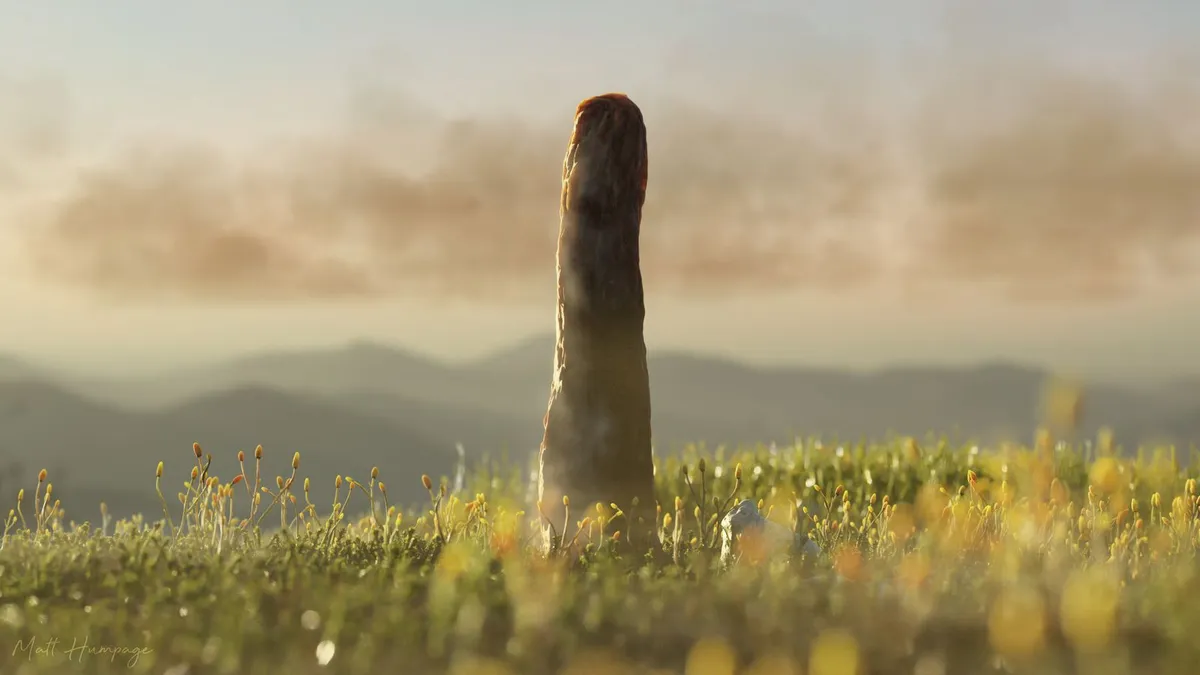
The fossil was unearthed from the Rhynie chert, a 407-million-year-old rock formation in northeast Scotland. Matt Humpage, Northern Rogue Studios
"If that conclusion proves true, Prototaxites may have been an 'independent experiment that life made in building large, complex organisms,'" says Laura Cooper, a plant scientist involved in the research. Life on Earth tried multiple ways to build something big and complex. Most of those experiments didn't make it. We know about plants and fungi because they survived. Prototaxites didn't.
The mystery deepens
What we don't know is why. Prototaxites appears to have been one of the first giant organisms to colonize land, which is remarkable on its own. Evidence suggests it ate decaying matter like fungi do, but the Early Devonian landscape wasn't flush with organic material. How it survived at all remains unclear. And what caused it to vanish — whether competition, climate change, or something else — is still a complete mystery.
Kevin Boyce, a paleobotanist at Stanford, puts it simply: "No matter what, it's something weird doing its own thing." That's the real story here. Not just that we found a fossil, but that life experimented with forms so fundamentally different from what survived that we're still struggling to categorize them 407 million years later. The more we learn about Earth's deep past, the stranger it gets.