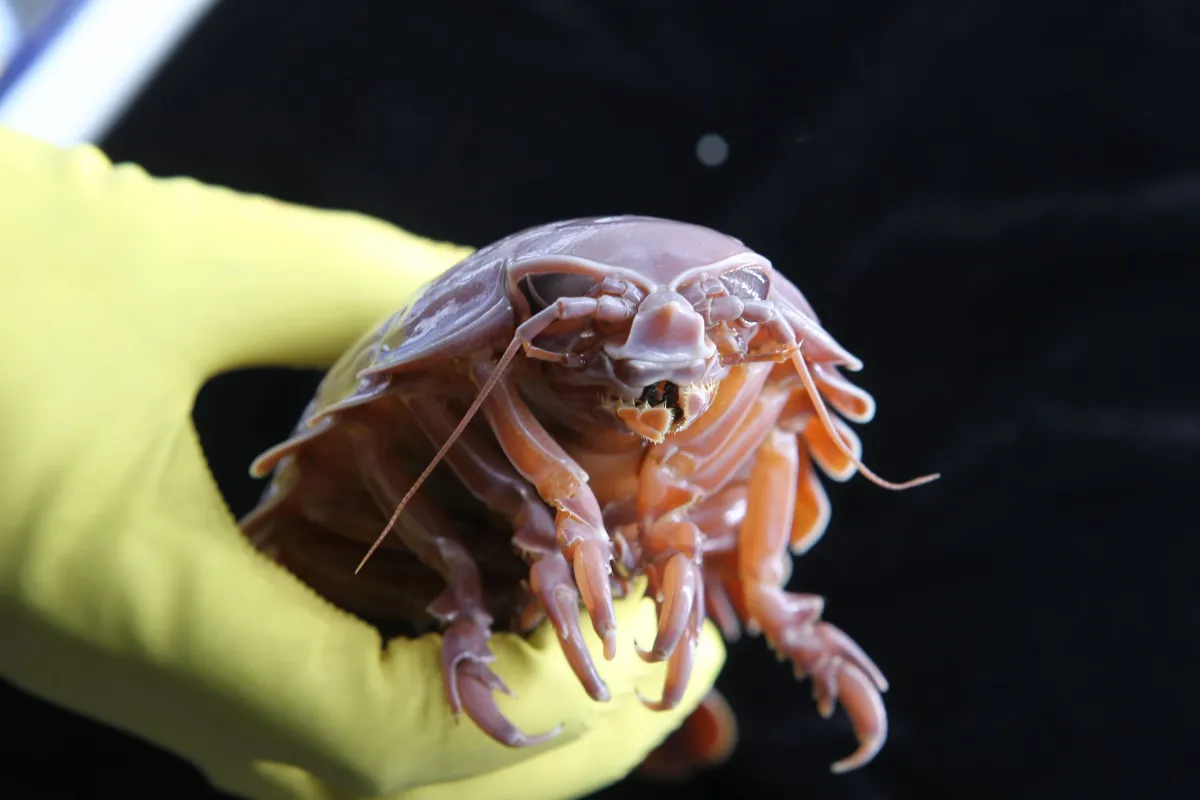
Supergiant deep-sea isopods can go without food for years. These creatures, larger than a football, live in the deep ocean where food is very scarce. Scientists have long wondered how they manage to survive.
A team from the Institute of Oceanology of the Chinese Academy of Sciences (IOCAS) studied this mystery. They found that these isopods have a huge stomach for storing food and a very low metabolism. This combination helps them survive long periods without eating.
Their findings were published in the journal Cell.
How Deep-Sea Isopods Survive
The researchers looked at two types of isopods: Bathynomus jamesi from about 898 meters deep and Bathynomus doederleini from about 300 meters deep. They compared their genes, bodies, how they function, and the microbes living with them. They found a survival method that involves "increasing revenue and reducing expenditure" when food is limited.
We're a new kind of news feed.
Regular news is designed to drain you. We're a non-profit built to restore you. Every story we publish is scored for impact, progress, and hope.
Start Your News DetoxThe stomach of a deep-sea isopod takes up about two-thirds of its body. This is much larger than the stomachs of similar creatures living in shallower waters. When full, the stomach holds a finely ground, well-digested, mud-like mix. It has few digestive bacteria but many Chlamydiae, which are linked to storing fats.
This suggests that deep-sea isopods eat huge meals when they can. Then, they drastically slow down their metabolism, allowing their stored food to be digested and used slowly over a long time.
A Gene for Energy Control
The scientists also found a gene called ND1. This gene came from a symbiotic bacterium and became part of the isopod's own genes. ND1 is similar to a part of Complex I in the electron transport chain, which is important for how the body uses energy.
Even though genes from other organisms can face challenges when entering a new genome, ND1 copied itself many times and became very active. The researchers also found that the expression of ND1 is controlled by changes to histones, which helps the isopods be very efficient with energy.
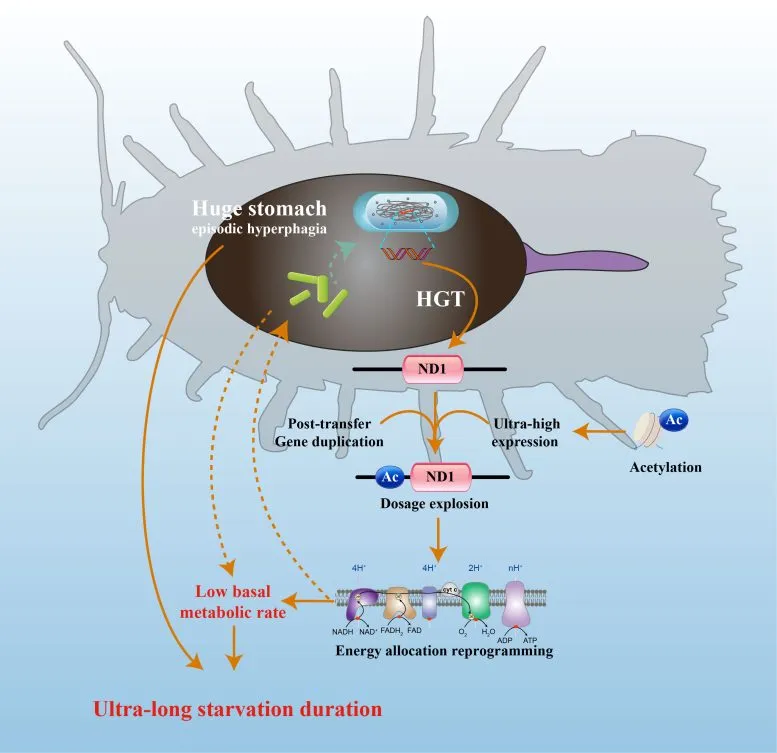
To see what ND1 does, the team put it into zebrafish, nematodes, and human cells. At normal temperatures, ND1 made organisms use more energy and less able to handle starvation. But in cold conditions, like the deep sea, ND1 slowed down energy use and mitochondrial activity. In zebrafish, this increased their ability to survive starvation by 37%.
Balancing Growth and Survival
These findings suggest that ND1 helps adjust the body's energy network by fine-tuning how metabolism slows down. This helps the isopods balance the high energy needs of growing very large with the need to save energy in harsh environments.
This study is the first to show how deep-sea megafauna use genes from other organisms and genetic changes to manage their energy.
Jianbo Yuan, the study's first author, noted that their work explains how deep-sea isopods can survive without food for so long. It also shows how life balances growth and survival in extreme places.
Deep Dive & References
Deep-sea megafauna co-opts microbial energy metabolism genes to withstand ultra-long starvation - Cell, 2026