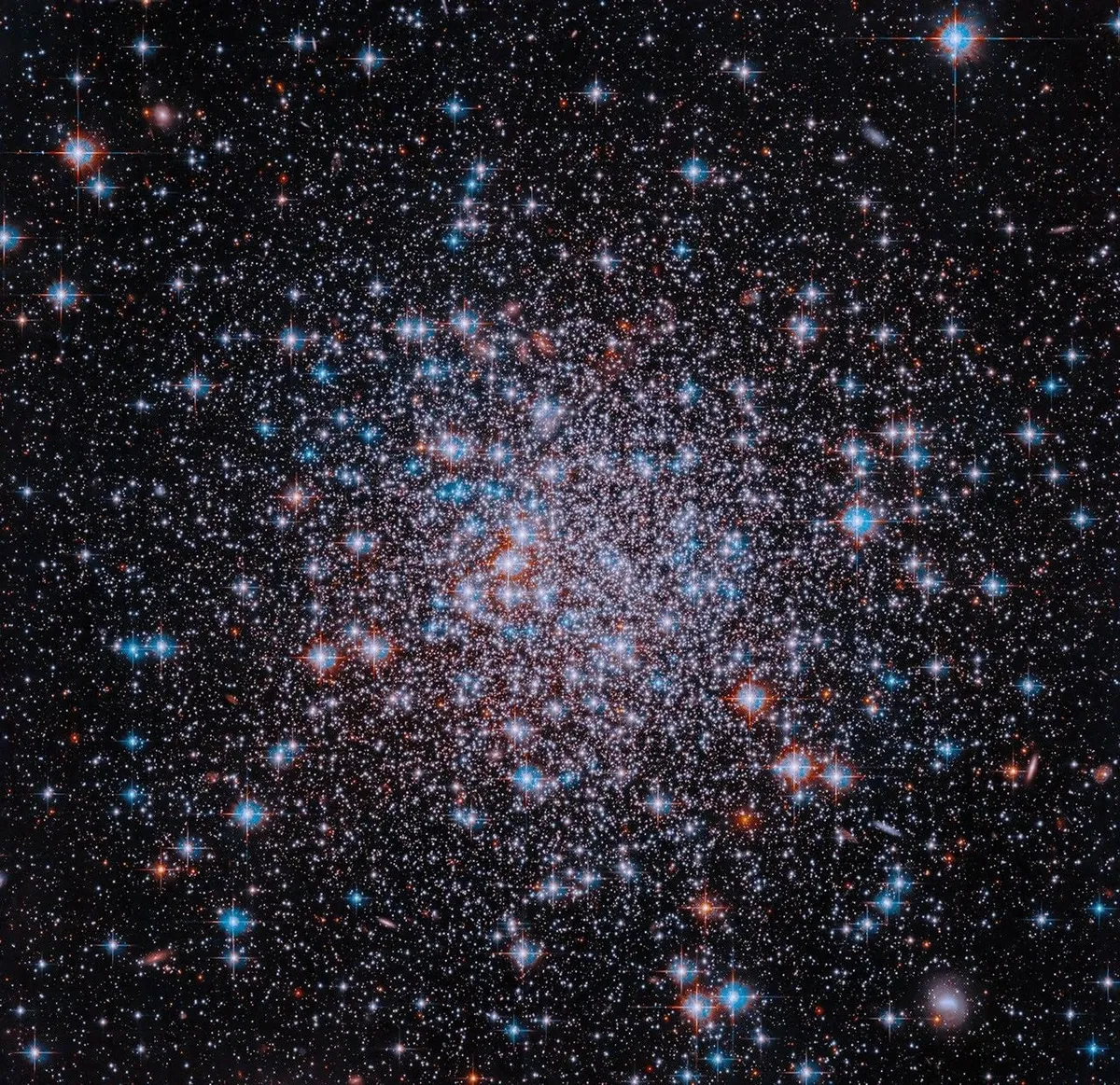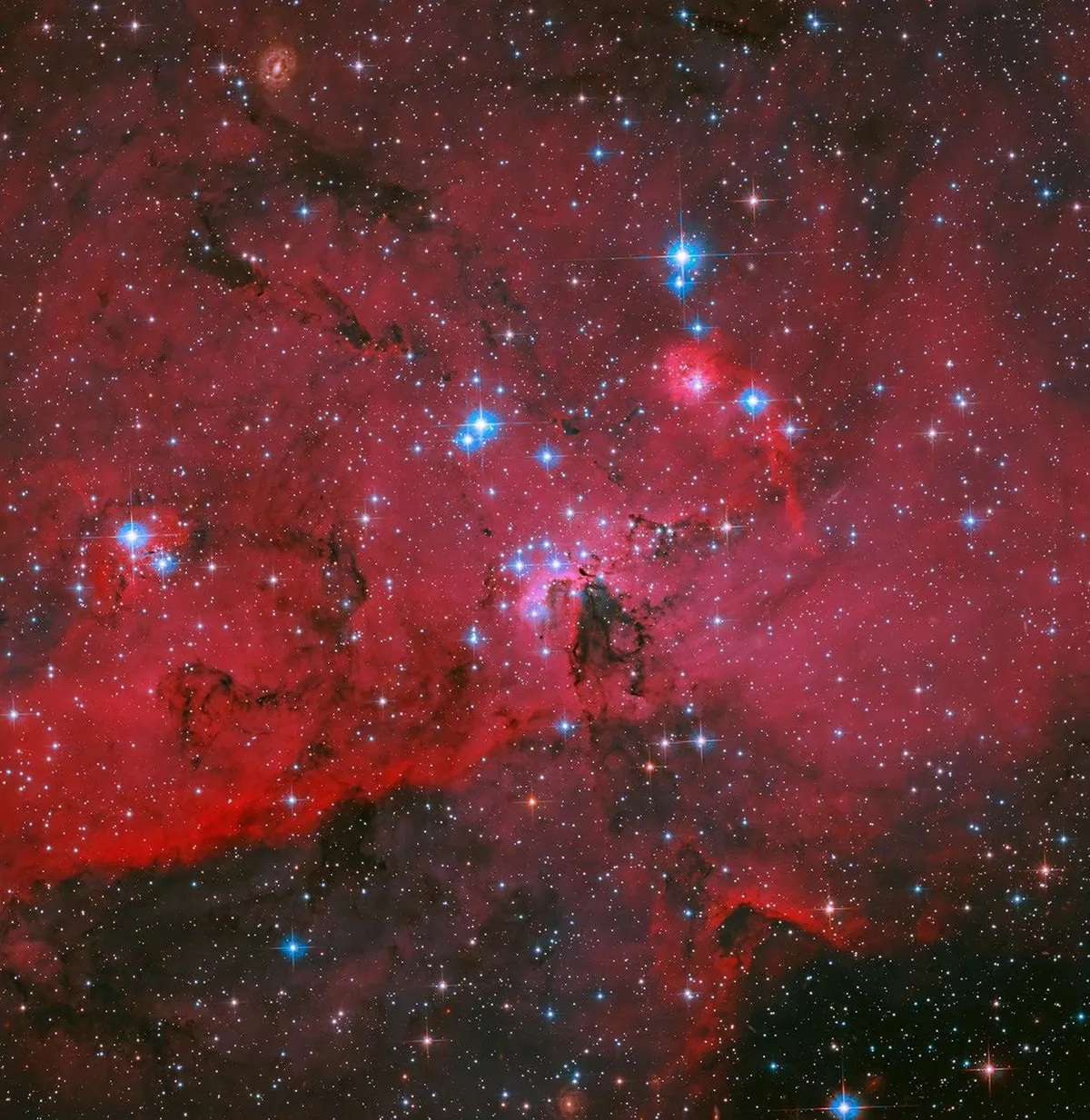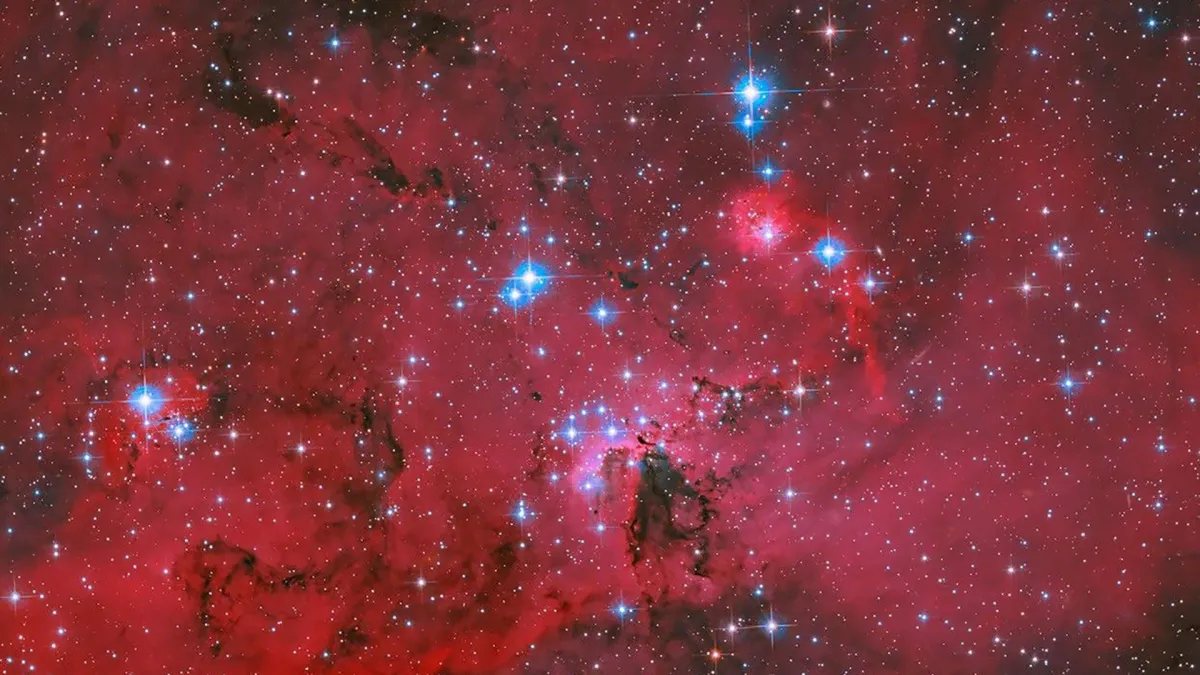
Imagine a scene straight out of a sci-fi movie, but it’s real, and it’s happening light-years away. NASA's Hubble Space Telescope just delivered a stunning visual: a bustling stellar nursery, all bright blue and white stars set against a dramatic backdrop of glowing red hydrogen gas. It's less a nebula, more a celestial rave, complete with its own smoke machine.
This vibrant cosmic canvas is officially known as LH 95, a massive star-forming region hanging out in the Large Magellanic Cloud. For those keeping score at home, that's a dwarf galaxy currently orbiting our very own Milky Way. LH 95 is a true melting pot, hosting both brand-new, low-mass stars and some truly gargantuan blue giants. It's basically a cosmic factory floor, churning out stars by the thousands.
The Drama of Stellar Birth, Up Close
Those brilliant blue stars aren't just pretty faces; they're the heavyweights of LH 95, each weighing at least three times more than our Sun. They're also responsible for the fireworks, blasting out powerful ultraviolet light and stellar winds that heat the surrounding hydrogen gas, sculpting the nebula into its breathtaking forms. Dark, thick dust lanes cut through the glow, resilient against the stellar assault, creating a stark contrast that makes the whole scene pop.
We're a new kind of news feed.
Regular news is designed to drain you. We're a non-profit built to restore you. Every story we publish is scored for impact, progress, and hope.
Start Your News DetoxNow, about those colors: what you're seeing isn't quite what your naked eye would perceive (if you could, you know, just look at a stellar nursery). The blues represent shorter visible light, while the reds are a clever combination of longer visible light and a touch of near-infrared. That bright red glow, specifically, is hydrogen alpha emissions – the cosmic equivalent of a 'New Stars Forming Here!' sign.
And form they do. Hubble's observations have revealed thousands of stars still in their awkward teenage phase, pulling in material from the gas and dust disks that birthed them. Researchers pinpointed roughly 2,500 'pre-main-sequence' stars — basically, they've got most of their mass but haven't quite flipped the switch on nuclear fusion. They're still shrinking under their own gravity, waiting for their cores to get hot and dense enough to ignite hydrogen fusion and officially become a star. It's a bit like a cosmic oven preheating.
A Longer Childhood for Stars
This deep dive into LH 95 has given astronomers a new perspective on stellar growth. Turns out, a young star's 'accretion rate' — how fast it slurps up material — slows down as it ages. And here's the kicker: this process can drag on for several million years, significantly longer than some previous theories suggested. So much for a quick growth spurt.
This discovery helps scientists understand the intricate ballet of how stars accumulate their final mass and how the dusty disks around them evolve before winking out of existence. It's a nuanced process, far from the instant gratification we often imagine for cosmic events.
LH 95 isn't just a one-off star-making machine; it's been at it for ages, meaning multiple generations of stars are living side-by-side. Case in point: the most massive star in the region, clocking in at 60 to 70 times the Sun's mass, appears to be a million years younger than its four-million-year-old neighbors. Talk about being the new kid on the block.
Stars this massive live fast and die young, ending their lives in spectacular supernova explosions that then seed the universe with the heavy elements needed for future generations of stars. It's the ultimate cosmic recycling program.
LH 95 is particularly valuable to astronomers because it's relatively close and offers a clearer view than our own galaxy's dust-obscured stellar nurseries. It's like having a front-row seat to the universe's most dramatic construction project. And with Hubble, plus the James Webb and upcoming Nancy Grace Roman Space Telescope, we're getting an ever-sharper picture of how it all comes to be. Which, if you think about it, is both impressive and slightly terrifying. In a good way.