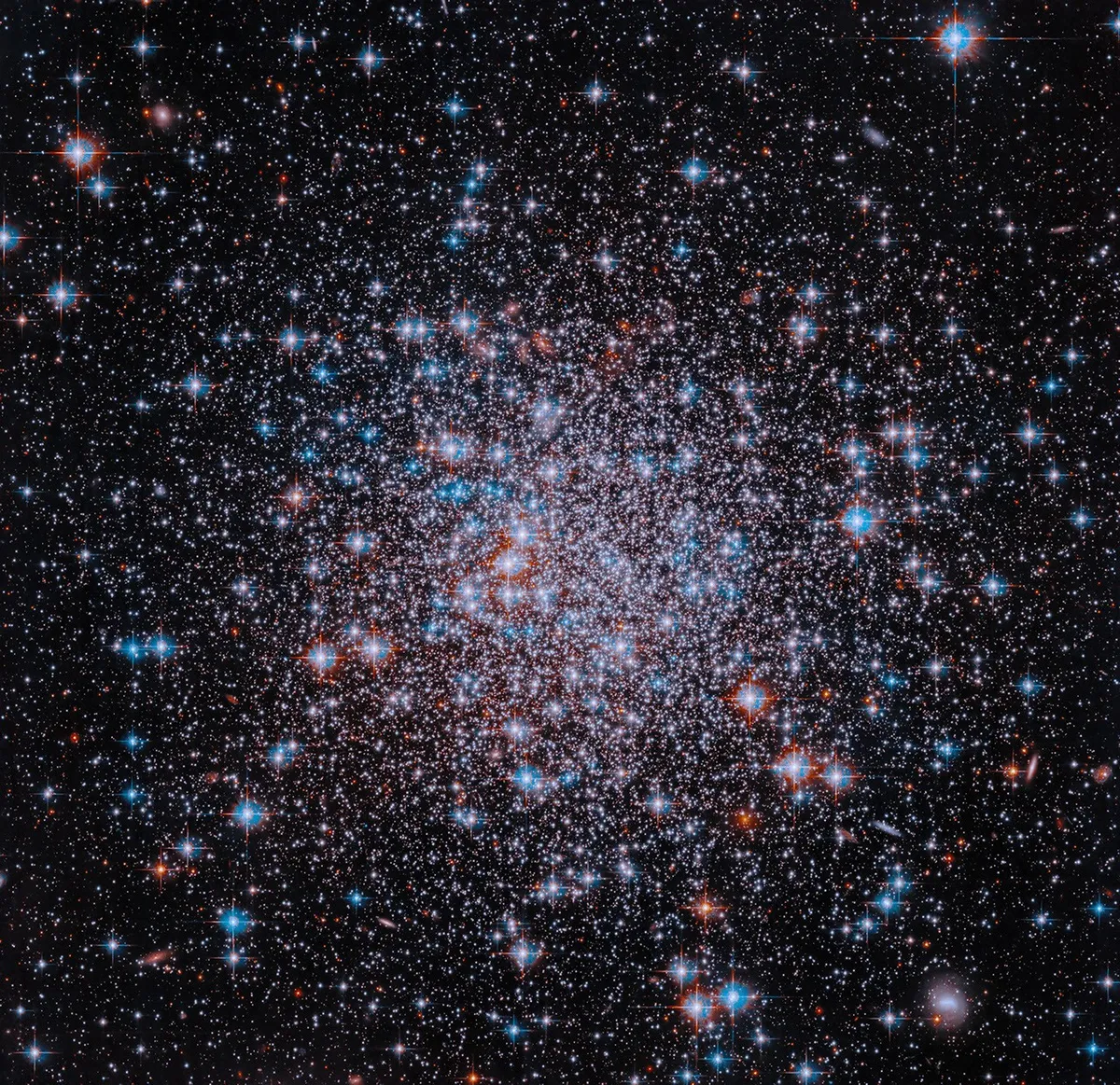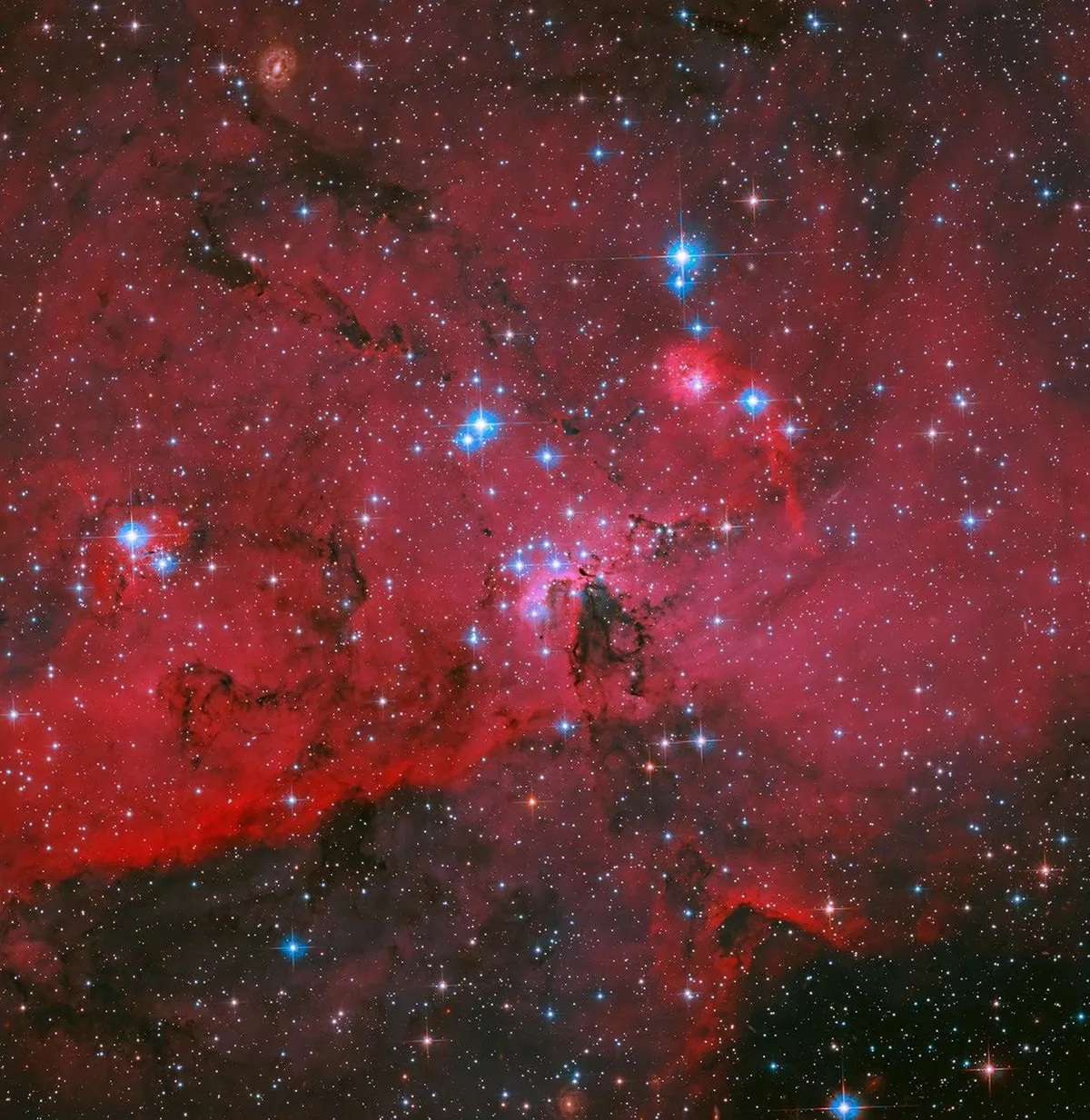
Imagine a cosmic fireworks display, but instead of fading, it's just getting started. That's essentially what NASA's Hubble Space Telescope just captured: a dazzling region called LH 95, a stellar nursery where stars are being born amidst glowing gas clouds.
It’s a vibrant tableau of bright blue and white stars, all set against a backdrop of swirling red gas. Think of it as the universe's most patriotic (and fiery) art installation.
LH 95 isn't just a pretty face; it's a bustling hub in the Large Magellanic Cloud, a smaller galaxy that's currently orbiting our very own Milky Way. Here, you'll find everything from tiny, newly forming stars to colossal blue giants, all hanging out together in what astronomers charmingly call a “stellar association.” Because apparently that's where all the cool kids are.
We're a new kind of news feed.
Regular news is designed to drain you. We're a non-profit built to restore you. Every story we publish is scored for impact, progress, and hope.
Start Your News DetoxThe Celestial Architects
The real heavyweights in LH 95 are those massive blue stars, each one at least three times the size of our Sun. These cosmic titans aren't just sitting there looking pretty; they're actively sculpting their surroundings. Their intense ultraviolet light and powerful stellar winds are essentially blowing around the hydrogen gas, heating it up and carving out the nebula over eons. It’s like a celestial sandblaster, but with far more dramatic results.
Adding to the visual drama are dense ribbons of dust, appearing as dark slashes through the luminous gas. These are the stubborn bits, more resistant to the stellar erosion, creating a striking contrast that makes the whole scene pop.
Now, about those colors: what Hubble sees isn't exactly what your eyes would. Blue represents shorter visible light, while red encompasses longer visible and near-infrared light. That brilliant red glow? That's the tell-tale sign of hydrogen alpha emissions, a cosmic neon sign screaming, "Star formation in progress!"
A Protostar Party That Lasts for Millions of Years
Astronomers use that hydrogen alpha light to find the real babies of the cosmos, the very young stars still tucked away in the glowing gas. Observations of LH 95 revealed thousands of stars still in the process of gathering material from surrounding disks of gas and dust. We're talking about 2,500 "pre-main-sequence stars" – essentially, stars that have almost reached their full mass but haven't quite flipped the switch on nuclear fusion. They're still shrinking, getting hotter and denser, waiting for their moment in the cosmic spotlight.
And here's a kicker: this growth process, where young stars bulk up, can last for several million years. That's significantly longer than some earlier theories suggested, proving that even in space, some things just take their sweet time.
What’s more, LH 95 isn't a one-and-done star factory. Hubble's observations show that star formation has been ongoing for millions of years, with different generations of stars coexisting. It’s a long-running family business, apparently.
There's even one massive star, about 60 to 70 times the Sun's mass, that appears to be a million years younger than its neighbors. It’s the new kid on the block, destined to burn bright and fast, eventually ending its life in a spectacular supernova. Because, of course, the universe loves a dramatic exit.
With so many developing stars and less dust blocking the view than in similar areas of our own galaxy, LH 95 is a dream come true for astronomers. It’s a nearby, relatively clear laboratory for studying how stars are born, grow, and eventually, well, explode. And if that's not a reason to look up, what is?