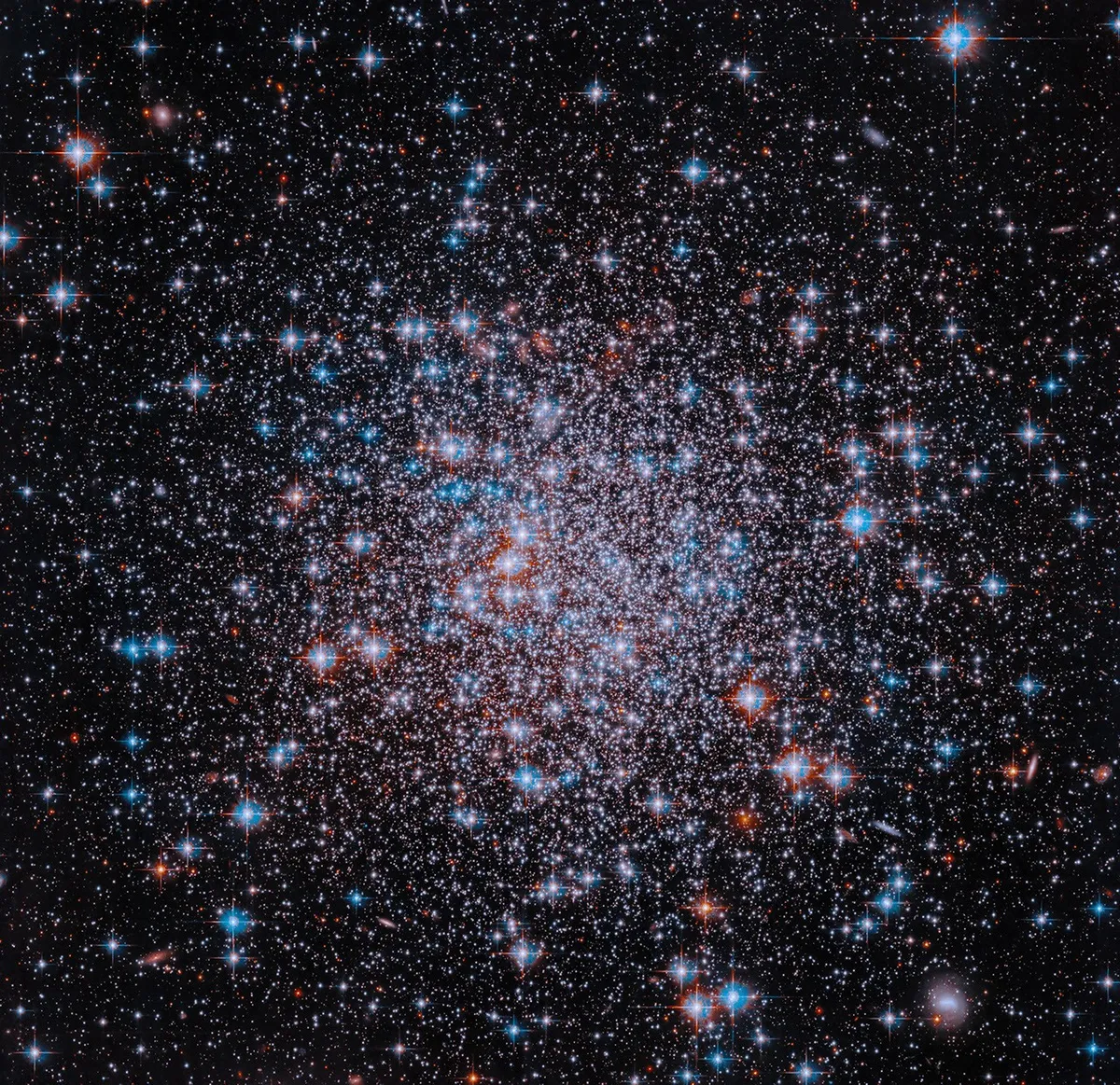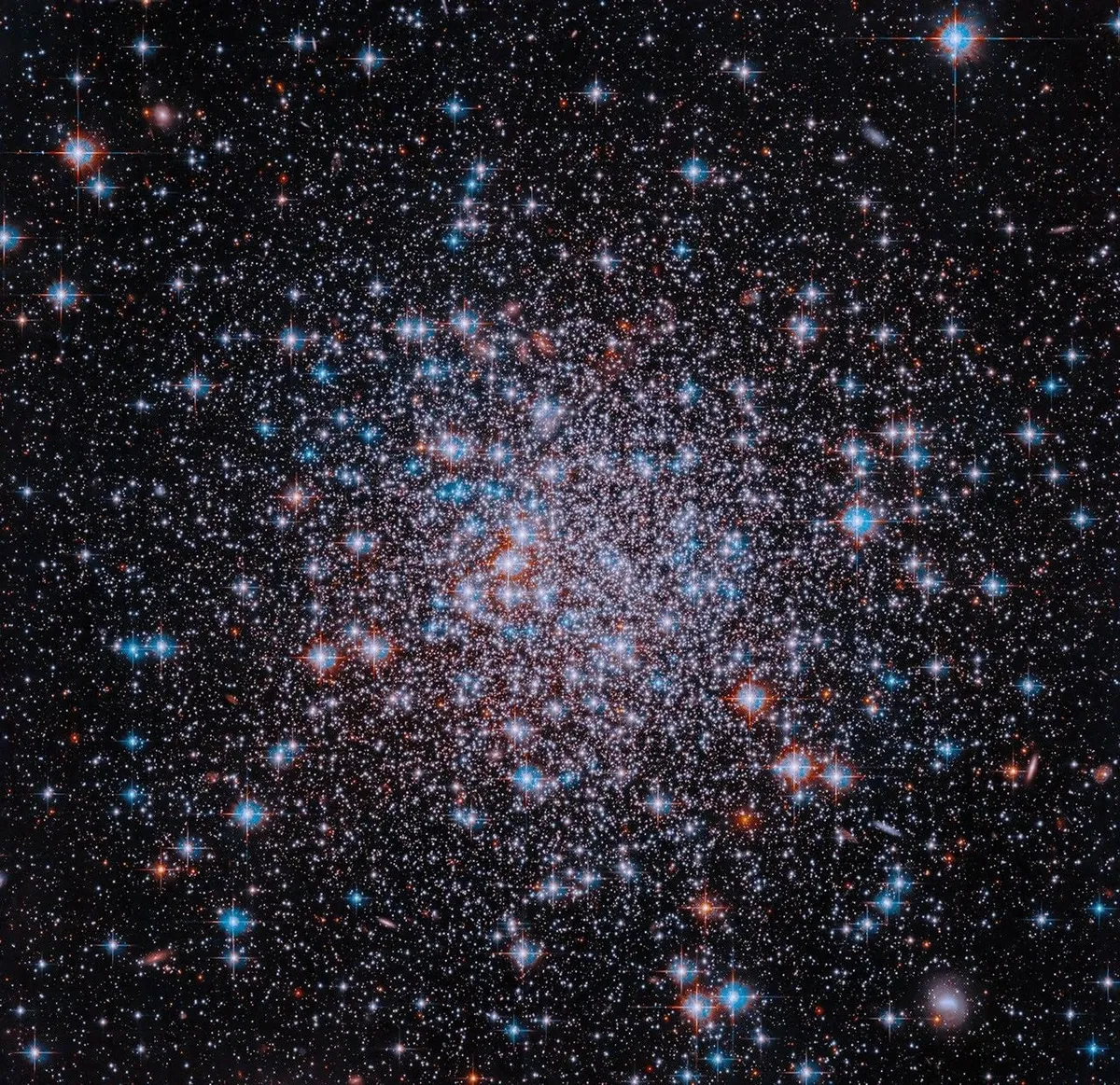
NASA's Hubble Space Telescope, never one to miss a party, recently dropped an image that's less a picture and more a time machine. We're talking about a globular cluster named NGC 6426, a glittering huddle of stars so ancient it practically remembers the Big Bang. And because it's Hubble, it's also ridiculously pretty, sparkling in patriotic red, white, and blue hues. Happy (belated) 250th, America.
This isn't just any old star cluster. NGC 6426 is tucked away in the Milky Way's outer halo, a region where things tend to be... well, old. It's one of about 150 such globular clusters in our galaxy, each a dense, spherical neighborhood of stars held together by gravity's iron fist. The fascinating bit? These stars usually form from the same initial gas cloud, making them cosmic siblings, all roughly the same age.
And what an age it is. NGC 6426 clocks in at a staggering 13 billion years old. Let that number sink in for a second. The universe itself is only about 13.7 billion years old. So, when you're looking at this image, you're essentially peering into the universe's baby photos, a mere blink after creation.
We're a new kind of news feed.
Regular news is designed to drain you. We're a non-profit built to restore you. Every story we publish is scored for impact, progress, and hope.
Start Your News DetoxWhat a Star's Color Says
The colors you see in Hubble's image aren't just for show. They're telling a story about temperature. Blue stars are the hotheads of the galaxy, burning intensely. Red stars, on the other hand, are the cooler, more laid-back types. Hubble captures these variations by observing different wavelengths of light – blue for shorter visible light, red for longer visible and near-infrared light.
These ancient stars also have what scientists call "low metallicity." Which sounds fancy, but really just means they're not big on elements heavier than hydrogen and helium. Think of it as the universe's early days, when things were simple, and heavy elements were just starting to cook inside the first massive stars.
Even more intriguing, NGC 6426 shows signs of two distinct generations of stars. This suggests that after the first colossal stars went supernova (a rather dramatic way to go), they enriched the surrounding gas with those newly forged heavy elements. This cosmic shrapnel then became the building blocks for a second generation of stars, and eventually, the planets that might orbit them. Pretty neat, considering it all started with just hydrogen and helium.
Hubble snagged this shot as part of a grander mission: to map the ages of globular clusters in our galactic halo. By understanding these ancient stellar cities, astronomers hope to piece together the Milky Way's origin story, tracing how our galaxy grew and evolved over eons. Because apparently, even galaxies have a history to uncover, and Hubble, after three decades of mind-blowing discoveries, is still happily doing the detective work.