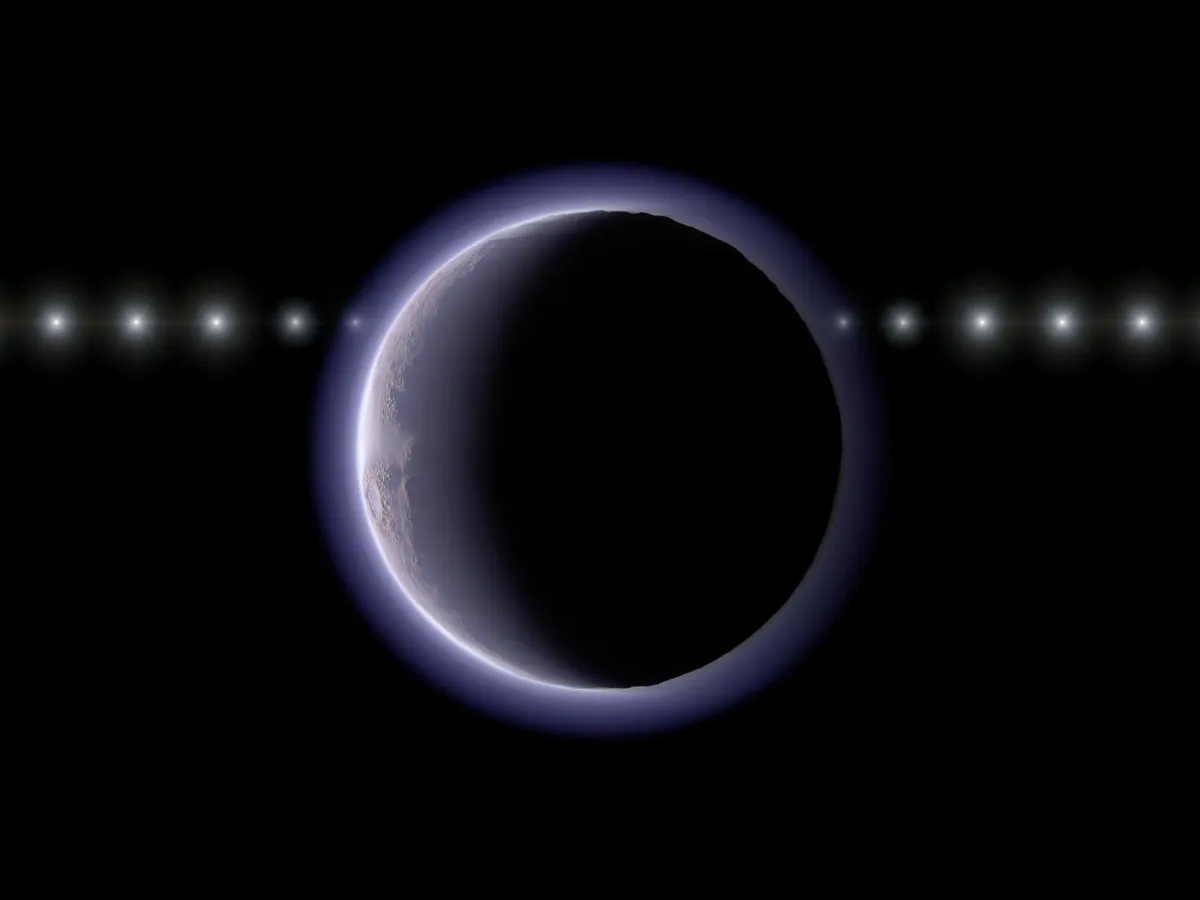
Deep in the outer solar system, there's a tiny, icy world named 2002 XV93 that's decided to do the impossible: it has an atmosphere. Which, if you're a celestial body of a certain size, you really shouldn't. Scientists are currently scratching their heads, wondering what dramatic, recent event gave this little guy its gaseous glow-up.
Japanese astronomers, a mix of pros and incredibly skilled amateurs, stumbled upon this thin veil of gas. The discovery immediately launched a dozen new questions about how it got there and, more importantly, what's keeping it from just floating off into the void. Because, honestly, it should have done that ages ago.
The Atmosphere That Shouldn't Be
Most icy objects past Neptune – what the cool kids call trans-Neptunian objects (TNOs) – are pretty much airless. Pluto, bless its demoted heart, is one of the few exceptions. TNOs are brutally cold, and their gravity is so weak that any gas that does show up usually just says, "Later, gators!" and peace-outs into space.
We're a new kind of news feed.
Regular news is designed to drain you. We're a non-profit built to restore you. Every story we publish is scored for impact, progress, and hope.
Start Your News Detox2002 XV93 is only about 500 kilometers wide. For perspective, Pluto is a chunky 2,377 kilometers across. So, by all cosmic rules, 2002 XV93 should be as naked as a newborn star. But no.
The universe gave scientists a rare viewing party on January 10, 2024. 2002 XV93 decided to pass directly in front of a distant star, as seen from Japan. Normally, if a celestial body is airless, the star's light winks out instantly. But if there's gas involved, the light dims slowly, like a dimmer switch, as it passes through the atmosphere before disappearing. A team led by Ko Arimatsu at NAOJ Ishigakijima Astronomical Observatory watched the whole thing. Their measurements showed that slow fade. Bingo.
So, What's Going On Out There?
Here's the kicker: this atmosphere is a temporary resident. Calculations suggest it would vanish in under 1,000 years if it weren't constantly replenished. This means something relatively recent – in astronomical terms, anyway – must have either created it or given it a serious top-up.
Initial thoughts turned to ice on the surface, slowly sublimating into gas. But the James Webb Space Telescope hasn't spotted any obvious ice patches that could be fueling this atmospheric party. So, that's one theory out.
Now, the big brains are considering other options. Maybe material from inside 2002 XV93 erupted to the surface, releasing gas. Or, perhaps, a rogue comet decided to make a rather dramatic entrance, either delivering gas itself or triggering a release from the object, creating a temporary, very surprising atmosphere.
Whatever the cause, it seems this tiny world is determined to keep its secrets, and its air, for now. More observations, naturally, are needed. Because apparently, even in the vacuum of space, some things just refuse to follow the rules.