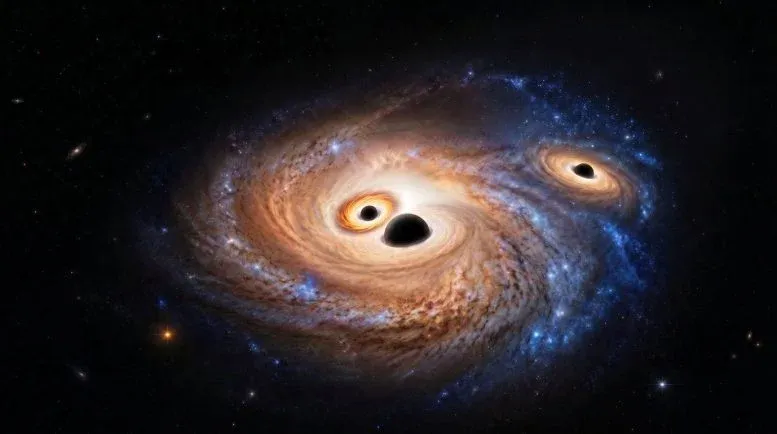
Three supermassive black holes have been found in a galaxy called J0148-4214. This galaxy is very old, seen as it was only about 1.2 billion years after the Big Bang. This discovery helps scientists understand how black holes grew and merged in the early universe.
An international team, led by the Max Planck Institute for Extraterrestrial Physics, found these black holes. Each black hole is actively pulling in matter from a surrounding disk of gas and dust. The light from this galaxy has traveled for over 12.5 billion years to reach Earth.
Hannah Übler, a research group leader at MPE and lead author of the study, noted this is the first time three active black holes have been seen in one galaxy in the distant universe. Two black holes are close to the galaxy's center, about 620 light-years apart. The third is further out, about 5,500 light-years from the center.
We're a new kind of news feed.
Regular news is designed to drain you. We're a non-profit built to restore you. Every story we publish is scored for impact, progress, and hope.
Start Your News DetoxÜbler explained that this finding suggests that early universe processes were good at bringing massive black holes together. This set the stage for the large black hole mergers that future observatories will likely detect through gravitational waves.
How the Black Holes Were Found
Astronomers identified the black holes by looking for specific light patterns from hydrogen atoms. These atoms move very fast due to the black holes' strong gravity. The light pattern from the galaxy's center was complex, suggesting two nearby black holes.
Since these two black holes were too close to be seen separately, researchers used a technique called spectro-astrometry. This method measures tiny shifts in light emissions to pinpoint their locations. A third active black hole was found by observing the galaxy's outer parts.
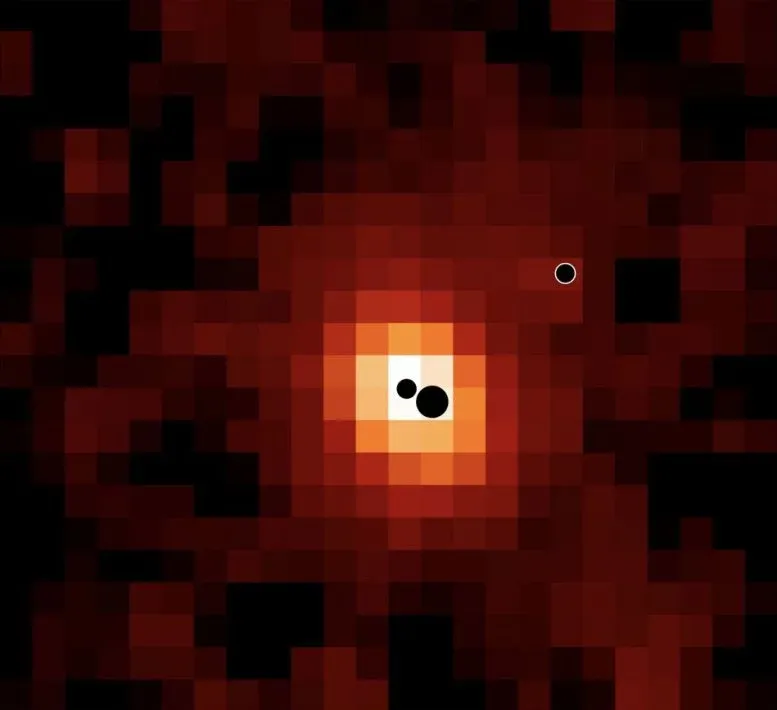
The black holes have masses about 80 million, 0.6 million, and 2 million times the mass of our Sun. The largest one, at 80 million solar masses, is feeding more slowly than its smaller companion of 0.6 million solar masses. This smaller black hole is growing so fast it's exceeding the maximum rate predicted by current models.
Dr. Giovanni Mazzolari, a co-author, said that data from the James Webb Space Telescope (JWST) helped identify the black holes and estimate their masses and how fast they are growing. The galaxy itself has a stellar mass of about 1.3 billion Suns, and the black holes make up a significant part of that.
What This Means for Black Hole Growth
The two central black holes are expected to merge within the next few hundred million years. This could be another way massive black holes grew quickly in the early universe. Roberto Maiolino, a professor at the University of Cambridge and co-author, called these results "extremely exciting." He believes they show that black hole merging might be an extra, fast way for them to grow rapidly.
The third black hole, located away from the center, could have moved there after an earlier merger, or it might be slowly moving inward. This discovery also highlights how important detailed spectroscopy is for finding multiple active black holes in distant galaxies. Without this advanced technique, astronomers might have only found one of the three black holes.
Deep Dive & References: BlackTHUNDER: Evidence of three massive black holes in a z ∼ 5 galaxy - Astronomy & Astrophysics, 2026