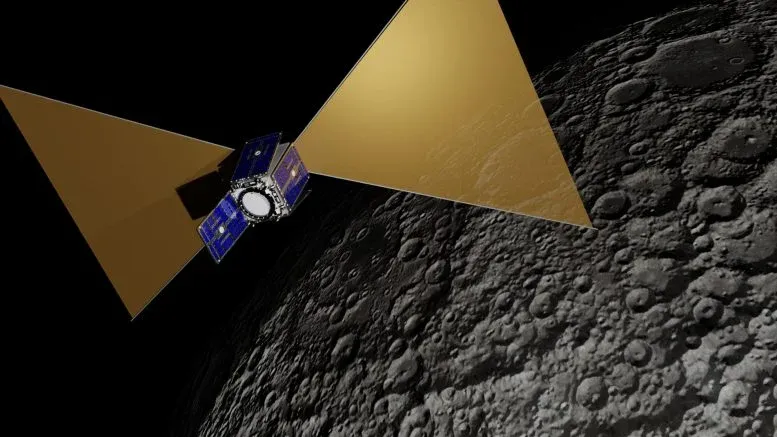
A new satellite, no bigger than a suitcase, could help scientists explore a time in the universe's history that has never been seen directly. This period is known as the cosmic dark ages. It lasted about 150 million years before the first stars began to shine.
The satellite, called CosmoCube, was developed in the UK. It will orbit the Moon, using the far side as a shield from radio signals on Earth. From there, it will listen for a very faint signal from the early universe.
Listening to the Early Universe
This signal, called the 21-centimeter line, comes from hydrogen atoms. It dates back to the time between the Big Bang's afterglow and when the first stars formed. Scientists have not yet been able to observe this era directly.
We're a new kind of news feed.
Regular news is designed to drain you. We're a non-profit built to restore you. Every story we publish is scored for impact, progress, and hope.
Start Your News DetoxTrying to find a signal over 13.5 billion years old from Earth is very hard. Earth's atmosphere blocks the right radio frequencies. Also, radio, satellites, and phones create too much interference.
The Moon helps solve these problems. CosmoCube will spend about 40 minutes behind the Moon during each two-hour orbit. This protects it from Earth's radio noise. Over a two-year mission, the satellite should gather about 1,000 hours of observations. This will offer clues about how the universe changed from a dark, empty state to the complex cosmos we see today.
The UK Space Agency has funded the mission. Researchers hope to launch CosmoCube within five years. The project's details were published in Nature Astronomy.
Dark Matter and Tiny Signals
CosmoCube will also study dark matter. This invisible matter helps form and hold galaxies together. The satellite will examine conditions before the first stars appeared.
Professor Eloy de Lera Acedo from Cambridge's Cavendish Laboratory said this hydrogen emission could help us understand dark matter's role in the early universe. It could show how dark matter pulled hydrogen together to form the first stars and galaxies.
The satellite will look for very low radio frequencies, between 10 and 50 MHz. Ground telescopes cannot easily access this range. This is why the Moon's far side is so important for CosmoCube.
De Lera Acedo noted that the Moon's far side is the only place to get the shielding needed to detect such a faint signal while observing all of space. It solves many problems at once, opening a clear window to the very early universe.
Once in lunar orbit, CosmoCube will deploy a long, light radio antenna. This antenna is designed to detect the 21-centimeter hydrogen signal when the spacecraft is behind the Moon.
Because the signal is so weak, CosmoCube must also track noise from its own electronics. A special calibrator will switch between sky observations and built-in reference sources. This helps researchers find and correct small errors that might look like a cosmic signal.
After the data comes back to Earth, scientists will use advanced statistical methods. They will separate the desired signal from other radio waves, especially those from the Milky Way. Computer simulations will also help remove distortions.
De Lera Acedo explained that the mission is unique because of its small size. It will explore the earliest parts of the dark ages that other missions cannot reach, using a compact and relatively low-cost platform.
The Future of Lunar Silence
The radio-quiet environment on the Moon's far side might not stay quiet forever. Other countries, like the US and India, are also planning missions there.
CosmoCube will carry a miniature radiometer that combines modern analog and digital technology. Its spacecraft platform, called 'SSTL-21', is being developed in the UK by Surrey Space Technology Limited (SSTL).
Working prototypes already exist, and testing is underway. The project involves collaborations with industry partners and academic partners in the UK and EU.
Dr. Will Grainger from STFC RAL Space said CosmoCube aims to do ambitious science from a very small satellite in a challenging environment. This requires clever design. They have tested models of the satellite and its instruments to ensure they can operate in the Moon's varying temperatures.
De Lera Acedo believes this could be a major UK success story. The hardware, software, and technology are all being developed in the UK. It could help answer one of the universe's most profound questions.
Deep Dive & References
The CosmoCube lunar mission for probing the dark ages and cosmic dawn via 21-cm cosmology - Nature Astronomy, 2026
This work received support from the UK Space Agency, the Kavli Foundation, and the Science and Technology Facilities Council (STFC).