
Zirconium pentatelluride (ZrTe₅) is an exotic material that has surprised scientists. Under extremely strong magnetic fields, its electrical resistance continues to change, even when it shouldn't, according to standard physics. This strange behavior points to a new understanding of its quantum properties.
Researchers from Brazil and the U.S. studied this material at very cold temperatures, near absolute zero. They used powerful magnetic fields up to 60 tesla. Their findings suggest that the material's unique "topology" — how its electronic structure is arranged — is the reason for these unusual effects, rather than interactions between many particles.
Unpacking the Strange Behavior
Normally, when a magnetic field is applied, electrons settle into specific energy levels called Landau levels. In pure metals, as the magnetic field changes, these levels cross a boundary called the Fermi level, causing the electrical resistance to go up and down in a regular pattern. These are known as Shubnikov–de Haas oscillations.
We're a new kind of news feed.
Regular news is designed to drain you. We're a non-profit built to restore you. Every story we publish is scored for impact, progress, and hope.
Start Your News DetoxHowever, ZrTe₅ didn't follow this pattern. Its resistance oscillations were not regular, and they kept happening even beyond the "quantum limit." At this limit, electrons should only be in the lowest energy level, and oscillations should stop.
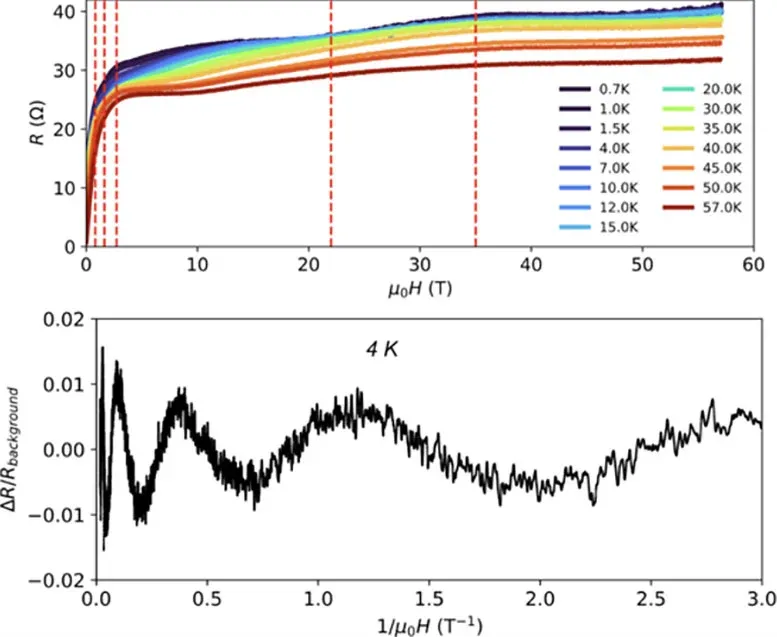
The scientists explained this with "reentrant Landau levels." Instead of moving away, some energy levels can curve back and cross the Fermi level again. This repeated crossing creates extra oscillations. This happens because of two effects: the cyclotron energy from electron movement and the Zeeman effect from electron spin. In ZrTe₅, these are strongly linked, making the energy levels change in a complex way.
Topology, Not Interactions, Is Key
A big question was whether these odd oscillations came from many electrons interacting or from the material's basic electronic structure (its topology). The research showed that the topology was the cause. A simple model based on the material's inherent properties, including strong spin-orbit coupling, could explain the observations.
This finding helps clear up a long-standing puzzle. Different samples of ZrTe₅ sometimes show different types of quantum oscillations. The new analysis suggests that all these behaviors come from the same underlying electronic structure. The differences likely depend on how many charge carriers are present and the size of the Fermi surface in each sample.
The experiments also revealed that the oscillations involve two separate contributions related to electron spin. These contributions interfere with each other, which explains why the oscillation strength didn't just decrease as the temperature rose, as expected. Instead, it showed a dip in strength at certain temperatures.
To conduct these experiments, researchers needed special facilities like the National High Magnetic Field Laboratory in Los Alamos. This lab can create powerful magnetic fields and extremely low temperatures.
These results not only explain the strange oscillations in ZrTe₅ but also highlight its importance for studying other exotic states of matter. By carefully adjusting conditions, scientists believe they could find even more unusual states in this material.
Deep Dive & References
Reentrant Landau levels in a Dirac topological insulator - Nature Communications, 2026