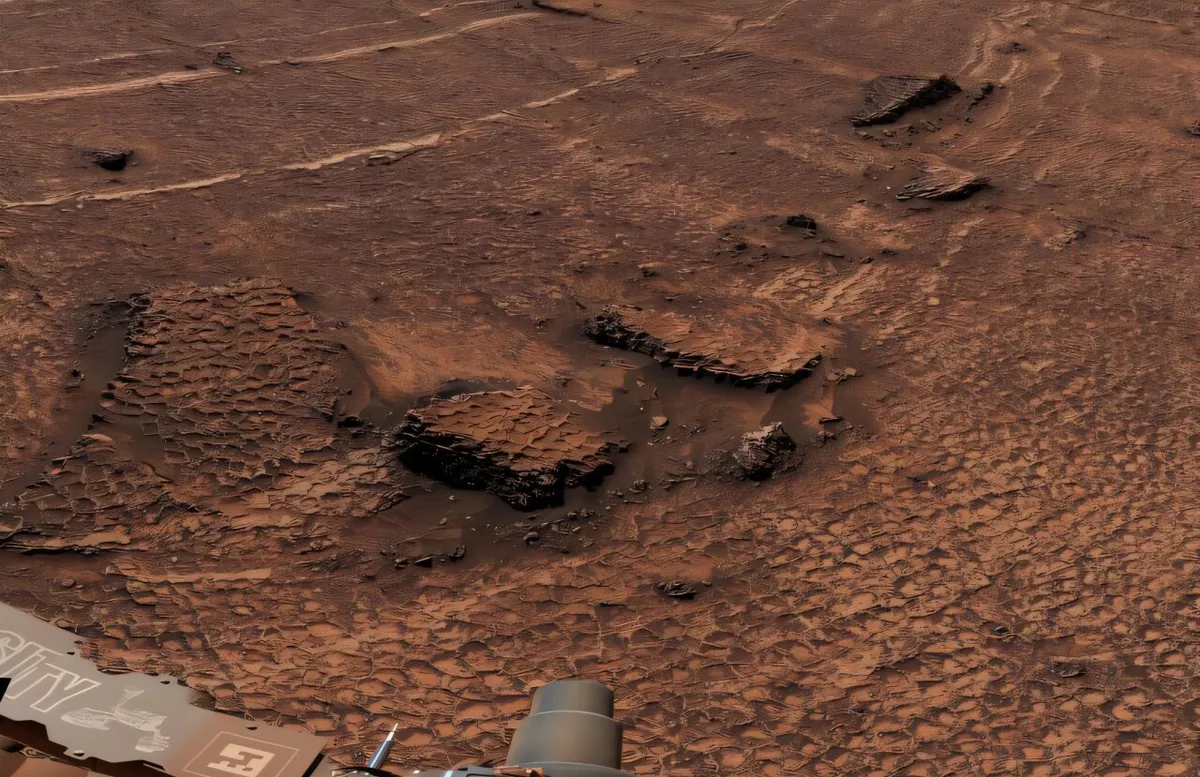
The Mars Curiosity rover recently pulled off a classic move: sending back images that make you wonder if you're looking at a forgotten art installation or just, you know, another planet. This time, it's a vast field of polygon-shaped features, stretching out like some cosmic honeycomb. While similar patterns have been spotted elsewhere on Mars, this is the first time Curiosity has gotten such a close-up.
Mars is a planet that doesn't like to redecorate. Unlike Earth, it skips the whole plate tectonics, volcano, and flowing water routine that constantly reshapes our world. Even the dust storms, dramatic as they sound, haven't done much to alter the surface. This means Mars has been largely untouched for billions of years, offering scientists a rather convenient, ancient time capsule.
A Glimpse into Mars's Wet Past
So, what are these geometric marvels? Scientists are leaning toward the idea that they're ancient mud cracks. A 2023 study in Nature already suggested that intense wet and dry cycles created similar features Curiosity found within Gale Crater. This latest discovery seems to bolster that theory, painting a picture of a Mars that was once, surprisingly, a lot like Earth.
We're a new kind of news feed.
Regular news is designed to drain you. We're a non-profit built to restore you. Every story we publish is scored for impact, progress, and hope.
Start Your News DetoxThese particular polygons are pretty petite, measuring a mere 1.5 to 3 inches wide. They likely formed during the Noachian-Hesperian transition, roughly 3.8 to 3.6 billion years ago, when Mars might have had a climate that wasn't quite so... Martian. NASA's Dr. Ashwin Vasavada put it best: "This sea of polygons took our breath away." Which, if you think about it, is a pretty good reaction to a planet's ancient history laid bare.
Now, not all Martian polygons are created equal. While these new ones are probably mud cracks, others across the Red Planet might have formed from freeze-thaw cycles or even tectonic stress. But Gale Crater remains the only place where a rover has gotten up close and personal with actual mud cracks. Orbiters like NASA's HiRISE have also seen these patterns, but on a much grander scale – some are over 1,000 feet in diameter. Imagine a mud puddle that big.
Today, Mars is a cold, dry place, a stark contrast to its wetter, more dynamic past. But thanks to discoveries like these polygons, we're getting a clearer picture of a planet that once had a whole lot more going on. It's a geological deep dive, billions of years in the making, and Curiosity is just getting started.