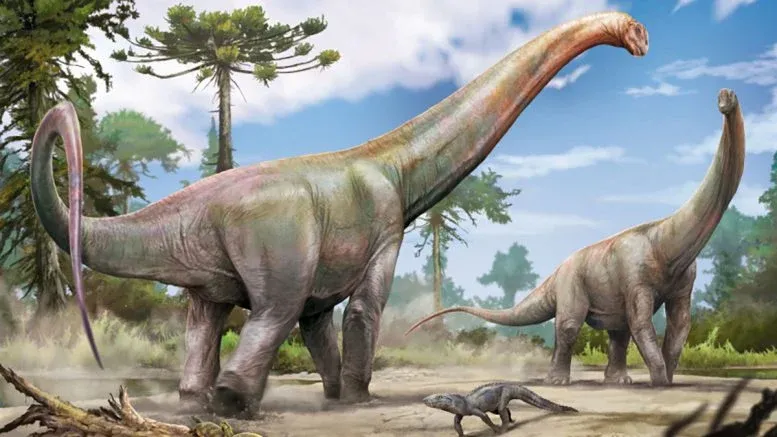
A construction crew in Brazil recently uncovered the fossilized remains of a giant, previously unknown dinosaur. This creature, named Dasosaurus tocantinensis, was about 20 meters long and lived roughly 120 million years ago.
Its closest known relative lived in what is now Spain. This suggests an ancient land connection between Europe and South America.
Researchers believe the ancestors of Dasosaurus tocantinensis likely traveled to South America from North Africa. This would have happened between 140 and 120 million years ago, when these landmasses were still part of the supercontinent Gondwana.
We're a new kind of news feed.
Regular news is designed to drain you. We're a non-profit built to restore you. Every story we publish is scored for impact, progress, and hope.
Start Your News DetoxA Rare Giant Emerges
The fossils were found during work on a road-rail terminal in Davinópolis, Maranhão. Archaeologists monitoring the site as part of environmental licensing first discovered the bones. Initially, they thought the remains belonged to large mammals.
Elver Luiz Mayer, a professor at the Federal University of the São Francisco Valley (UNIVASF), realized the fossils were much older. He noted their depth of about eight meters and the known age of the geological formation. This indicated the material was from the transition from the Lower to the Upper Cretaceous period, about 120 million years ago.
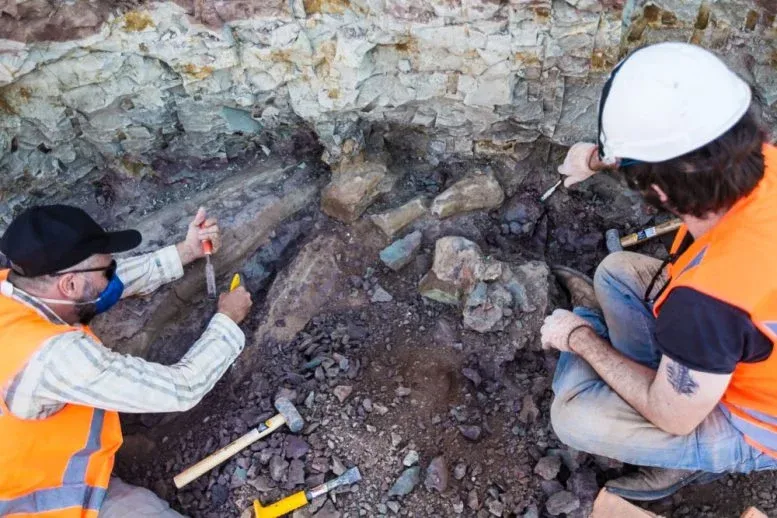 Elver Mayer and a team member excavate around the fossils. Credit: Amai Fotografia
Mayer then assembled a team of specialists to study the specimen. After a long preparation process, analyses were done in Pará. The fossils are now kept in São Luís, Maranhão.
The specimen is considered relatively complete. It includes tail vertebrae, a 1.5-meter femur, ribs, foot bones, and arm and leg bones. Researchers believe more fossils from this dinosaur might still be at the excavation site.
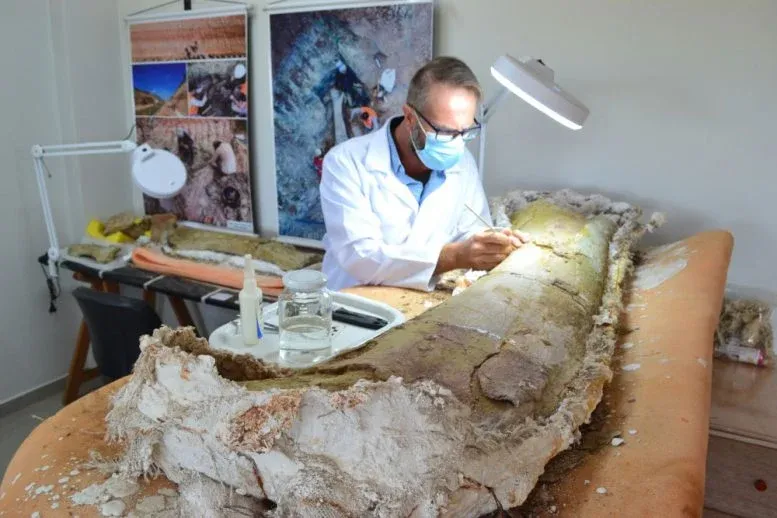 Mayer prepares a femur fossil, approximately 1.5 meters long. Credit: Elver Mayer/Univasf
The dinosaur's name, Dasosaurus tocantinensis, reflects its origins. "Daso" means "forest," referring to the regional woodlands. "Tocantinensis" refers to the Tocantins River, which is near the fossil site.
Bone microstructure analyses showed a growth pattern that combines features of older sauropods with traits of titanosaurs. Titanosaurs are a group closely related to Dasosaurus. This finding suggests that some growth and bone remodeling patterns appeared earlier in dinosaur evolution than previously thought. This insight could help explain how some dinosaurs grew to enormous sizes.
Construction and Conservation
The discovery of Dasosaurus highlights a challenge in paleontology. Large construction projects can damage fossil records. However, they can also expose rock layers that would otherwise be hard for paleontologists to reach.
Experts emphasize the need for better cooperation between construction projects and paleontological efforts. This would help reconcile development with federal laws on fossils. It would also promote new discoveries while ensuring the proper preservation of heritage.
The research group is discussing further excavation at the site with the construction company. More fossils could provide additional insights into Dasosaurus and its dinosaur relatives.
Deep Dive & References
- A new titanosauriform with European affinities in the Early Cretaceous of Brazil: insights on Somphospondyli phylogeny, histology and biogeography - Journal of Systematic Palaeontology, 2026