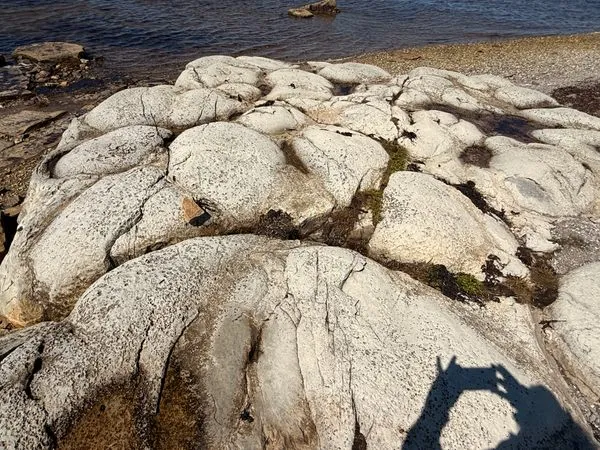
Imagine strolling along a picturesque Canadian coastline, minding your own business, when you stumble upon something truly ancient. Not just old-house-ancient, but Earth's-first-breath-ancient. Welcome to Flower's Cove, Newfoundland, one of only two places on the entire planet where you can go for a walk among fossilized thrombolites.
These aren't your average rocks. These are the OG oxygen producers, estimated to be a staggering 650 million years old. To put that in perspective, dinosaurs were still 225 million years from making their grand entrance when these bun-shaped formations were busy changing the world. Their name, rather charmingly, means "clotted structure." Which, if you think about it, is a pretty accurate description for what are essentially the planet's first eco-engineers.
The Original Air Purifiers
These gray, flattened boulders, some three to four meters wide, are the handiwork of prehistoric single-celled organisms. They spent their days patiently depositing layers of calcium carbonate from the saltwater, slowly building these solid structures that now line the cove. Many of them look like giant, petrified pies, complete with a circular center and wedge-shaped sections, even if time has given some a more abstract art vibe.
We're a new kind of news feed.
Regular news is designed to drain you. We're a non-profit built to restore you. Every story we publish is scored for impact, progress, and hope.
Start Your News DetoxOften called "living rocks," they're a testament to the quiet, persistent power of tiny life. Mixed in with these ancient wonders, you'll also spot darker, round glacial erratics – bonus rocks left behind by the Pleistocene glacier, just for fun. Look closely, and you'll see faint, irregular patterns on their surfaces, maybe drainage channels or tide cracks. Some even have tunnels, courtesy of prehistoric metazoan organisms who apparently enjoyed a good subterranean commute.
Getting to these natural marvels is surprisingly easy. A short walking trail leads you across the charming red and white "Marjorie's Bridge" and onto a boardwalk. It's a surreal experience: a casual stroll across a modern bridge, then straight into a landscape shaped by the very dawn of life. If that's not a conversation starter, we don't know what is.