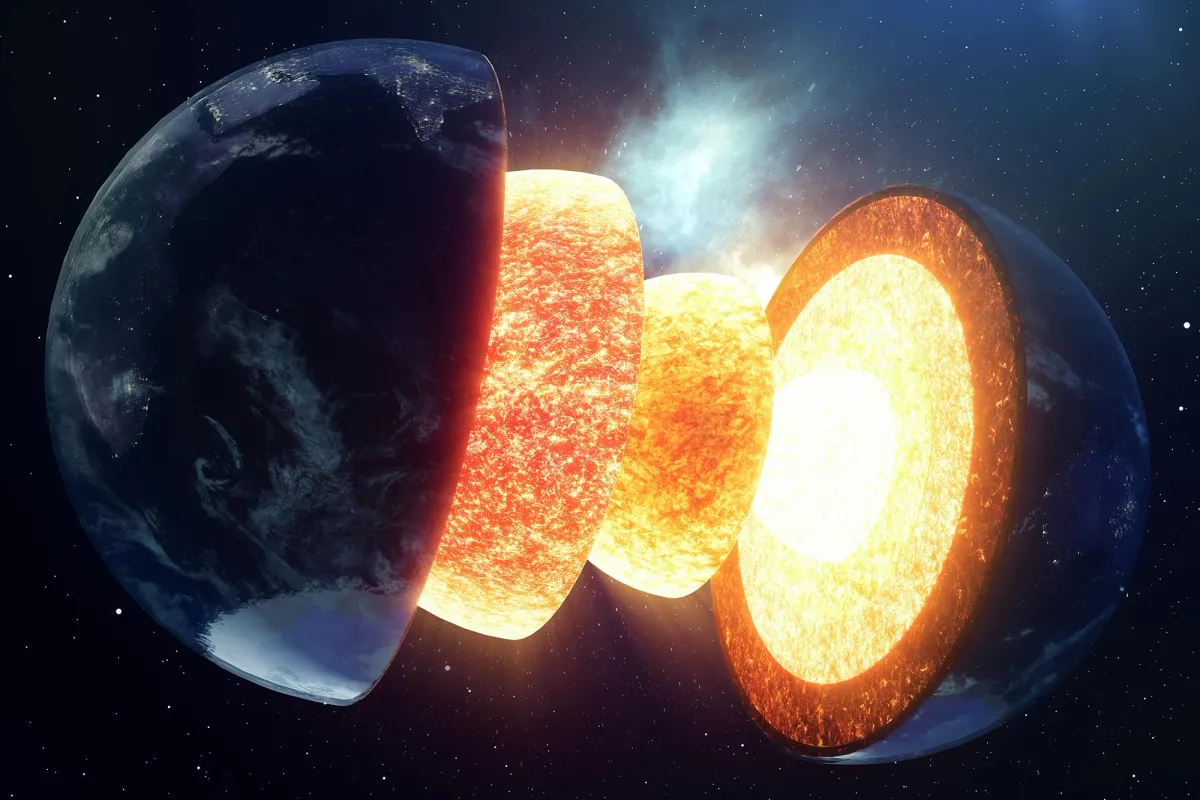
For decades, scientists had a pretty solid idea of how Earth got its start: a chaotic cosmic blender, pulling in bits and pieces from across the entire solar system. Picture it, a little bit from Jupiter's backyard, a dash from beyond, all swirling together to form our big blue marble. It made sense, especially for getting critical ingredients like water.
Then, along came a new study from ETH Zurich, and suddenly, everyone's favorite planetary origin story got a serious glow-up. Turns out, Earth might have been a lot more of a homebody than we thought.
Earth: Made with 100% Local Ingredients
Researchers Paolo Sossi and Dan Bower decided to take a fresh look at meteorite data — specifically, the isotopic fingerprints of various space rocks, including those from Mars and the asteroid Vesta. Isotopes, for the uninitiated, are just different versions of the same element, kind of like siblings who share a last name but have slightly different quirks.
We're a new kind of news feed.
Regular news is designed to drain you. We're a non-profit built to restore you. Every story we publish is scored for impact, progress, and hope.
Start Your News DetoxTheir new, souped-up analysis method revealed something genuinely startling: Earth appears to have formed almost entirely from material found in the inner solar system. We're talking less than two percent (and possibly zero!) of our planet's mass coming from beyond Jupiter. Let that satisfyingly small number sink in.
As Bower put it, they were "truly astonished" by the findings. It seems our planet is a pure product of its neighborhood, a composition so distinct it doesn't quite match any existing meteorite blend we've studied. Which, if you think about it, is both impressive and slightly terrifying.
This wasn't some quick glance, either. The team crunched data from ten different isotopic systems, using a statistical approach that Sossi described as a "data science experiment" rarely seen in geochemistry. They weren't just looking at oxygen isotopes anymore; they brought in the heavy hitters like chromium and titanium, which act like cosmic origin stamps.
Jupiter: The Ultimate Bouncer
So, why the two distinct material sources in our solar system? Scientists have long suspected Jupiter played a critical role. As the gas giant formed quickly, its immense gravity essentially carved a gap in the protoplanetary disk — that swirling ring of gas and dust where planets are born. Jupiter, it seems, acted as the solar system's ultimate bouncer, keeping most of the outer solar system's material from crashing the inner party.
What was unclear was just how effective that barrier was. This new analysis suggests it was practically impenetrable. Almost no material from beyond Jupiter made it to Earth's construction site. And the kicker? Earth's composition looks remarkably similar to Mars and Vesta, implying our inner solar system neighbors shared the same local-only building philosophy.
Sossi even thinks they can predict the composition of Venus and Mercury now, though confirming that will require some actual rock samples from those elusive planets. (Get on it, NASA.)
These findings don't just rewrite textbooks; they open up entirely new questions. Like, if Earth formed from hot, inner solar system material, where did all its water come from? The scientific discussion, Sossi notes, is far from over. Good thing, because we're going to need a bigger whiteboard.