For decades, astronomers noticed something that shouldn't happen. Most galaxies near us are moving away, despite the gravitational pull of our own cosmic neighborhood. Andromeda heads toward us at 100 kilometers per second — but everything else seems to be leaving. The puzzle nagged at scientists for half a century. Now, researchers have finally figured it out.
The answer lives in the architecture of space itself. Beyond our Local Group (the Milky Way, Andromeda, and dozens of smaller galaxies), matter isn't scattered evenly in all directions. Instead, it forms a vast, flattened sheet stretching tens of millions of light-years across — imagine a cosmic pancake, with empty voids yawning above and below.
Ewoud Wempe, a PhD researcher at the University of Groningen, led an international team using advanced computer simulations to test this idea. They started with the universe's earliest moments, letting their model evolve forward to recreate today's Local Group. The result: a "virtual twin" of our cosmic environment that finally matched what astronomers actually observe.
We're a new kind of news feed.
Regular news is designed to drain you. We're a non-profit built to restore you. Every story we publish is scored for impact, progress, and hope.
Start Your News Detox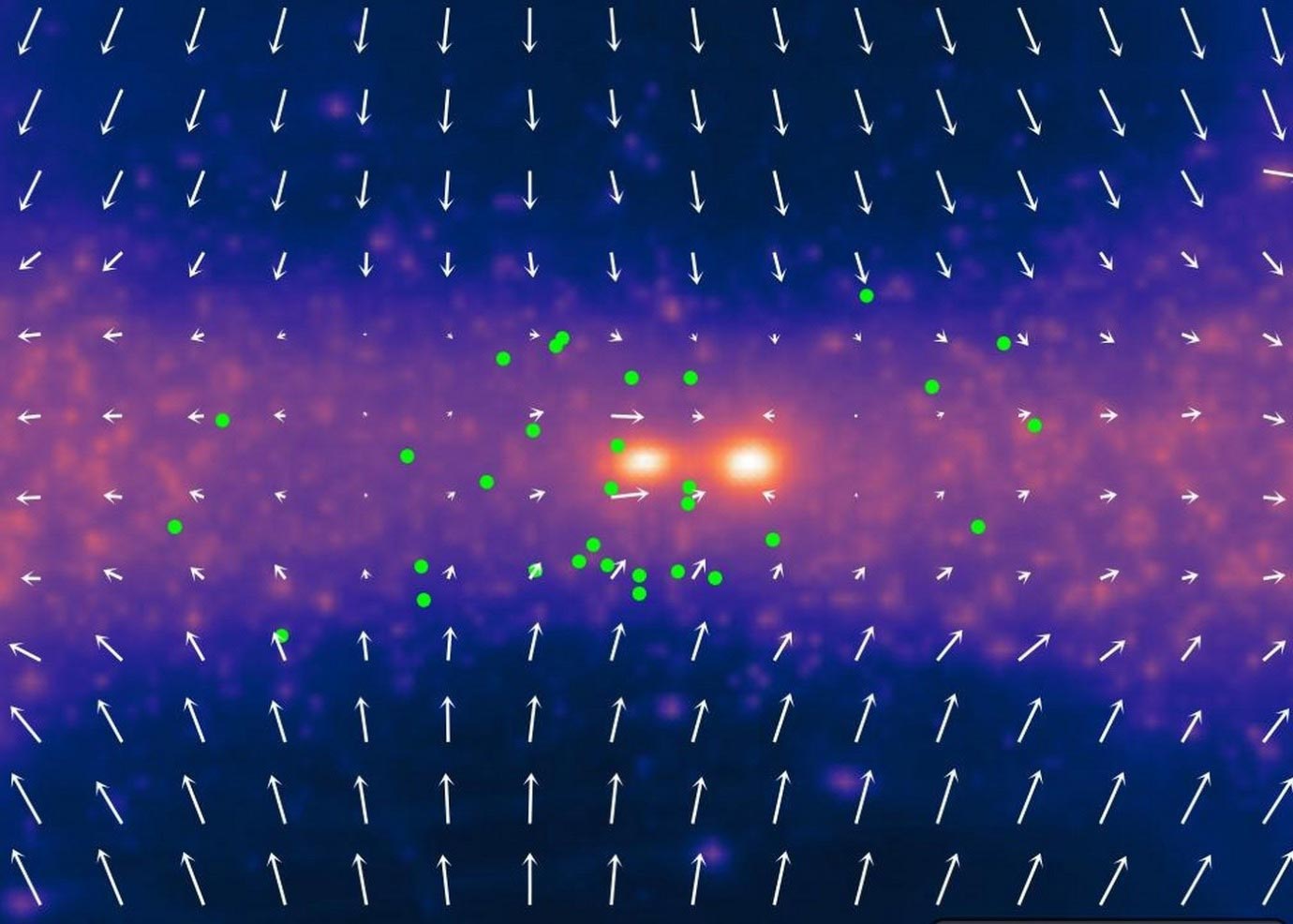
How a flat sheet changes everything
The mechanics are elegant. Galaxies in this flat plane experience gravitational pulls in two directions at once. The Local Group tugs them inward. But the sheet of matter beyond — stretching across the plane — pulls them outward with equal force. The result: galaxies drift away, even though the Milky Way and Andromeda are genuinely massive. Above and below the plane, where you'd expect matter to exist, there's almost nothing. So there are no galaxies there to contradict the observations.
Amina Helmi, Wempe's collaborator, called the discovery "exciting" — a measured word from someone who'd watched this problem resist explanation for years. "Based purely on the motions of galaxies," she said, "we can now determine a mass distribution that corresponds to positions within and just outside the Local Group."
This is the first time anyone has successfully mapped dark matter's distribution in our cosmic neighborhood. The simulations included 31 galaxies just outside the Local Group, matching their observed velocities with remarkable precision. The work, published in Nature Astronomy, required computational power to track how the universe evolved from its earliest state to now.

What makes this breakthrough matter isn't just solving a puzzle that's lingered since the 1970s. It's that it bridges two worlds of cosmology — the broad, universe-wide patterns we see in the cosmic microwave background, and the specific, local dynamics of our galactic neighborhood. For the first time, those two views align in a single coherent model.
The next frontier: understanding whether this flat structure extends even further into space, and what role it might play in the universe's larger architecture.