For 60 years, the data suggested Arctic snow cover was expanding. Turns out the satellites were simply learning to see more clearly.
It's a humbling reminder that even our most careful measurements can mislead us. Researchers at the University of Toronto have now confirmed what many climate scientists suspected: the NOAA snow cover record—a cornerstone of Arctic climate assessments since the 1960s—was showing the opposite trend from what was actually happening.
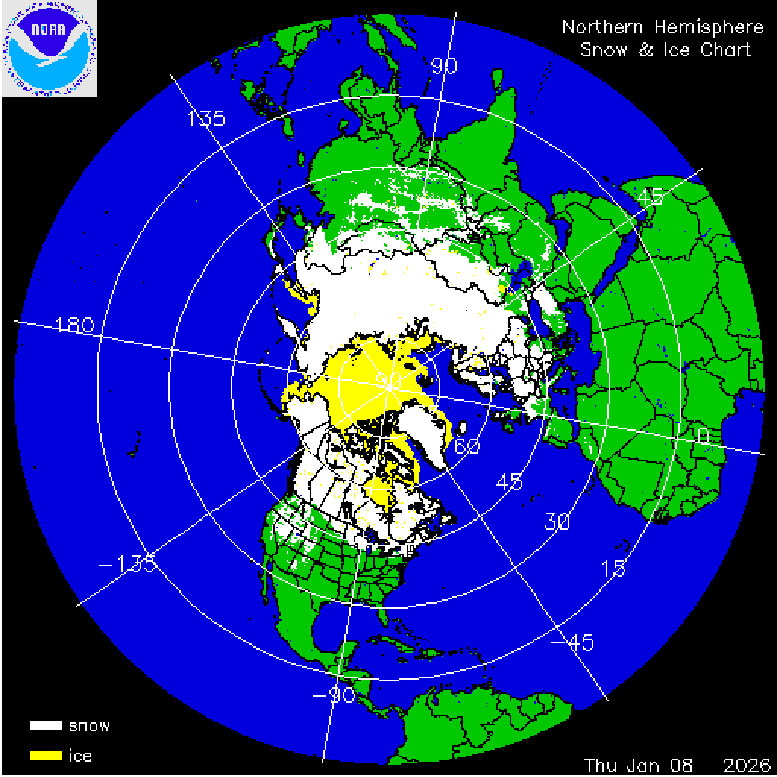
The original data indicated Arctic snow cover was growing by about 1.5 million square kilometers per decade. The corrected analysis reveals it's actually shrinking by roughly half a million square kilometers per decade—an area the size of half Ontario disappearing every ten years.
We're a new kind of news feed.
Regular news is designed to drain you. We're a non-profit built to restore you. Every story we publish is scored for impact, progress, and hope.
Start Your News DetoxWhy This Matters
Snow isn't just scenery. It's one of Earth's most effective mirrors, reflecting about 80% of incoming solar energy back into space. Darker land and vegetation absorb more than half the energy that hits them. This reflectivity—what scientists call albedo—acts as a powerful climate regulator.
When snow disappears, darker surfaces emerge. They absorb more heat. That heat melts more snow. Which exposes more dark surfaces. This feedback loop, called the snow-albedo effect, is a major driver of what's known as Arctic amplification—why the Arctic is warming roughly twice as fast as the rest of the planet.
"It's as if the satellite's eyeglasses got better and better over that period," explains Aleksandra Elias Chereque, the PhD student who led the reanalysis. "It looks like there's more snow now than there used to be – but that's only because the satellite kept getting better prescriptions."

The culprit was instrumental drift. Over decades, NOAA's satellite sensors became increasingly sensitive to thin snow cover—the kind that older instruments couldn't reliably detect. This improvement in detection capability created an artificial upward trend in the data. It wasn't that snow was growing. The satellites were simply becoming better at counting snow that had been there all along, while also picking up smaller patches that older instruments would have missed entirely.
The corrected findings, published in Science Advances in 2025, align with other independent observations of Arctic snow decline and strengthen confidence in climate models. For researchers working on everything from weather prediction to long-term climate projections, this matters. A 60-year dataset that pointed in the wrong direction could have skewed how we understand Arctic warming mechanisms and how well our models capture them.
"Showing how and why the snow cover trend was wrong helps us learn how to use this data set properly," Chereque says. "And that helps in understanding whether climate models are accurate."
The irony is sharp: better technology revealed that the Arctic is warming faster than we thought, not slower. The corrected record confirms that snow loss is accelerating, driven by human-caused warming and amplified by the snow-albedo feedback. It's not a reason to relax. But it is a reason to trust the science more—because science, when done well, catches its own mistakes.