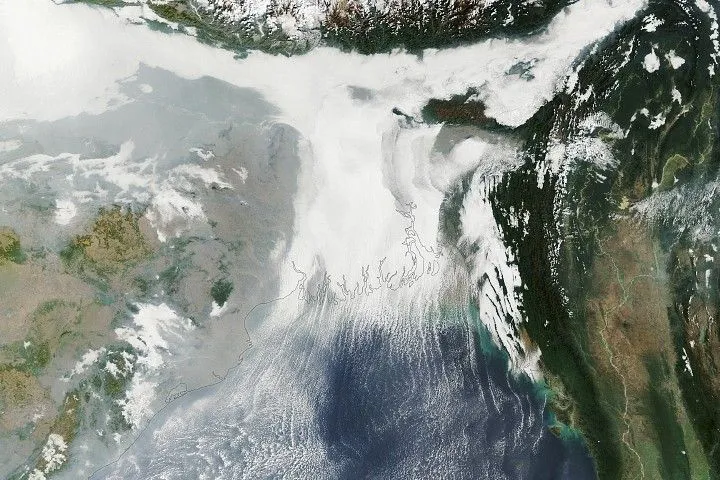
Early January brought something that looked beautiful from space but felt suffocating on the ground. NASA's Terra satellite captured the Ganges Delta wrapped in a thick blanket of low clouds on the morning of January 6, 2026—the kind of winter fog that forms when cool earth meets moisture-heavy air and there's nowhere for it to go.
This wasn't unusual weather. It was predictable winter. But that didn't make it any less disruptive.
Across the Indo-Gangetic Plain—the fertile flatlands stretching from Pakistan through northern India to Bangladesh—dense fog rolled in during an early January cold wave. Meteorological departments in both Bangladesh and India had warned of "moderate to very dense fog," and the warnings proved accurate. By January 2, flights at Dhaka's international airport were being diverted one after another. In northern, central, and eastern India, the same story repeated: airports closed, trains delayed, roads slowed to a crawl.
We're a new kind of news feed.
Regular news is designed to drain you. We're a non-profit built to restore you. Every story we publish is scored for impact, progress, and hope.
Start Your News DetoxHow winter fog actually forms
The science here is straightforward. When ground temperatures drop while winds stay light and moisture sits thick in the air, radiation fog forms—heat escaping from the earth gets trapped near the surface, and what was invisible water vapor becomes visible fog. It's a seasonal rhythm in this region, but knowing the mechanism doesn't make commuting through it any easier.
What makes the satellite image striking is what happened over the Bay of Bengal. Beyond the dense fog over land, long parallel bands of clouds stretched across the water—what meteorologists call cloud streets. These form when cold air moves over warmer ocean water, picks up heat and moisture, and rises in organized columns. Where the air ascends, clouds develop. Where it sinks, clear sky appears. The result looks almost like brushstrokes from above.
Beautiful from 700 kilometers up. Paralyzing at ground level.
The fog disruptions weren't minor inconveniences. International flights were rerouted. Passengers missed connections. Supply chains felt the ripple. Local news outlets tracked the chaos not as a curiosity but as a genuine problem affecting millions of people trying to move through their days. For a region where winter fog is predictable, the impact on modern infrastructure—airports, highways, rail networks designed for clear conditions—remains a yearly test.
As climate patterns shift and winter weather becomes less predictable in some regions while intensifying in others, understanding these seasonal events matters more than it used to. The Ganges Delta's January fog isn't going anywhere, but how cities and infrastructure adapt to it is still being written.