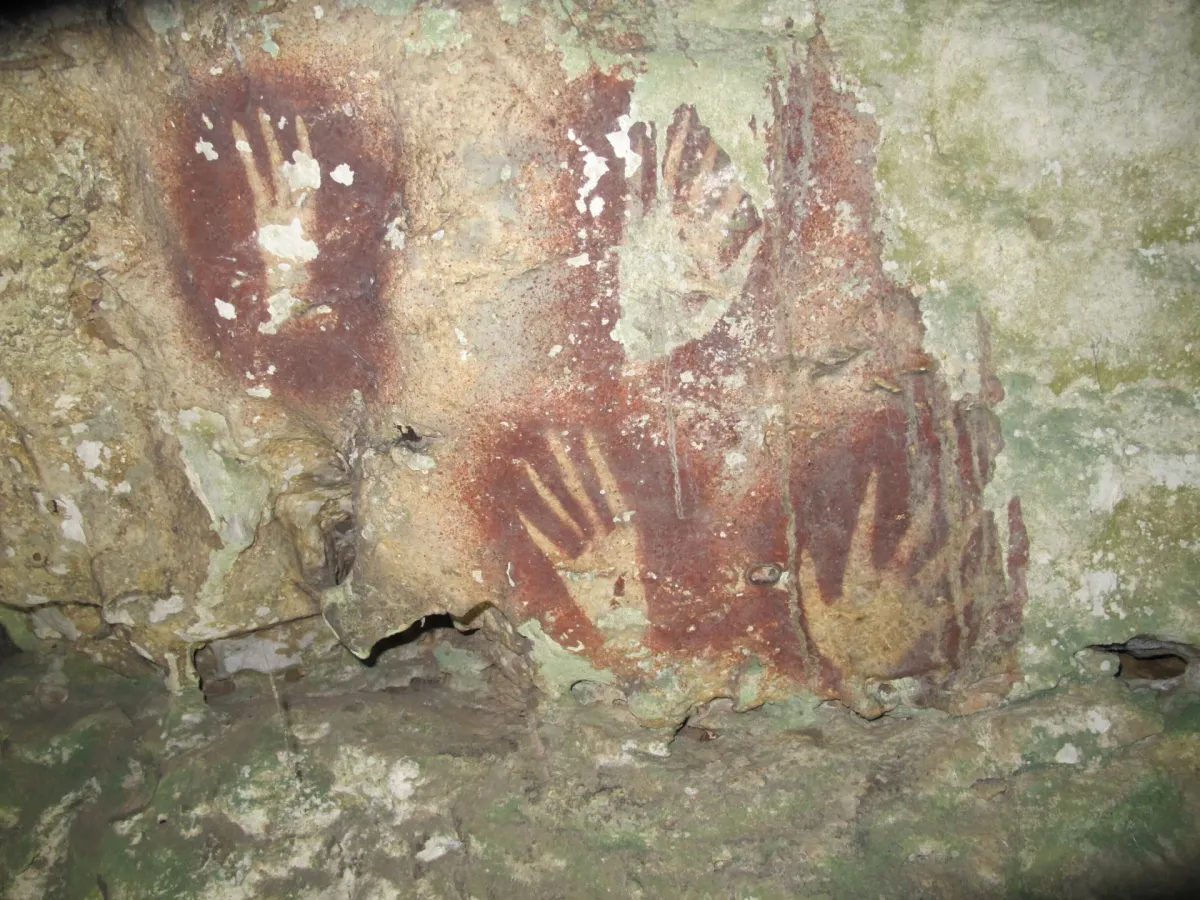
Someone pressed their hand against a limestone wall in a cave on Muna island, and a companion blew pigment over it. The outline that remained has just been confirmed as the oldest known painting in the world — older than anything else humans have left behind.
Archaeologists working in Indonesia's Sulawesi region have been mapping these hand stencils for nearly a decade. Adhi Agus Oktaviana from Indonesia's National Research and Innovation Agency began searching in 2015, and what he found — layered beneath newer paintings of horses and chickens — pushes back our understanding of when humans first made art.
The hands that changed everything
The tan-colored stencils are distinctive in a way that suggests intention. "The tips of the fingers were carefully reshaped to make them appear pointed," says Maxime Aubert, an archaeological scientist at Griffith University who helped date the work. His colleague Adam Brumm proposes something stranger still: the artists may have been deliberately transforming the human hand into something else — an animal claw, perhaps. We don't know why. We may never know. But someone 67,800 years ago thought it mattered enough to do it.
We're a new kind of news feed.
Regular news is designed to drain you. We're a non-profit built to restore you. Every story we publish is scored for impact, progress, and hope.
Start Your News DetoxDating cave art this old requires precision that didn't exist a generation ago. The team analyzed uranium in mineral layers that formed gradually on top of the pigment — a technique that gives a clear minimum age for when the paint was applied. The result: these hands are more than 15,000 years older than the previous oldest art found in the same region, which the team discovered just last year.
What makes this discovery even more striking is that the cave was used repeatedly over millennia. Some paintings were made 35,000 years after others, suggesting that people returned to this place across countless generations, adding their marks to the walls.
Why this matters
These handprints aren't just old — they're evidence of something we often take for granted. The people who made them were not only surviving in a difficult landscape; they were creating. They were experimenting with representation, with transformation, with leaving something behind. Adhi has said the art "shows that our ancestors were not only great sailors, but also artists."
The Sulawesi region, along with neighboring East Timor and Australia, is becoming clearer as a center of early human creativity and migration. Aboriginal cultures in Australia have documented evidence of continuous living traditions stretching back at least 60,000 years. Now we know that artistic expression was part of that story from nearly the beginning.
As researchers continue mapping these caves, more layers of our shared past are likely to emerge from beneath the stone.