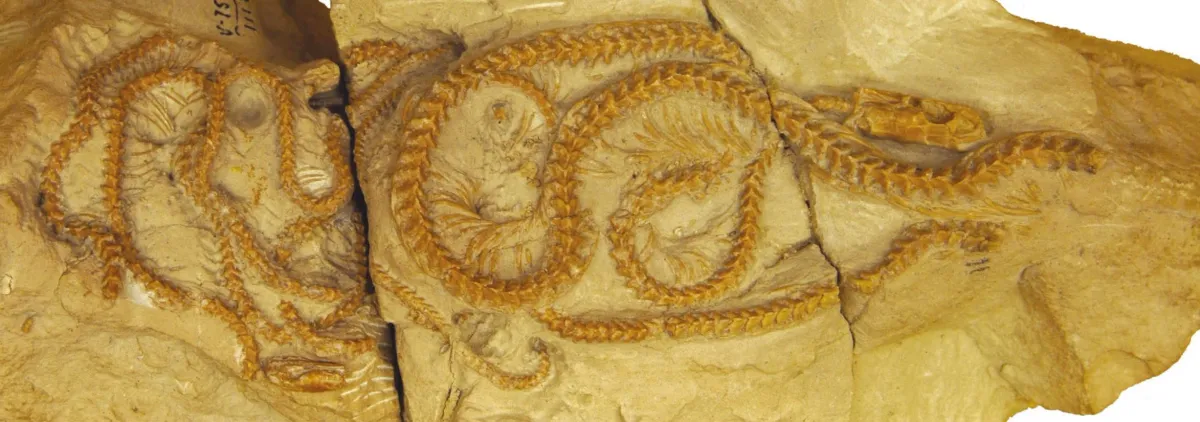
Turns out, some secrets are best kept hidden inside a rock, only to be unearthed by a CT scan millions of years later. Scientists in Wyoming just found a 34-million-year-old snake fossil that's not just rewriting the evolutionary playbook, but also hinting at some surprisingly familiar social habits.
Meet Hibernophis breithaupti, a newly identified ancient relative of modern boas and pythons. This isn't just any old fossil; it's a small, burrowing snake that's now making paleontologists rethink North America's role in the early days of boa-like snake evolution. And its discovery is a story in itself. Researchers, sifting through four fossils from Wyoming's White River Formation, found three of them crammed into a single rock. Two were visible; the third, a shy little thing, only popped up after a CT scan. Because apparently that's where we are now: scanning rocks for hidden reptiles.
The Original Group Chat
What makes Hibernophis such a big deal isn't just its age or its surprisingly intact skull (snake fossils are usually just a pile of backbones). It's how it was found: curled together in what looks suspiciously like a burrow. This could be the oldest evidence yet of snakes hibernating in groups. Let that sink in for a moment. Complex social behaviors, like huddling for warmth, potentially started tens of millions of years earlier than we thought.
We're a new kind of news feed.
Regular news is designed to drain you. We're a non-profit built to restore you. Every story we publish is scored for impact, progress, and hope.
Start Your News DetoxMichael Caldwell, a paleontologist who co-led the research, pointed out that modern garter snakes are famous for their massive hibernation parties, sometimes gathering by the thousands in dens. To see possible proof of this behavior from an era when dinosaurs were still a relatively fresh memory is, as he put it, "amazing."
This ancient snake is a bit of an evolutionary enigma, sitting somewhere between early booid snakes and Charinaidae. It’s like finding a distant cousin whose family tree branches off in all sorts of unexpected directions. Its unique features suggest that snake evolution wasn't a neat, linear progression, but a much more sprawling, branched affair. Hibernophis isn't just a new species; it's a peek into the origin story of some of the world's most recognizable constrictors, proving that even 34 million years ago, sometimes you just need a buddy to get through the winter.