Imagine a crime scene, but the only evidence is a fossilized pile of barf. Now imagine that barf just introduced us to a brand new species of pterosaur that’s been hiding in plain sight for 110 million years.
That's pretty much what happened when scientists cracked open a chunk of fossilized vomit, officially known as a regurgitallite. This particular bit of prehistoric puke, discovered in Brazil's Araripe Basin, contained the remains of two small, seagull-sized pterosaurs, four fish, and a whole lot of questions about ancient lunch habits.
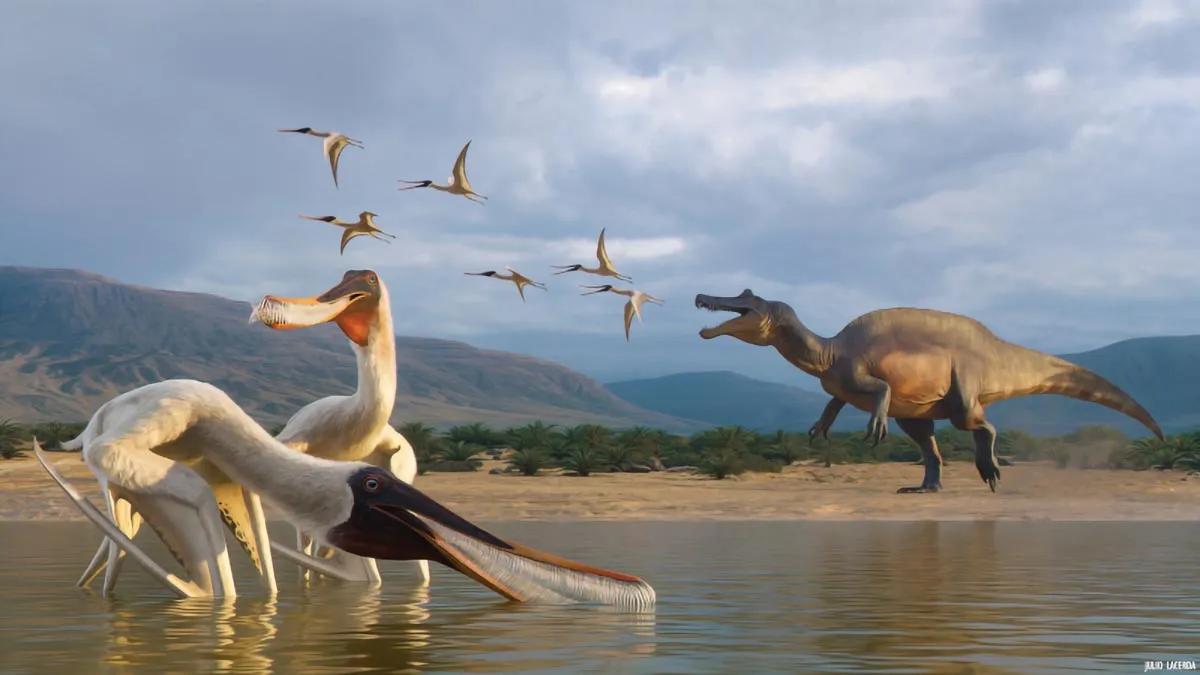
Roughly 110 million years ago, a large predator — perhaps a hungry dinosaur like Irritator challengeri or even a massive pterosaur like Tropeognathus mesembrinus with an eight-meter wingspan — snagged these two flying reptiles and then, for good measure, swallowed four fish. Later, the predator did what predators do: it regurgitated the parts it couldn't digest. And thank goodness for that, because what it spat out was a scientific jackpot.
We're a new kind of news feed.
Regular news is designed to drain you. We're a non-profit built to restore you. Every story we publish is scored for impact, progress, and hope.
Start Your News DetoxThe Pterosaur That Ate Like a Whale
For decades, this particular fossil sat in a museum, likely mistaken for just another collection of fish remains. But in 2024, researchers from Brazilian universities took a closer look. What they found inside the partially digested bones of those two small pterosaurs was a complete surprise: the first known filter-feeding pterosaur species from the tropics.
Meet Bakiribu waridza, which translates to "comb mouth" in the local Kariri language. This new species had rows of tightly packed, bristle-like teeth, perfect for straining tiny crustaceans and other small creatures from the water. Think of it as the prehistoric, flying version of a whale, but significantly less majestic and with more scales.
Rubi Vargas Pêgas, a postdoctoral researcher involved in the study, noted the sheer improbability of the find. The Araripe Basin is a fossil-rich area, and nearly 30 types of pterosaurs were already known from there. None of them were filter feeders. Finding an entirely new family for the region was, as one might imagine, a bit of a shock.
What makes Bakiribu waridza even more intriguing is its location. Filter-feeding pterosaurs typically hung out in freshwater environments, not the coastal regions that the Araripe Basin was back then. It's almost as if this particular pterosaur took a wrong turn, only to end up in the stomach of a larger animal, and then, eventually, in a museum display.
A Clue-Filled Culinary Catastrophe
The regurgitallite itself offered a trove of information. The pterosaur bones showed clear signs of stomach acid erosion, while the four fish were surprisingly well-preserved. This suggests the fish were a recent snack, consumed just before the predator decided the Bakiribu wasn't sitting right.
Paleontologist Aline M. Ghilardi, who led the study, noticed that all the specimens in the vomit pointed in the same direction. Modern fish-eating birds swallow their prey headfirst to avoid choking on fins. This ancient predator likely employed the same technique, giving scientists a peek into its dining etiquette.
The discovery of Bakiribu waridza not only adds a fascinating new branch to the pterosaur family tree but also highlights the unexpected ways ancient life can reveal itself. Sometimes, all it takes is a really bad case of indigestion and a very observant scientist. The fossil has now been transferred to the Plácido Cidade Nuvens Museum of Paleontology in Santana do Cariri, ensuring this unique find is preserved in its original territory, which, if you think about it, is a pretty classy move for a pile of ancient barf.