Imagine a baby crocodile — cute, scaly, and probably a little bitey. Now imagine it growing up, not just getting bigger, but deciding, “You know what? Four legs are so last Triassic. I’m going bipedal.”
That’s essentially the wild growth story scientists have pieced together about Sonselasuchus cedrus, a bizarre crocodile relative from the dinosaur age. This ancient reptile, a member of a group called shuvosaurids, seems to have started its life on all fours, then dramatically shifted to walking on two legs as it matured. Because apparently, even 200 million years ago, some creatures just had to stand out.
The Unlikely Biped
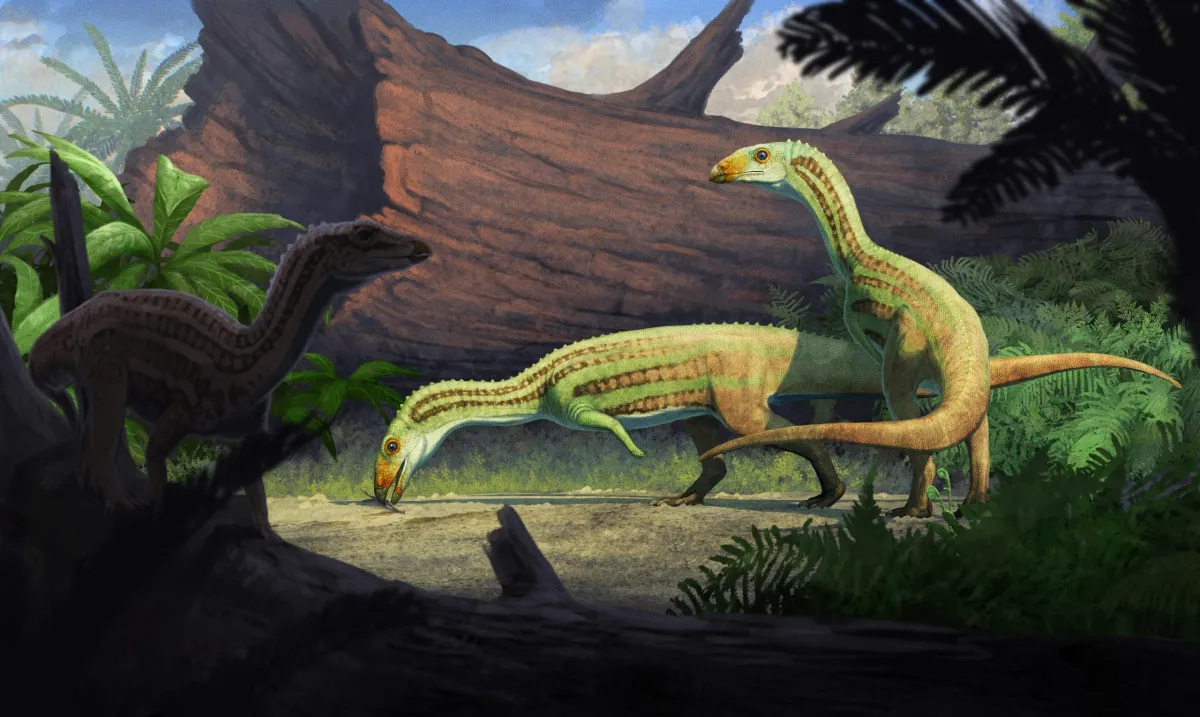
These shuvosaurids were unusual “crocodile-line” archosaurs, which means they’re related to modern crocodiles, but not exactly what you’d picture lurking in a swamp. Many of them, including Sonselasuchus, actually looked a lot like fast-running, ostrich-like dinosaurs called ornithomimids. Think long legs, a toothless beak, and a general air of “I’m late for something important.”
We're a new kind of news feed.
Regular news is designed to drain you. We're a non-profit built to restore you. Every story we publish is scored for impact, progress, and hope.
Start Your News DetoxBoth groups lived at the same time during the Late Triassic period, roughly 225 to 201 million years ago. This was long before modern crocodiles decided to perfect their current, rather less flamboyant, form.
The revelation comes from a study in the Journal of Vertebrate Paleontology, where researchers from the University of Washington and the Burke Museum analyzed fossil remains with some truly odd limb proportions. These weren't just differences in size; they hinted at a fundamental change in how the animal moved throughout its life.
Lead author Elliott Armour Smith put it rather plainly: “Essentially, we think these creatures started out their lives on four legs. They then started walking on two legs as they grew up. This is particularly peculiar.” Peculiar indeed, given that this kind of developmental shift is rarely seen in reptiles. It’s like a human deciding at puberty that walking on their hands is the superior mode of transport.
Professor Christian Sidor, who worked with Armour Smith, was part of the team that unearthed 950 Sonselasuchus fossils back in 2014. The discovery site? Arizona’s Petrified Forest National Park, a place so rich in ancient bones that it’s basically a prehistoric treasure chest. Over the past decade, more than 3,000 fossils have been pulled from this single spot alone. And what did this ancient bipedal croc-cousin look like? Standing about 25 inches (64 centimeters) tall, it sported a toothless beak, surprisingly large eye sockets, and hollow bones. Armour Smith notes these features are uncannily similar to those of ornithomimid dinosaurs, even though Sonselasuchus evolved them completely independently. It's a classic case of convergent evolution: different creatures, similar environments, similar solutions to life’s challenges.
Sonselasuchus likely roamed forested areas, hence its species name cedrus, a nod to the cedar trees reminiscent of Late Triassic evergreens. The genus name, pronounced “sawn-SAY-la-SOOK-us,” comes from the Sonsela Member, the rock layer where these fascinating fossils were found.
So next time you see a crocodile, remember its distant relative that decided to ditch two wheels for one. Or rather, four legs for two. Which, if you think about it, is both impressive and slightly terrifying.