Jupiter and Saturn, our solar system's two gas giants, are basically cosmic siblings. Both are enormous. Both have rings (yes, Jupiter has them too, they're just not as flashy). And both are absolutely lousy with moons. But here's where the family resemblance ends: Jupiter boasts over 100, including four behemoths. Saturn, the show-off with 280+ moons, has only one truly massive one: Titan.
For decades, scientists have been scratching their heads, wondering why these two similar planets ended up with such wildly different lunar families. Now, new research points to an unlikely culprit: magnetic fields. Because apparently, even moons are subject to the whims of invisible forces.
The Great Galactic Reconciler
A team of researchers from Japan and China, including some very clever folks at Kyoto University, decided to build a unified model. The goal? To explain both Jupiter's sprawling moon city and Saturn's more exclusive club using the same fundamental physics. Think of it as the ultimate space-age family therapist, but for planets and their orbiting offspring.
We're a new kind of news feed.
Regular news is designed to drain you. We're a non-profit built to restore you. Every story we publish is scored for impact, progress, and hope.
Start Your News DetoxLead author Yuri I. Fujii pointed out that understanding our own solar system's lunar drama is crucial for testing theories about how planets form in the first place. So, they fired up the supercomputers and simulated the early lives of Jupiter and Saturn, tracking everything from temperature shifts to, you guessed it, magnetic fields. They also modeled the swirling disks of gas and dust around each planet – the celestial nurseries where moons are born.
What did they find? The key difference between these two moon systems boils down to those surrounding disks, and specifically, the strength of each planet's magnetic field.
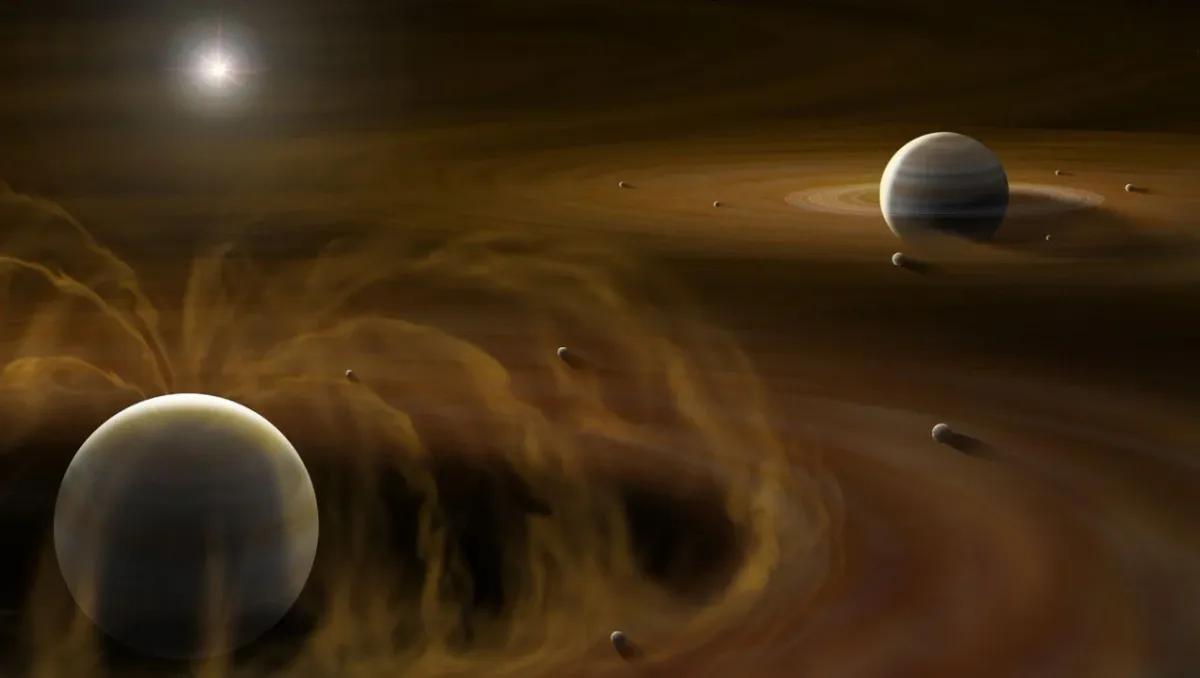
Jupiter, with its notoriously powerful magnetic field, likely carved out a protective "cavity" within its disk. This cosmic safe zone acted like a bouncer, trapping and shielding its large moons – Io, Europa, Ganymede, and Callisto – as they formed. Let them survive and thrive, it seems.
Saturn, however, was less magnetically endowed in its youth. Its early magnetic field was too weak to create a similar cavity. Without that protective bubble, moons trying to form in its disk had a much tougher time surviving the turbulent environment. Hence, one giant moon (Titan, the overachiever) and a whole lot of smaller ones.
This isn't just a fascinating peek into our own backyard; it's a new lens through which to study distant gas giants. The model suggests that Jupiter-sized planets might typically host a compact collection of many large moons, while Saturn-sized worlds might sport just one or two big ones. Which, if you think about it, is both impressive and slightly terrifying. The universe, it turns out, is a giant magnet, and we're all just living in it.