A rare meteorite found in the Sahara Desert might be the last piece of a lost planet. This ancient world existed during the early days of our solar system.
About 4.5 billion years ago, a large planetary body orbited the Sun. It was possibly as big as the Moon or even Mars. This body later broke apart after hitting another object.
Researchers now say they have found the first direct proof this lost protoplanet existed. The discovery suggests some early worlds formed very differently from Earth and other rocky planets.
We're a new kind of news feed.
Regular news is designed to drain you. We're a non-profit built to restore you. Every story we publish is scored for impact, progress, and hope.
Start Your News DetoxAaron Bell, a research professor at the University of Colorado Boulder, noted that it's amazing to think such a large world once existed. He explained that we only know about it because some fragments landed on Earth. These meteorites show a completely different way early planets developed.
A Meteorite From a Lost World
The evidence comes from a meteorite named Northwest Africa (NWA) 12774. It's an extremely rare type called an angrite.
Angrites are some of the oldest volcanic rocks in the solar system. They formed just a few million years after the solar system began, about 4.56 billion years ago. They are also very uncommon. Only 68 angrites have been found among over 80,000 meteorites on Earth.
Scientists have long been puzzled by their chemical makeup. Unlike Earth and Mars, angrites have very little silicon dioxide, or silica. Silica is a main part of almost all known rocky planets.
Because of this unusual composition, researchers once thought angrites came from small asteroids. These asteroids would have been less than 200 kilometers (124 miles) in radius.
Unexpected Evidence Deep Inside the Rock
Bell and his team studied NWA 12774. They found clinopyroxene, a mineral common in Earth's crust and mantle. What was unusual was its high aluminum content. This shows the mineral formed under great pressure deep inside a planetary body.
The researchers created models to understand the conditions needed to make the meteorite's minerals.
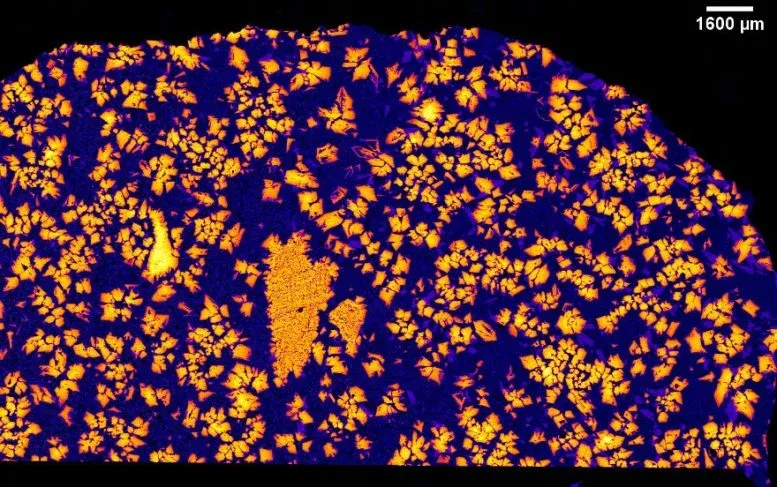
Their results showed that the aluminum-rich clinopyroxene could only form at pressures of at least 17.5 kilobars. To compare, the pressure at the bottom of the Mariana Trench, Earth's deepest ocean, is about one kilobar.
Such high pressures would be impossible inside a small asteroid. Instead, the calculations suggest the angrite parent body had a radius of at least 1,000 kilometers (621 miles).
A Planetary Body Larger Than Expected
More evidence suggested the source body might have been even bigger. Crystals inside NWA 12774 kept sharp edges and subtle chemical patterns. These likely would not have survived if they formed deep below the surface.
This finding suggests the crystals grew at fairly shallow depths. This means the parent body would have needed to be much larger to create the necessary pressures.
Based on this, the angrite parent body could have been more than 1,800 kilometers (1,118 miles) in radius. This would make it similar in size to the Moon. It might even approach the size of Mars, which has a radius of 3,300 kilometers (2,050 miles).
Bell noted that many meteorites have not been fully studied. He believes there were likely more of these protoplanets we don't know about.
Researchers still don't know what happened to this ancient world. One idea is that it was destroyed in a huge collision early in the solar system's history. Its pieces might have then become part of other rocky planets, including Earth.
Bell explained that the materials forming the angrite parent body are very different from those of Earth and Mars. This points to a distinct and separate way planets formed in the early solar system.
Deep Dive & References
High-pressure clinopyroxene in Northwest Africa 12774 and new geobarometric evidence for a planetary embryo-sized angrite parent body - Earth and Planetary Science Letters, 2026