Let's be honest, Jupiter's been slacking. While the gas giant next door is busy showing off its measly 115 moons, Saturn just hit a celestial jackpot: 293 confirmed moons as of June 2026. Two hundred ninety-three. Let that satisfying number sink in.
That's more natural satellites than any other planet in our solar system, making Saturn the undisputed heavyweight champion of lunar real estate. Because apparently, that's where we are now.
Most of these aren't exactly prime property. We're talking small, often oddly shaped hunks of rock and ice, many just a few kilometers across, tumbling around in tilted, far-flung orbits. Think of them as Saturn's eccentric, distant relatives.
We're a new kind of news feed.
Regular news is designed to drain you. We're a non-profit built to restore you. Every story we publish is scored for impact, progress, and hope.
Start Your News DetoxThe Big Six
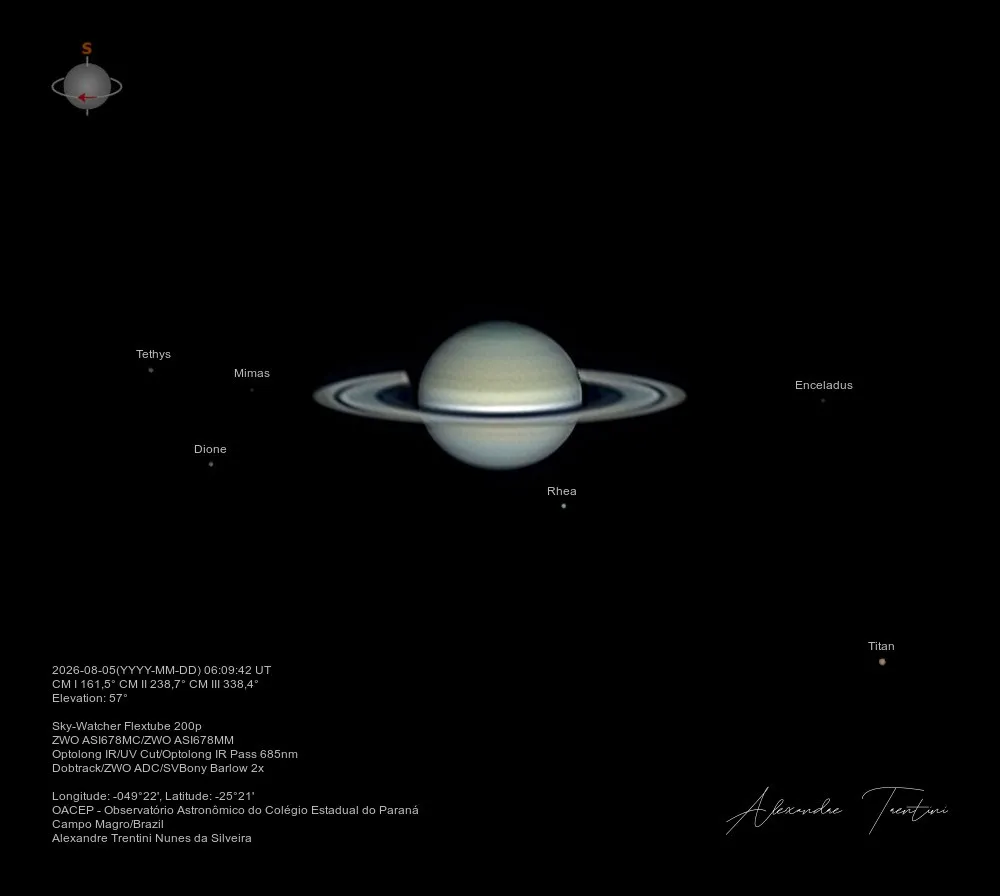
But among the crowd, there are some true stars. This image, snapped on August 5th, shows off six of Saturn's largest and most famous. You can spot Titan, the big kahuna, dominating the lower right. With a diameter of 5,150 kilometers, it's not just bigger than Earth's moon; it actually slightly out-sizes the planet Mercury. Which, if you think about it, is both impressive and slightly terrifying.
The rest of the icy gang includes Mimas, Tethys, Enceladus, Dione, and Rhea — all significant players in Saturn's sprawling cosmic court.
Titan was the first to be spotted way back in 1655 by Dutch astronomer Christiaan Huygens, who probably just thought he was having a very good night with his telescope. Fast forward to the space age, and missions like Voyager and Cassini truly blew the lid off Saturn's moon count, turning a few known satellites into a veritable lunar metropolis.
So next time you're feeling overwhelmed, just remember Saturn and its 293 moons. It's out there, quietly achieving greatness, while Jupiter just... exists.