Across the Sun's surface, hot plasma constantly rises, cools, and sinks. Now, researchers have found tiny swirling structures at the edges of these churning areas. These structures might help explain how the Sun twists, stores, and moves magnetic energy.
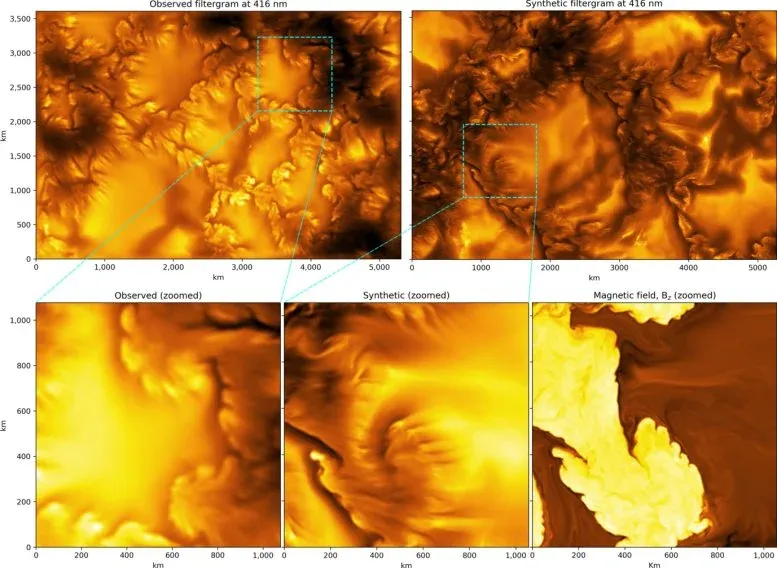
These plasma vortices were seen using the NSF Daniel K. Inouye Solar Telescope in Hawaii. This is the world's largest solar telescope. The observations were combined with advanced computer simulations.
The research involved scientists from the U.S. National Science Foundation National Solar Observatory (NSF NSO), the Max Planck Institute for Solar System Research (MPS) in Germany, and the High Altitude Observatory (HAO) in the USA.
We're a new kind of news feed.
Regular news is designed to drain you. We're a non-profit built to restore you. Every story we publish is scored for impact, progress, and hope.
Start Your News DetoxSeeing the Tiny Vortices
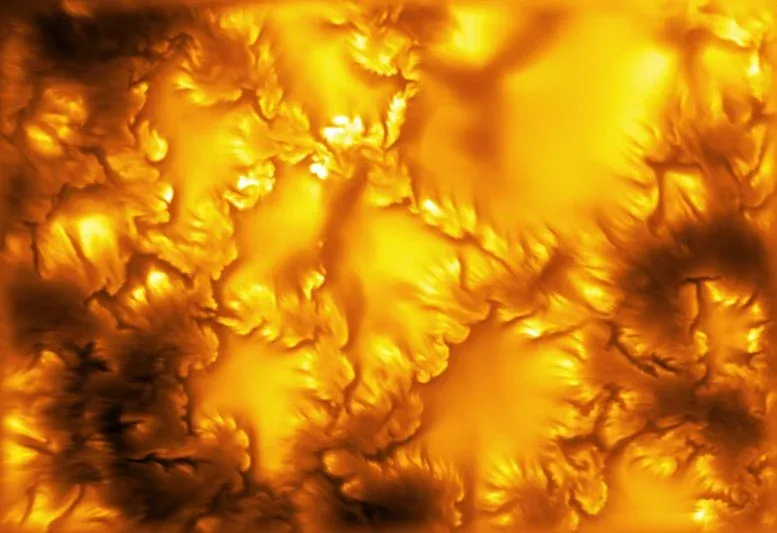
To see these structures, researchers needed to resolve features only about 20 kilometers (about 12 miles) wide. This is like spotting a one-euro coin from 180 kilometers (about 112 miles) away. They used a special broadband imaging camera from MPS. MPS scientist Michiel van Noort helped with the observations and image processing.
Van Noort explained that detecting these vortices pushed the limits of what the largest solar telescope and advanced simulations can achieve.
These new structures form along the boundaries of "granules." Granules are features that cover the Sun's surface, ranging from 500 to 2,000 kilometers (about 310 to 1,240 miles) wide. They create the pattern called solar granulation.
Granulation happens because plasma moves from the Sun's hot inside. It rises to the surface, cools down, and then sinks again. At the edges of these granules, researchers saw delicate fringes that curl like breaking ocean waves.
Scientists believe these swirling patterns are Kelvin-Helmholtz instabilities. These happen when nearby fluids move at different speeds, creating forces along their boundary. This can lead to waves or vortices.
This same process happens in many places, like lake surfaces, ocean waves, and even in the atmospheres of Jupiter and Saturn. On the Sun, plasma layers at the granule boundaries move at different speeds, creating these instabilities.
How Vortices Affect the Sun's Magnetic Field
These tiny vortices might help answer a big question: how does the Sun store and release energy in its magnetic field? Sometimes this energy is released in small bursts called nanoflares.
The current idea is that magnetic energy builds up as magnetic field lines twist, like a tightly wound spring. When enough energy is stored, the magnetic setup becomes unstable. This energy can then escape through "magnetic reconnection," where twisted magnetic field lines break and reconnect in a new way.
What wasn't clear was what causes these magnetic field lines to twist repeatedly. The newly seen vortices could be part of the answer. Since they appear continuously where the magnetic field is strong, the swirling plasma might regularly cause this twisting.
The analysis also shows that these small vortices effectively mix magnetized plasma with unmagnetized plasma on the Sun's surface. This mixing could help magnetic fields move quickly into the solar atmosphere.
This is important because the Sun's magnetic activity changes over an eleven-year cycle, which is very fast for cosmic timescales. For its magnetic structure to change so quickly, magnetic flux must move efficiently through the atmosphere.
Existing models have struggled to explain such fast movement. These new vortices offer a possible way that magnetic flux could move away from the surface fast enough to support these changes.
Sami K. Solanki, director of the MPS, noted that these newly found plasma vortices show how tiny processes, even those at the edge of what we can observe, significantly shape our star.
Deep Dive & References
Ubiquitous Kelvin–Helmholtz instabilities driving plasma mixing on the Sun - Nature, 2026