Dark markings on Pluto's giant heart-shaped glacier might mean something surprising is happening beneath its frozen surface. Scientists believe liquid nitrogen could be rising through cracks and briefly flowing across the ice. This would be the first sign of liquid flowing on Pluto right now.
This discovery comes from a new study led by the Southwest Research Institute (SwRI). Researchers used images from NASA's New Horizons spacecraft to find this evidence.
Pluto's Surprising Glacier
Sputnik Planitia is the western part of Pluto's famous heart shape. It's a huge glacier made mostly of frozen nitrogen, bigger than Texas and Oklahoma combined. Images from New Horizons in 2015 and 2016 showed city-sized patterns across its northern areas. These patterns were separated by thin dark lines and wider dark patches.
We're a new kind of news feed.
Regular news is designed to drain you. We're a non-profit built to restore you. Every story we publish is scored for impact, progress, and hope.
Start Your News DetoxA new analysis suggests these markings might form when liquid nitrogen periodically reaches and wets the surface. The findings were published in The Planetary Science Journal.
Dr. Alan Stern, the lead author and principal investigator of the New Horizons mission, said Pluto keeps surprising them. He noted that this suggests liquids have recently appeared on Pluto's surface and points to a new type of changing feature on the dwarf planet.
Dark Streaks Point to Subsurface Liquid
Pluto's atmosphere and surface conditions make liquid nitrogen rain impossible. However, the dark patterns on northern Sputnik Planitia look like features on Earth's glaciers. These features on Earth are wetted by rainwater or by liquid coming from beneath the surface.
To check this similarity, researchers compared New Horizons observations with NASA Landsat 9 images of icy places on Earth, like Greenland's ice sheet. On Earth, narrow dark features appear where liquid water reaches snow and ice.
The similar structures on Sputnik Planitia are very striking. This suggests that nitrogen might be moving up from under the glacier, temporarily wetting its frozen surface.
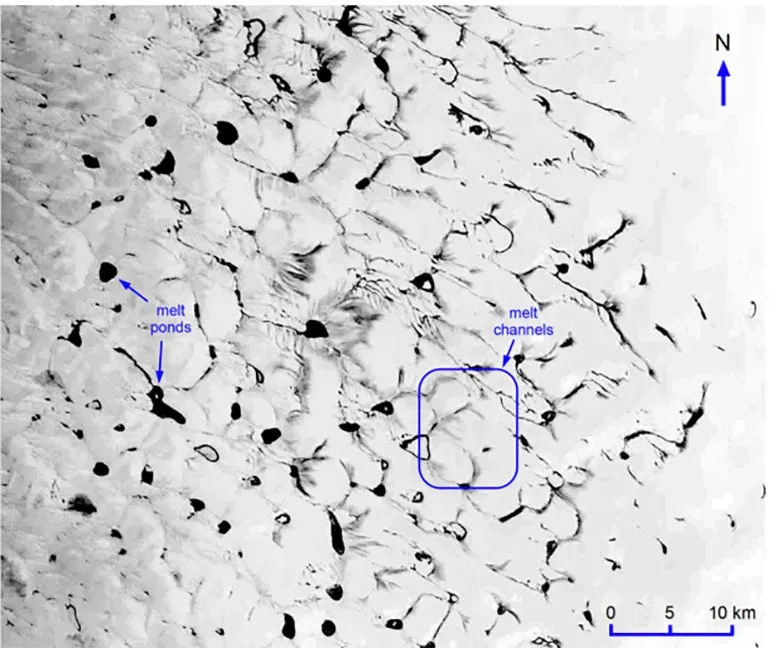
Dr. Kelsi Singer, a co-author from SwRI, explained that Sputnik Planitia's surface is very young, likely less than one million years old. This means the features must have formed recently. She added that Pluto has many unique terrains, and this area helps scientists understand how materials behave in extreme environments.
How Nitrogen Could Rise
Earlier studies had suggested ancient times when liquid flowed on Pluto. This new analysis, however, points to liquid nitrogen possibly existing beneath Sputnik Planitia now, or very recently.
Computer simulations by Dr. Orkan Umurhan, a senior research scientist at the SETI Institute, offer a possible explanation. The models show that nitrogen ice deep beneath Sputnik Planitia, which is several kilometers thick, can melt at the base of the glacier. This melting produces liquid nitrogen.
The simulations also suggest that buoyancy or pressure from below could push this liquid upward through narrow channels, like lava or geyser tubes. Once it reaches the surface, the nitrogen might stay liquid long enough to flow downhill across the glacier. This would wet the ice and create the dark markings seen by New Horizons.
Umurhan believes these findings are a strong reason to study solid nitrogen physics at very low temperatures. He emphasized the importance of examining how solid nitrogen materials behave under stress and strain, which can cause them to melt. These processes have not been studied in detail in labs.
Much of Pluto Remains Unexplored
Currently, no other region of Pluto shows similar signs of liquid rising from beneath a glacier. However, more than half of the dwarf planet has not yet been mapped in high detail. This means similar features could exist elsewhere but haven't been seen clearly.
This same process of melting and upward liquid movement might also explain activity elsewhere in the solar system. This includes the geysers seen by NASA’s Voyager 2 on Neptune’s moon Triton.
More detailed mapping of Pluto and other worlds in the Kuiper Belt will be needed to confirm if similar processes happen beyond Sputnik Planitia.
Deep Dive & References
Evidence for Possible N2 Basal Flow beneath Pluto’s Northern Sputnik Planitia - The Planetary Science Journal, 2026