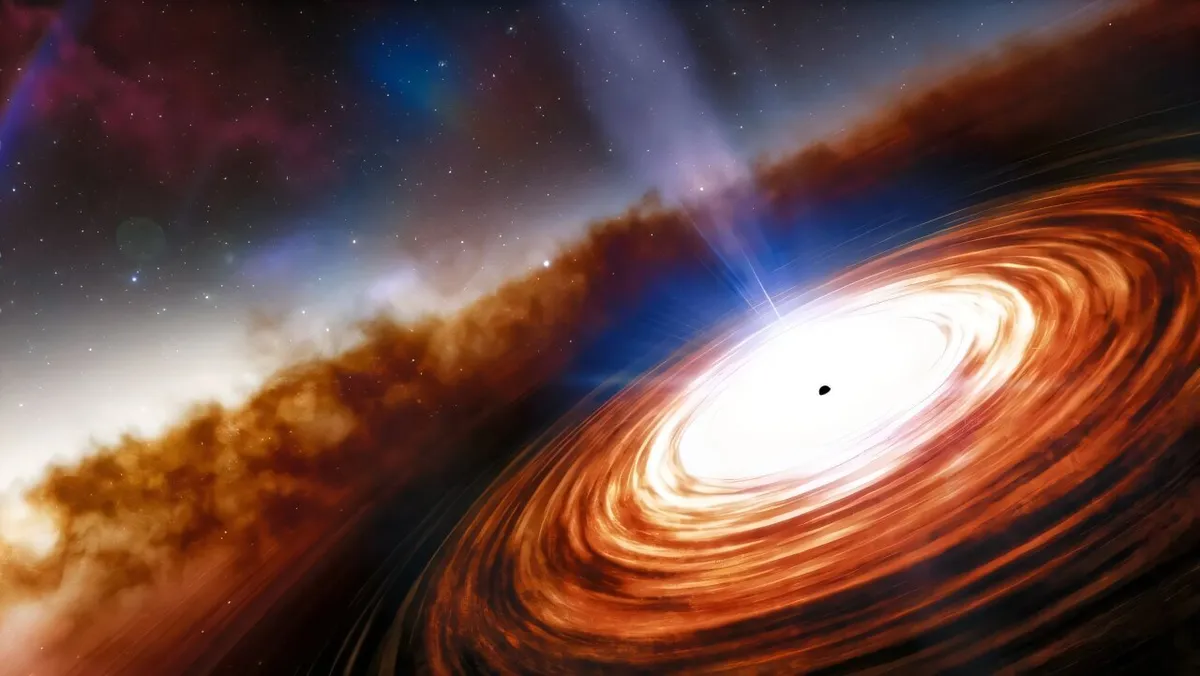
The James Webb Space Telescope (JWST) found supermassive black holes (SMBH) in the early universe that seemed too big. These black holes existed when the universe was only about 2 billion years old. Scientists thought they didn't have enough time to grow so massive.
This led to two main ideas. Either our understanding of the early universe is wrong, or the JWST observations were misleading. New research suggests the latter.
Re-evaluating Early Black Holes
A new study in The Astrophysical Journal suggests that these "overmassive black holes" (OBH) might be due to how they were observed. Madisyn Brooks, a Ph.D. student at the University of Connecticut, led this research.
We're a new kind of news feed.
Regular news is designed to drain you. We're a non-profit built to restore you. Every story we publish is scored for impact, progress, and hope.
Start Your News DetoxThe authors explain that JWST has found many active galactic nuclei (AGN) in the early universe. These black holes seemed much more massive than expected compared to their host galaxies.
In our local universe, a black hole's mass is usually about 0.1% of its galaxy's stellar mass. But JWST found early galaxies where the black hole was 10 to 100 times "too massive" for its galaxy. This led to the idea of "heavy seeds" for black holes.
However, the new research points out a problem: selection bias. JWST surveys can only detect the brightest AGN. These are rare and might not represent the typical black hole population.
A New Approach to Observation
To get a clearer picture, the researchers used a technique called "stacking analysis." They combined the light spectra from 2,000 galaxies across four JWST surveys: CEERS, JADES, RUBIES, and GLASS. Stacking helps to average out noise and reveal signals that might be missed in individual observations.
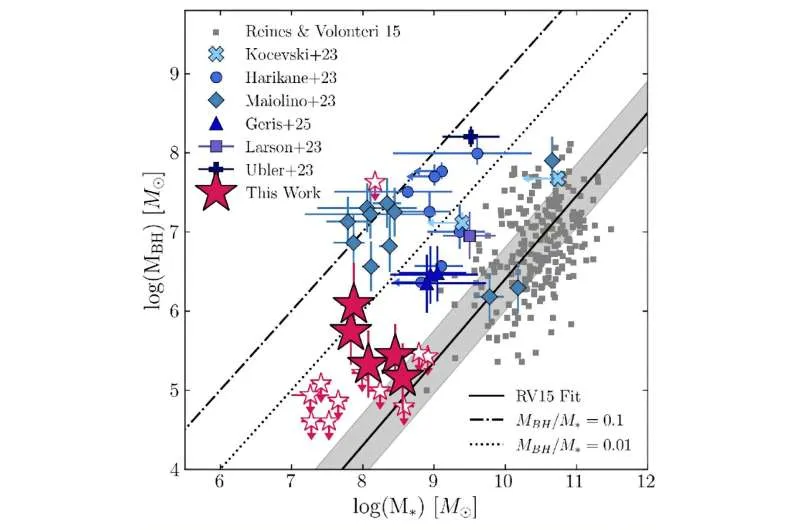 Caption: This figure from the research illustrates some of the findings. It shows BH mass as a function of stellar mass. Red open and filled stars are from this work. Stacks with detected broad Hα emission are shown with red filled stars, and 3σ BH mass upper limits are shown with red open stars. Grey squares are local AGN. Other markers are from previous research, and the JWST's observations of OBHs in the early universe. The MBH–M relation in the local Universe is shown by the solid black line. The results show that early universe OBHs are not really that overmassive and are closer to the relation in the local Universe. Credit: Madisyn Brooks et al 2026 The Astrophysical Journal*
Their findings suggest that individual detections of AGN tend to show the most extreme cases. By stacking data from "normal" galaxies, they found that the average black hole in the early universe was at most 10 times more massive than its host galaxy. This is much closer to what we see in the local universe.
If this research is correct, there's no need for "heavy seeds" to explain these early black holes. They can be explained by "light stellar-remnant seeds" growing at a moderate rate.
Deep Dive & References
Beyond the Monsters: A More Complete Census of Black Hole Activity at Cosmic Dawn - The Astrophysical Journal, 2026