Astronomers have witnessed a star's death almost as it began. They caught a rare X-ray flash from a supernova erupting 500 million light-years away.
Usually, supernovae are found after the explosion is already well underway. But SN 2026gzf was different.
On March 21, 2026, the Einstein Probe detected a quick pulse of soft X-rays. This signal, EP260321a, lasted only a short time. It seemed to capture the exact moment an explosion broke through the surface of a dying star.
We're a new kind of news feed.
Regular news is designed to drain you. We're a non-profit built to restore you. Every story we publish is scored for impact, progress, and hope.
Start Your News DetoxCatching a Star's First Flash
Less than an hour later, telescopes on Earth were already watching the same area. They saw a supernova quickly getting brighter. This alone was unusual.
The explosion looked like a powerful supernova. These are often linked to gamma-ray bursts and jets of matter moving almost at the speed of light. However, astronomers found neither of these with SN 2026gzf.
Two separate teams studied the event. Brendan O’Connor from Carnegie Mellon University led one, and Jillian Rastinejad from the University of Maryland, College Park, led the other. Their findings, published in The Astrophysical Journal Letters, give a very detailed look at the explosion and the star's final turbulent stages.
Both teams identified EP260321a as a "shock breakout." This is when the powerful shock wave from a stellar explosion bursts through the star's surface. It releases the first light of a supernova.
A shock breakout is the supernova's opening flash. After a massive star's core collapses, a huge shock wave moves outward. When it reaches the surface, radiation suddenly escapes into space.
Shock breakouts are only visible for seconds to hours. The optical supernova that follows can shine for weeks or months. This means astronomers have a much larger window to find the later explosion than its first flash.
A Rare X-Ray Signal
This explains why clear detections are so rare. In the last two decades, only one other X-ray shock breakout has been confirmed.
EP260321a was even more valuable. Astronomers detected the opening X-ray flash. Then, they followed the same explosion across many wavelengths as the supernova developed.
The supernova itself, SN 2026gzf, was a broad-lined Type Ic (Ic-BL) supernova.
Type Ic supernovae come from stars that have already lost their outer hydrogen and helium layers before exploding. The "broad-lined" part means their spectra show unusually wide features. These are caused by material expanding at incredible speeds.
Ic-BL explosions are interesting because some are linked to gamma-ray bursts. These are extremely powerful flashes of high-energy radiation. In these cases, the collapsing star can launch narrow jets that move almost at the speed of light.
SN 2026gzf seemed to fit this family, but a key piece was missing. Despite the supernova looking like energetic Ic-BL explosions linked to gamma-ray bursts, sensitive searches found no gamma-ray burst, relativistic jet, or lingering afterglow.
The Mystery of the Missing Gamma-Ray Burst
Its X-ray shock breakout was also the faintest ever seen with an Ic-BL supernova. However, the supernova itself was not weak. This combination challenges the idea that similar energetic stellar explosions always produce similar results.
O’Connor noted that SN 2026gzf looks very much like other energetic supernovae previously linked to gamma-ray bursts. Yet, follow-up observations found no evidence for a relativistic jet or an afterglow. These are usually seen in such events.
One idea is that the jet was "choked." This means it started forming deep inside the star but failed to escape. If so, much of its energy would stay trapped instead of creating a bright gamma-ray signal.
Clues from the Star Before It Died
The observations also reveal what the star was doing before it died. Rastinejad’s team believes the star was a Wolf-Rayet star. It was born with about 20 times the mass of the Sun.
Wolf-Rayet stars are a late stage in the lives of some massive stars. They are very hot and can lose huge amounts of material before they finally collapse.
For SN 2026gzf, the star seems to have lost mass in irregular bursts. This removed all its hydrogen and helium. By the time it exploded, what was left was a stripped star made mostly of carbon and oxygen.
The material it expelled did not just disappear. It gathered around the star, creating a physical record of its final years.
Researchers found at least two distinct structures. A small, low-mass shell close to the star created the initial X-ray signal. A larger, non-symmetric shell farther out contributed to the optical light seen as the supernova expanded.
Rastinejad explained that their observations allowed them to study the X-ray shock breakout, the supernova, and how the supernova interacted with material the dying star had previously shed. This information helped them map the material around the star and understand its violent life before it collapsed.
This surrounding debris is important. Astronomers cannot directly watch the final centuries of a star hundreds of millions of light-years away. The material it sheds before death acts as a fossil record of its behavior.
For SN 2026gzf, this record points to an unstable and violent end. Gokul Srinivasaragavan, a member of Rastinejad’s team, said this is the first time they have mapped the environment of a star stripped of hydrogen and helium before it exploded. He is excited to observe more shock breakout events in similar detail to see if all stripped stars have a similar "lifestyle" before collapsing.
Finding the Star in Old Images
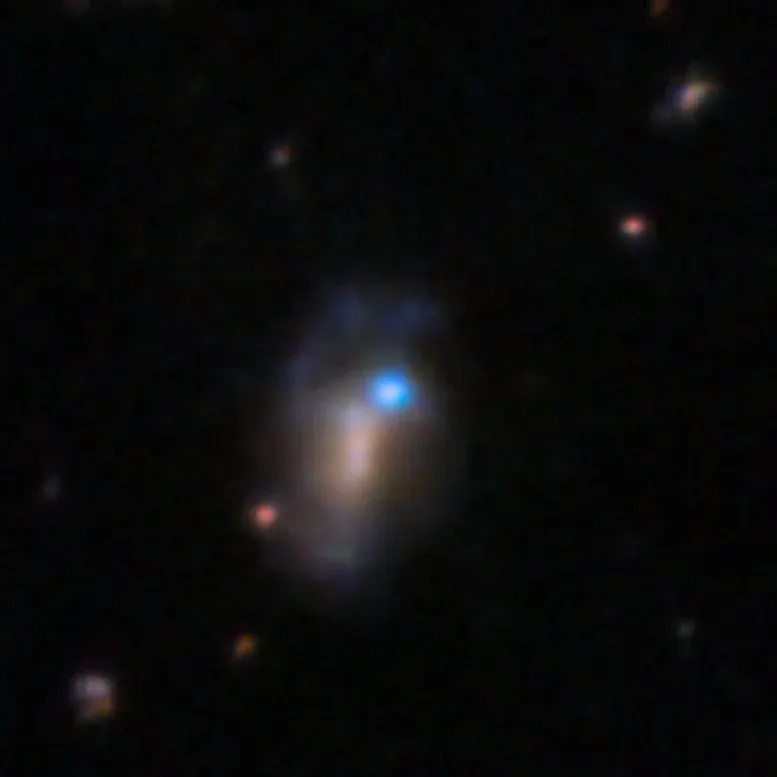
Researchers got a rare bonus when they looked at older observations of the galaxy. Images taken with the Dark Energy Camera (DECam) about 10 years before the explosion showed a blue source at the same location.
These old images provide a glimpse of the star system before the supernova. This allows astronomers to compare the system before and after the star's destruction.
O’Connor’s team also used DECam on the NSF Víctor M. Blanco 4-meter Telescope in Chile. They followed the supernova as it brightened to its maximum.
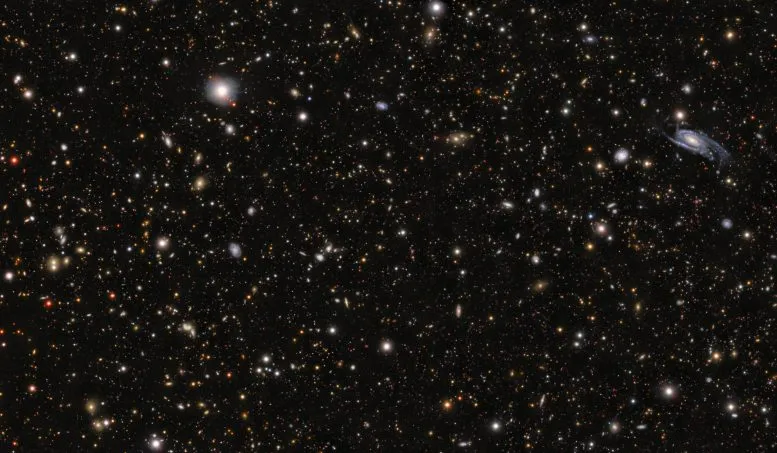
Another lucky break was that SN 2026gzf was in the NSF–DOE Vera C. Rubin Observatory’s COSMOS Deep Drilling Field. This area is designed for repeated, sensitive observations.
Public data from the Rubin alert broker Babamul helped track the supernova across many wavelengths. The observations also showed signs that the star system had been active shortly before the explosion. This is very valuable for astronomers trying to link a star's final behavior to the type of explosion it produces.
The Rubin Observatory is expected to keep observing the region. This could give researchers a years-long record of how the fading supernova and its surroundings change.
A Global Network of Telescopes
No single observatory could have reconstructed the entire event. The Dark Energy Spectroscopic Instrument (DESI) on the NSF Nicholas U. Mayall 4-meter Telescope obtained repeated spectra.
DESI normally observes many targets at once using thousands of optical fibers. Fibers not used for the main survey can be directed toward transient objects like supernovae. This turns unused observing capacity into a way to track rapidly changing events.
These repeated spectra allowed astronomers to watch SN 2026gzf change. They also helped classify it as an Ic-BL supernova.
Xander Hall, a graduate student on O’Connor’s team, noted that DESI’s spare-fiber program allowed them to return to SN 2026gzf repeatedly. They followed how its spectrum changed as the explosion evolved. This shows the power of using DESI’s spare fibers for quick follow-up and classification as Rubin increases its transient alert stream.
O’Connor’s group also used NASA’s Chandra X-ray Observatory, the National Radio Astronomy Observatory’s Very Large Array (VLA), Wendelstein Observatory, Palomar Observatory, the Hobby-Eberly Telescope, and the Southern African Large Telescope (SALT).
Rastinejad’s team gathered observations from Gemini North in Hawai‘i, Gemini South and the SOAR Telescope in Chile, Rubin Observatory, Palomar Observatory, and the VLA. These measurements covered wavelengths from X-rays to radio emission. They helped rule out a relativistic jet.
This broad coverage shows a big change in how astronomers study fleeting cosmic events. A space telescope can find something that lasts only minutes. Automated alerts can spread the news almost instantly. Then, telescopes on several continents can start gathering observations before the object changes dramatically.
For phenomena like shock breakouts, this speed can decide whether scientists witness the critical first stage or miss it forever.
A Powerful Explosion Without the Expected Afterglow
EP260321a and SN 2026gzf are unusual among stellar explosions. The event had a very faint X-ray shock breakout and no detected relativistic outflow. Yet, the supernova itself resembled the energetic Ic-BL explosions linked to some gamma-ray bursts.
This makes it a possible link between ordinary supernova shock breakouts and the more extreme stellar deaths that create low-luminosity gamma-ray bursts. More importantly, it suggests that an energetic Ic-BL supernova does not automatically mean a successful relativistic jet, gamma-ray burst, or long-lasting afterglow.
Deep Dive & References
- EP260321a/SN 2026gzf: The Faintest Shock Breakout Associated with a Broad-lined Supernova - The Astrophysical Journal Letters, 2026
- A Multi-Wavelength View of the First Type Ic-BL Supernova with an Einstein Probe X-ray Shock Breakout - arXiv, 2026