Our brains are pretty good at turning two flat images into a sense of depth. Three dimensions? We got this. But when you’re trying to understand the incredibly complex, multi-layered dance happening inside a cell, your natural 3D vision suddenly feels a bit…limited.
Enter the world of data scientists and AI, because apparently, that’s where we are now. Kevin Moon, director of Utah State University’s Data Science and Artificial Intelligence Center, points out that biological processes are a prime example of this data overload. Imagine trying to track hundreds of thousands of data points about how multiple sclerosis progresses at a cellular level, factoring in treatments and their results. Your brain just called in sick.
The AI That Finds What We Miss
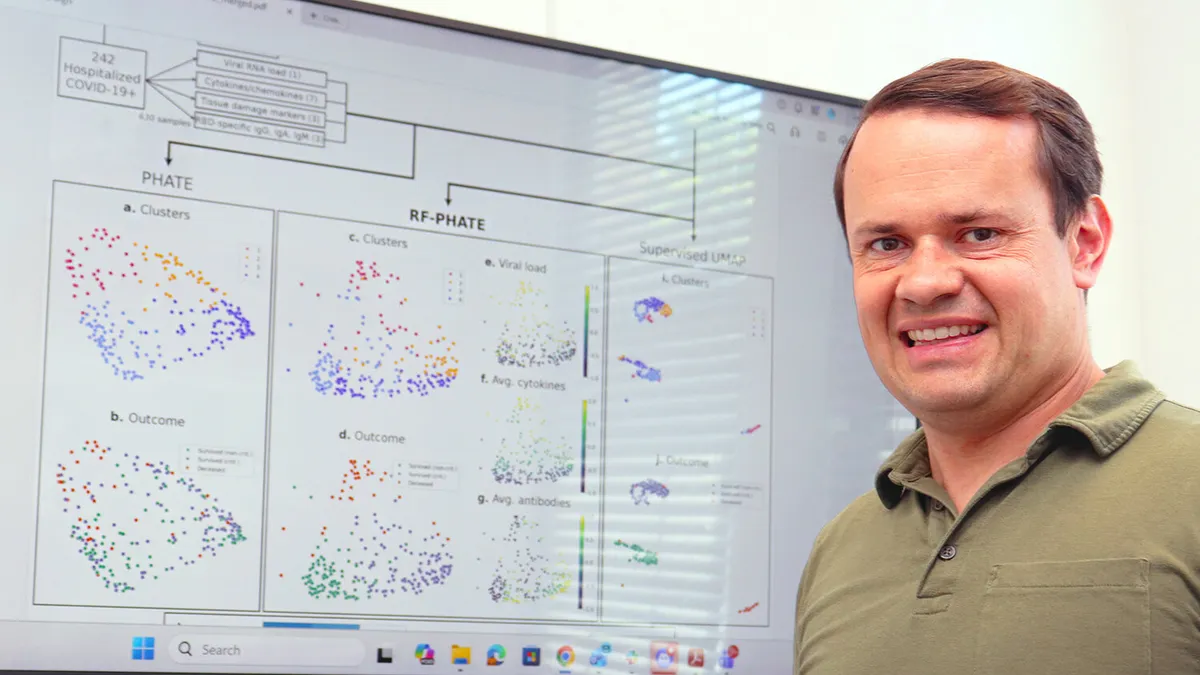
Moon and his team have been busy testing a new AI tool, RF-PHATE, designed to tackle exactly this kind of microscopic chaos. Published in Nature Computational Science, their paper, “Gaining Biological Insights through Supervised Data Visualization,” introduces a method that helps researchers actually see the important relationships hidden within these vast, complex datasets.
We're a new kind of news feed.
Regular news is designed to drain you. We're a non-profit built to restore you. Every story we publish is scored for impact, progress, and hope.
Start Your News DetoxMoon, along with lead author Jake Rhodes from Brigham Young University, and a crew of other experts from USU and beyond, have basically built a super-powered microscope for data. One that doesn't just show you what's there, but how it's all connected.
Older visualization methods, Moon explains, had a habit of either making differences between data groups seem too extreme or completely missing how those groups actually related to each other. It’s like looking at a crowd and only seeing individuals, not the conversations happening between them.
RF-PHATE, however, manages to preserve these crucial relationships. The team proved its mettle by using it to find evidence of a previously suspected subtype of multiple sclerosis. Finding these subtypes is a big deal, because MS affects everyone differently. Knowing the specific flavor helps doctors tailor treatments, rather than just throwing spaghetti at the wall.
Beyond the Biology Lab
While RF-PHATE was busy uncovering MS mysteries, it also got a workout with COVID-19 patient plasma data and lung cancer cell data. But Moon says its potential reaches far beyond biology. It could help make other AI models more understandable (a feat in itself) and even analyze how those models work. Because, as it turns out, even AI needs a little self-reflection sometimes.
Moon’s team is all in on “AI for Science,” a global push to use AI and machine learning to supercharge research and make sense of massive datasets. Because when it comes to understanding the universe, big or small, sometimes you need a little digital help to see the full picture.