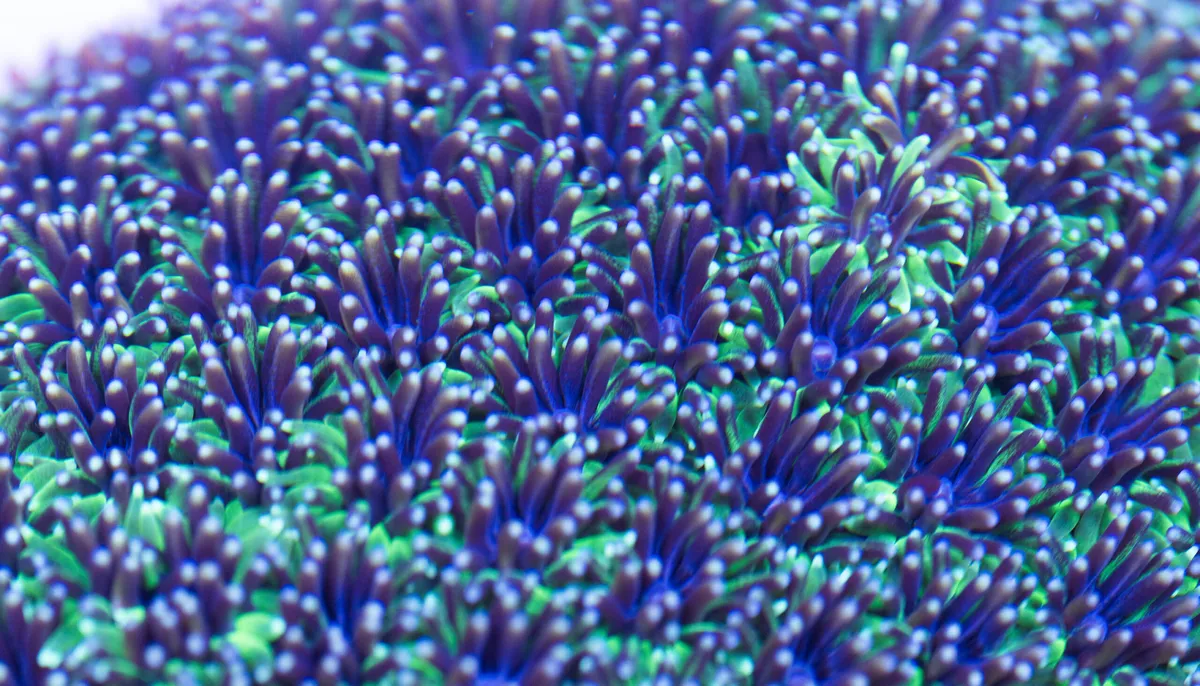
Tropical reefs grew large because algae moved into coral cells. These algae gave corals lots of food. This allowed corals to build huge communities in shallow waters.
But warming oceans are causing algae to leave corals. This is called bleaching. It turns lively reefs into empty places.
How Algae Live Inside Coral
Researchers at UC Berkeley have found a key answer: How do algae live inside coral cells? This discovery could help us understand why algae and coral are struggling. It might also show ways to bring them back together and save reefs.
We're a new kind of news feed.
Regular news is designed to drain you. We're a non-profit built to restore you. Every story we publish is scored for impact, progress, and hope.
Start Your News DetoxThe findings come from experiments in Phillip Cleves' lab at Berkeley. Cleves is an assistant professor of molecular and cell biology. He built a special saltwater nursery for coral.
On Australia's Great Barrier Reef, corals usually spawn once a year. This happens in October or November around the full moon. This limited spawning makes it hard to study the genes of coral and algae. It also makes it difficult to understand how they react to heat stress.
Cleves and his team can now make different groups of corals spawn all year. This gives them many chances to do genetic experiments.
The researchers used genetic changes in lab-grown corals and anemones. Anemones also host algae. They are challenging an old idea that corals absorbed algae into special cell parts called symbiosomes. Symbiosomes are like mitochondria, which power cells, and chloroplasts, which help plants make food. Both were once independent organisms that became essential parts of cells.
Cleves now suggests that algae acted like parasites. They found a way to live unharmed inside lysosomes. Lysosomes are cell parts that usually digest food and invaders.
Inside the lysosome, algae learned to take carbon from the coral cell. Then, they release sugars from photosynthesis to feed the coral. This benefits both the algae and the coral. It also helps other animals that host symbiotic algae.
In a paper published in Cell, Cleves and his team shared their findings. Their experiments show that symbiosomes form by joining with lysosomes. The algae have evolved to resist the digestive enzymes in the lysosome.
Cleves explained, "Parasites trick cells to do what they want. That's what I think is happening here." He added, "The algae are taking over the cell's nutrient centers. They act like food that never gets digested because they can make glucose from photosynthesis. I think about it as an everlasting gobstopper."
He noted that the line between a parasite (which harms its host) and a symbiont (which lives with its host for mutual benefit) can be blurry. The coral-algae relationship might be a new type of symbiosis. It involves taking over a cell part.
"It's good for the coral, it's good for the algae, so it's symbiosis," he said. "But I think it's basically repurposing the entire cell and taking over that nutrient center."
Algae's Adaptability
Shumpei Maruyama, a postdoctoral fellow at Berkeley, and Catherine Henderson, a doctoral student at Carnegie Science, led genetic experiments. They found at least 200 proteins on the symbiosome membrane where algae live. One protein moves bicarbonate. This bicarbonate turns into carbon dioxide inside the symbiosome. This might explain how algae get the carbon dioxide they need for photosynthesis, even while isolated inside a cell.
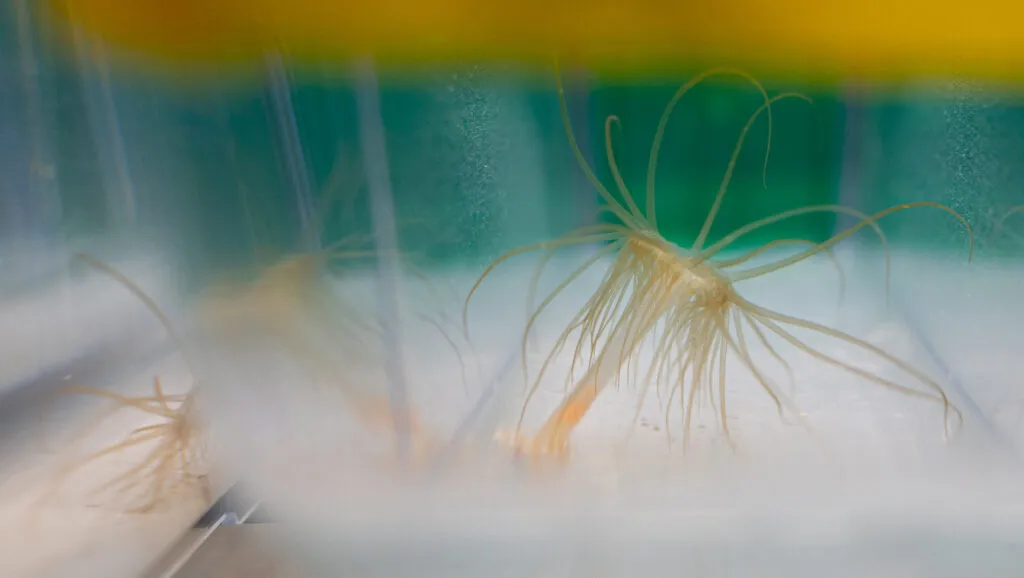 A half-inch-long anemone, Aiptasia, in a saltwater tank at UC Berkeley. The animals are used in genetic experiments to discover how algae form symbiotic relationships with a range of animals, from corals and anemones to jellyfish. Image: Brandon Sanchez Mejia for UC Berkeley
Maruyama said, "By doing a CRISPR knockout in the coral Galaxea fascicularis, we've shown that this bicarbonate transporter is required for symbiosis."
Cleves is now studying what other symbiosomal proteins do. He hopes to find out how heat stress breaks this relationship, causing coral to lose their algae. He is also looking into how these proteins help algae and coral cells communicate.
"Our overall research goal is to understand symbiosis and also to understand why corals bleach," he said. "We are now showing that the symbiosome is actually a type of phagolysosome, which is profound. We think that this hijacking of the phagolysosome tells us how these algae are so promiscuous at evolving new symbioses with coral, anemones, jellyfish, clams and even flatworms."
A Special Coral Nursery
In the basement of Berkeley’s Koshland Hall, Cleves showed off his unique coral nursery. He and lab manager Natalie Swinhoe designed it. It uses filters to clean city water. This water is then mixed with salt from the Red Sea in three large tanks.
This recreated seawater flows into brightly lit trays of Galaxea fascicularis coral. This is a reef-building species from the Pacific Ocean. Smaller basins hold Aiptasia, which are small anemones. This lab is the only one on campus with seawater on tap.
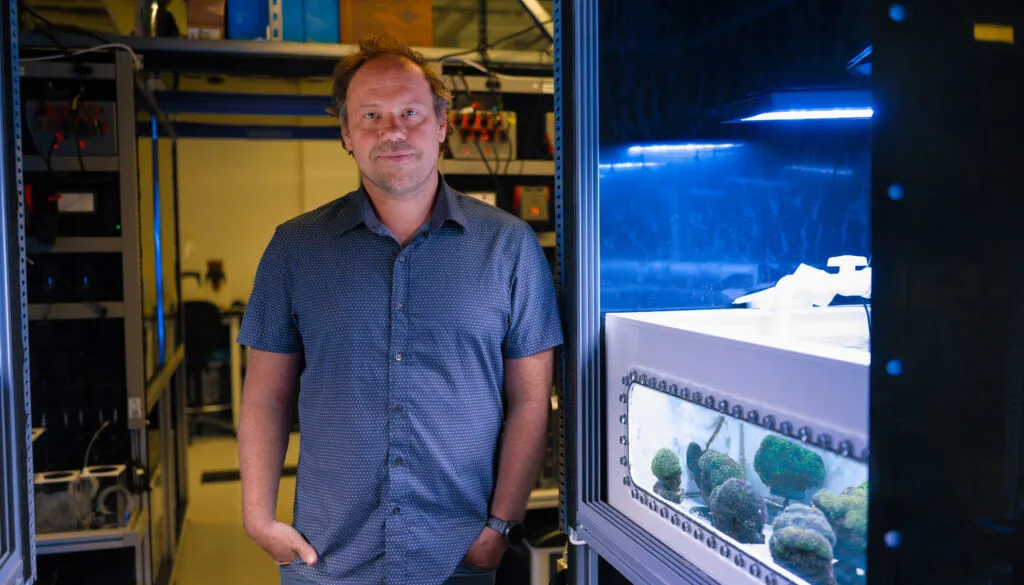 Phillip Cleves, assistant professor of molecular and cell biology, standing next to one of the saltwater aquaria in which he raises coral that spawn throughout the year. Image: Brandon Sanchez Mejia for UC Berkeley
Cleves spent years perfecting a way to make his lab corals spawn all year. Before, he had to travel to Australia for yearly genetic experiments. After other researchers learned to raise coral in the lab, Cleves decided to build his own nursery. He found that by slowly changing light cycles and temperature, he could shift the corals' spawning schedule.
Over two years, the corals fully adjust. His Berkeley lab now has six tanks of coral that spawn at different times. This gives six chances each year to do genetic experiments on coral eggs.
"Our big advance here is that we’re coupling the technology to spawn the animals with our ability to genetically engineer them," he said. "It really allows us to study gene function for the first time, to study coral-algal symbiosis, bleaching and heat tolerance. We have developed a variety of genetic tools: we can do CRISPR, we can do plasmid transgenesis, we can do RNAi knockdown. The paper is the first time we’re showcasing the powerful insights that can be made with these new technologies."
While spawning every few months is good for lab corals, Cleves uses Aiptasia for daily experiments. These anemones spawn every week and also host algae.
Cell Communication
The researchers first isolated the symbiosome membrane in Aiptasia. They identified about 200 proteins, many also found in the anemone's lysosome. By reducing some of these proteins using RNA interference (RNAi), Cleves and his team showed that many lysosomal proteins in the symbiosome are needed for algae to live inside these organelles.
These proteins include ones that move molecules in and out of the symbiosome and break down other proteins.
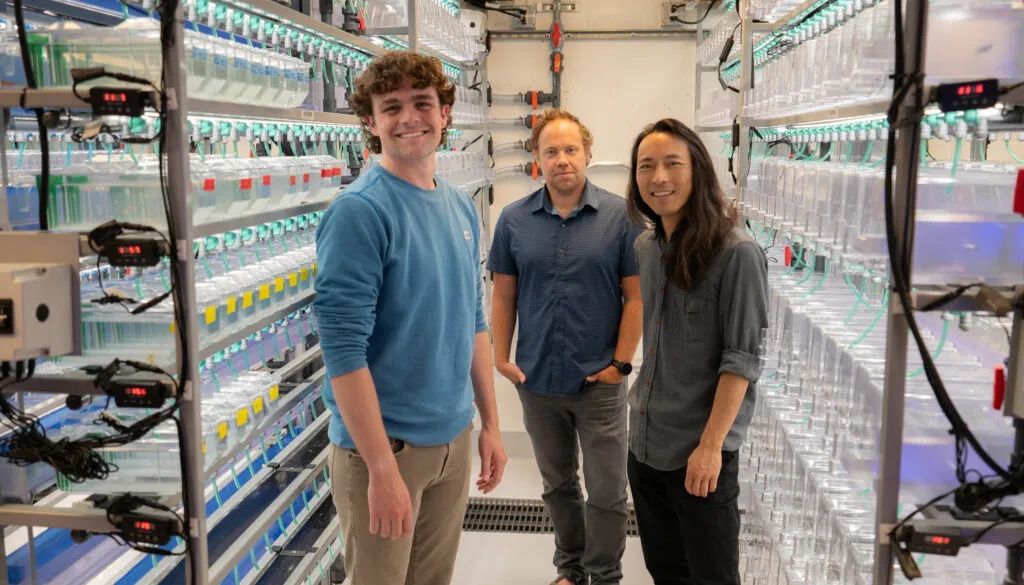 Phillip Cleves (center), postdoctoral fellow Shumpei Maruyama (right) and research technician Ty Engelke pose between ranks of saltwater tanks containing anemones, Aiptasia. Image: Brandon Sanchez Mejia for UC Berkeley
Cleves explained, "There are several vesicle trafficking proteins that we think are actually how the animal and the algae communicate, because they are trafficking cargo on and off the symbiosome, bringing stuff to the algae." He added, "We found a huge diversity of transporters that are predicted to transport everything from lipids to ammonium to neurotransmitters to histidine, as well as bicarbonate. And the most paradoxical thing of all was that we found a huge diversity of lysosomal proteases — these proteins usually eat up the contents of the lysosome to scavenge food to fuel the (coral) cell."
The lead authors then used CRISPR to change the bicarbonate transporter in coral. This change disrupted the algal symbiosis, showing how important it is for giving carbon to coral algae.
Cleves believes that the ability of dinoflagellates (a family of algae called Symbiodiniaceae) to survive inside cell "stomachs" explains their success. They have colonized many marine creatures. Since lysosomes are found in all animals and have been conserved through evolution, the algae can likely take over these parts in many hosts to form new symbioses.
"If evolving a new symbiosis is as simple as resisting lysosomal digestion, we should be able to have the algae persist inside lysosomes in other organisms, because much of the machinery is conserved," he said.
This work helps us understand how corals and algae work together when conditions are good. It might also explain coral bleaching.
"We think dysfunction of the symbiosomal proteins might be related to the breakdown of symbiosis," Cleves said. "So we’re now analyzing how the proteome shifts during heat stress to try to understand how this organelle changes during bleaching."
Deep Dive & References
Symbiosome formation by lysosome hijacking in cnidarian-algal symbiosis - Cell, 2026