Mars rovers have a tough gig. They're basically high-tech Tonka trucks trying to navigate a galactic sandbox, often getting stuck in the fine, loose stuff. It's a problem that's plagued more than a few missions, turning multi-million dollar machines into very expensive, very stationary paperweights.
But what if a rover didn't just roll? What if it swam?
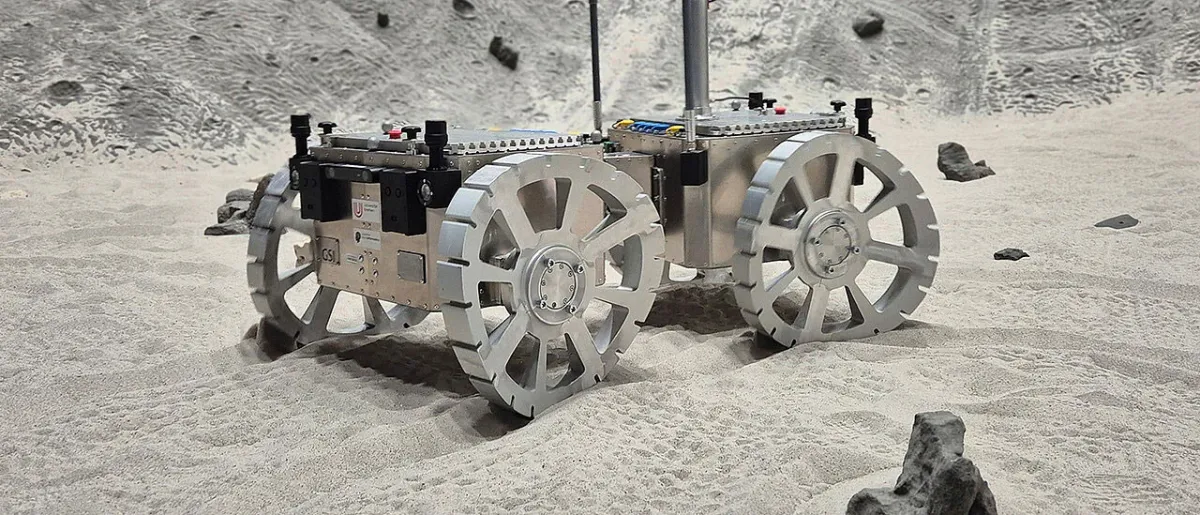
Enter the sandfish lizard (Scincus scincus), a small desert reptile that dives headfirst into sand to escape predators and hunt. Scientists have finally cracked the code of its subterranean shuffle, and now, a team at the University of Würzburg in Germany has used those insights to build a new kind of Mars rover wheel.
Imagine your car tires, but instead of just rotating, they're also doing a little synchronized swimming motion. These bio-inspired wheels don't just roll over sand; they mimic the sandfish's interaction with the ground, generating both forward and sideways forces. The result? Wavy tracks in the sand, and a rover that actually moves.
We're a new kind of news feed.
Regular news is designed to drain you. We're a non-profit built to restore you. Every story we publish is scored for impact, progress, and hope.
Start Your News DetoxThe Lizards Are Winning
Professor Marco Schmidt and his team, alongside researchers at the German Aerospace Center’s VaMEx initiative, realized that traditional wheels often slip, sink, or get hopelessly bogged down. "Conventional wheels often slip, sink, or get stuck on soft ground," notes researcher Amenosis Lopez, stating the obvious for anyone who's ever tried to drive on a beach. So, they looked to nature.
Their initial sandfish wheels were a bit chunky, leading to sinking and slipping. Because apparently, even biomimicry has a learning curve. But after some tweaks—making the wheels wider and lighter—they reduced ground pressure, improved stability, and got the whole operation under control. Future iterations might even see surface changes for better performance across varied terrain.
Beyond the hardware, the ESSEO team plans to integrate software that understands how slipping, sinking, and wheel-to-ground interaction actually work. This intelligent mobility could allow the rover to adapt its movement strategies in real-time, making it far more reliable in granular environments.
So, the next time you see a Mars rover, don't be surprised if it looks a little less like a car and a lot more like something that just emerged from a very deep, sandy nap. Because apparently, the future of space exploration is being written by a lizard.