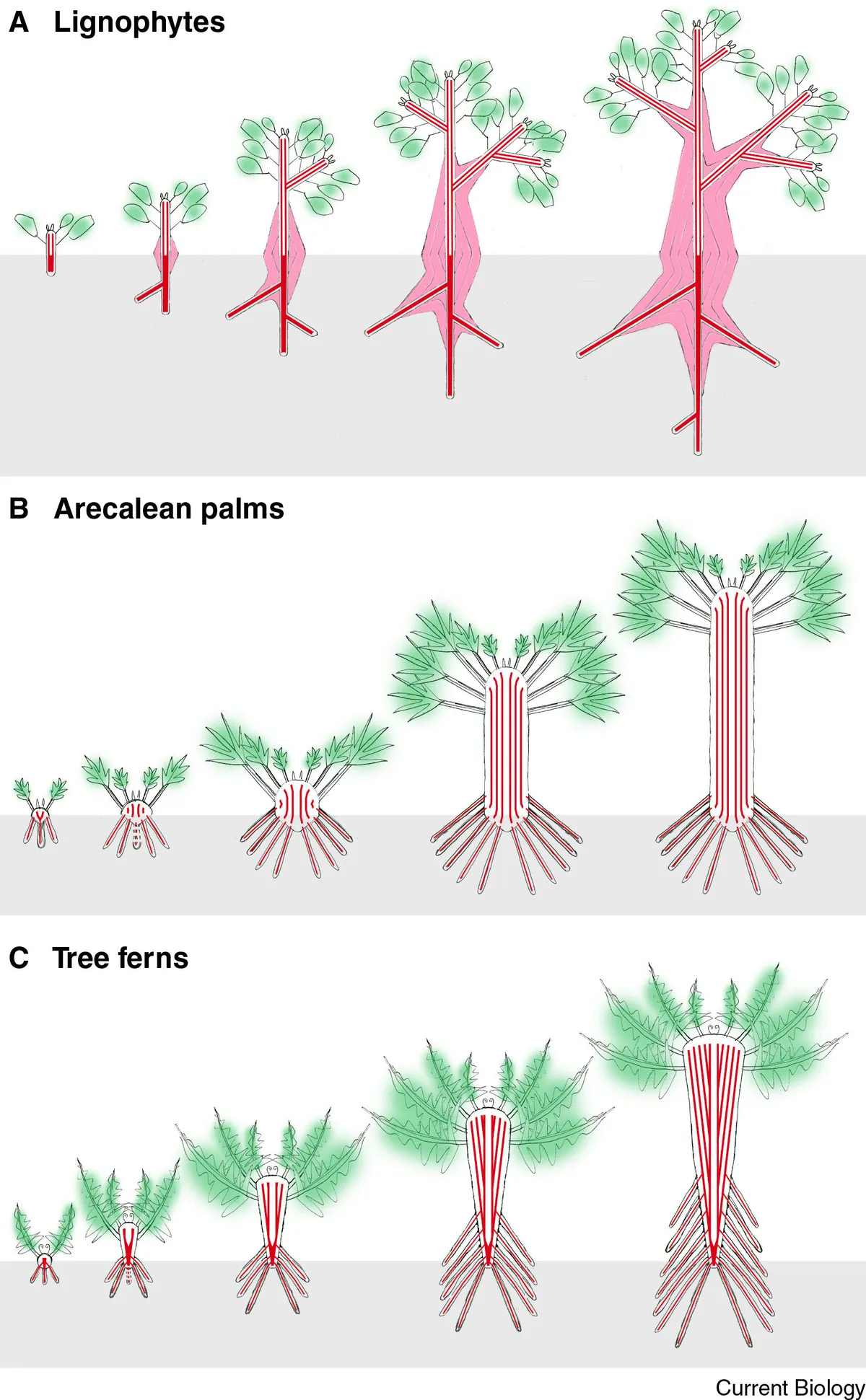
A new study is changing how we think about tree evolution. Researchers from Cal Poly Humboldt, Yale University, the University of Hohenheim, and the Czech Academy of Sciences looked into how trees became some of Earth's biggest and oldest living things.
The study, published in Current Biology, suggests that surviving drought might have been key to tree evolution. It challenges old ideas about what makes a tree a tree.
Instead of just seeing trees as plants with trunks and wood, the researchers believe a main feature is their ability to grow and replace water transport tissues throughout their lives. To become tree-like and grow taller for sunlight, they had to solve a big problem: moving water through a huge organism.
We're a new kind of news feed.
Regular news is designed to drain you. We're a non-profit built to restore you. Every story we publish is scored for impact, progress, and hope.
Start Your News DetoxWater Became the Central Challenge
To grow tall, trees must move water from their roots up to their trunks, branches, and leaves. As they got bigger, moving more water became harder, especially when water was scarce.
Xylem are tiny tubes that carry water in plants. These tubes can get blocked by air bubbles called embolisms. If these blockages spread, they can stop water flow and kill the plant. As plants developed larger water systems, they became more likely to suffer from embolisms and hydraulic failure.
But tree-like plants, the researchers suggest, started to separate these systems. This helped limit how much damage could spread.
This strategy is like a power grid with circuit breakers or a ship with watertight sections. If one part fails, the whole system doesn't shut down.
This led the researchers to a new idea. The evolution of trees might have been driven by the need to move more water through their taller bodies and survive when water transport systems failed.
A Pattern Repeated Across Tree History
"The same strategy appears again and again throughout the history of trees," explained Alexandru Tomescu. He is a botany professor and paleobotanist at Cal Poly Humboldt and a co-author of the study.
Tomescu and his team saw similar patterns in many living and fossil plants. This happened even though they evolved separately over millions of years. In each case, their water transport systems became more separated over time. This ability helps trees handle and recover from damage. It also lets them adapt to changing environments and live for decades, centuries, or even thousands of years, Tomescu noted.
"The pressures that shaped the first forests are still affecting forests today," he added. "Understanding how trees evolved to manage water stress may help us better understand how forests will respond to a changing climate."
Deep Dive & References
Evolution of arborescence at hydraulic, structural, and developmental limits - Current Biology, 2026