Stars like our sun begin as prestellar cores. These are cold, dense clouds of gas and dust held together by gravity. Scientists are still learning how stars form. New radio telescopes are helping them understand these early stages.
Researchers from Kyushu University and Max Planck Institute for Extraterrestrial Physics have now seen a process called ambipolar diffusion in a prestellar core. This is the first time this has been observed. This process weakens the core's magnetic field. This allows gravity to take over, causing the core to collapse and form a baby star, called a protostar.
These findings help explain how stars and star systems are created.
Magnetic Fields and Star Formation
Doris Arzoumanian, an associate professor at Kyushu University, explained that prestellar cores are very interesting. They are dense, cold, and full of complex chemistry. The cold conditions allow simple molecules to combine into more complex ones. These can even be precursors to molecules needed for life.
We're a new kind of news feed.
Regular news is designed to drain you. We're a non-profit built to restore you. Every story we publish is scored for impact, progress, and hope.
Start Your News DetoxOne key question is how magnetic fields affect star formation. Strong magnetic fields are present in prestellar cores. If a field is too strong, it can stop the core from collapsing. This delays star formation. The team wanted to find out how prestellar cores reduce their magnetic field strength.
The team used the IRAM 30-meter telescope. They focused on L1544, a prestellar core in the Taurus molecular cloud. This cloud is one of the closest star-forming regions to Earth.
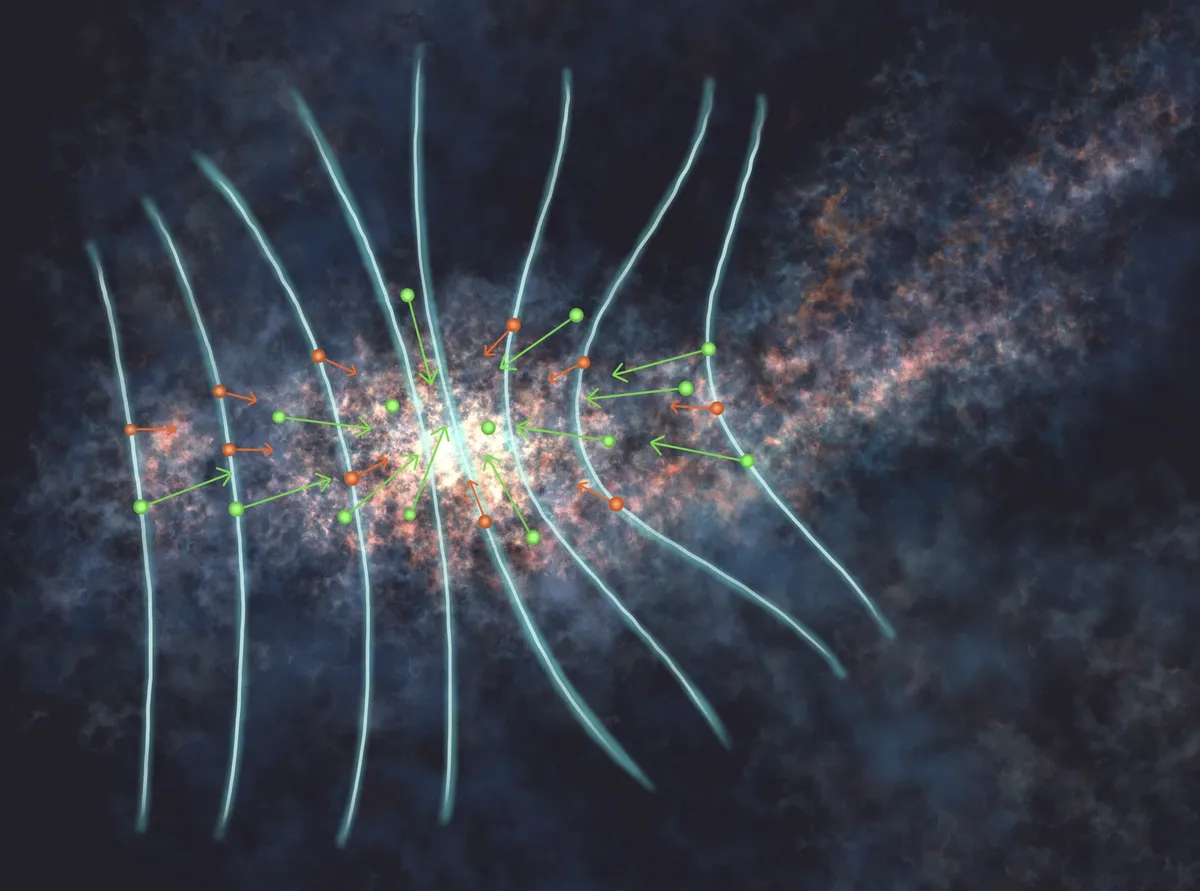
In molecular clouds, gas is partly ionized. This means ions are strongly linked to magnetic fields. Neutral particles interact with the field indirectly through collisions. Studying these molecules helps scientists understand the magnetic field in the core.
However, prestellar cores are very cold. This causes common molecular tracers to freeze onto dust grains, making them invisible. So, the team had to find new molecules to track.
Tracking Ions and Neutral Gas
Silvia Spezzano, a group leader at the Max Planck Institute for Extraterrestrial Physics, explained their choice of tracers. They used Diazenylium‑d1 (N2D+), an ion, and para‑monodeuterated ammonia (para‑NH2D), a neutral molecule. These are usually found in the same dense areas within prestellar cores.
The team collected spectral data from the core. Then, they modeled the speed of these two molecules.
They found a clear speed difference of about 0.05 km/s between the molecules. This showed evidence of ion-neutral drift. As a prestellar core gets denser, it becomes shielded from radiation. This reduces ionization. The link between molecules and magnetic fields weakens. Eventually, neutral particles separate and drift inward due to gravity. The ions, however, stay connected to the magnetic field.
As neutral particles fall towards the core's center, they speed up. The ions stay linked to the magnetic field. This creates the observed speed difference.
Arzoumanian noted that this process is called ambipolar diffusion. Observing it in a prestellar core was very difficult until now. As ambipolar diffusion continues, the magnetic field gets weaker. Eventually, gravity becomes the main force in the core. This leads to its collapse into a protostar.
Future Research
The team plans to confirm their findings. They will observe more prestellar cores. They also want higher-resolution observations. This will help them map the velocity drift of ion and neutral molecules more accurately.
Arzoumanian said these results came from a team effort. Experts in gas dynamics, astrochemistry, and dust physics worked together. Understanding how stars form helps answer basic questions about life's origins in planetary systems. It also helps us understand the universe better.
Deep Dive & References
Probing the ion-neutral drift velocity toward the L1544 prestellar core. Detection of ambipolar diffusion using N2D+ and para-NH2D - Astronomy & Astrophysics, 2026