What if time only exists when something changes? Scientists at the University of Birmingham built a tiny "mini universe" to explore this idea. They used 24,000 ultracold atoms to show that time can naturally appear from changes within a quantum system. This happened without needing any outside clock.
A Universe That Makes Its Own Time
Professor Giovanni Barontini created this lab "mini universe." His work, published in Physical Review Research, suggests we can measure time without a clock. Instead, time can come from how a quantum system behaves on its own.
Some modern physics theories, like the Wheeler-DeWitt equation, suggest time isn't a basic part of the universe. This equation describes the universe as one quantum state without an external clock. In this view, time flows because of how different parts of the system relate to each other, not from an independent ticking clock.
We're a new kind of news feed.
Regular news is designed to drain you. We're a non-profit built to restore you. Every story we publish is scored for impact, progress, and hope.
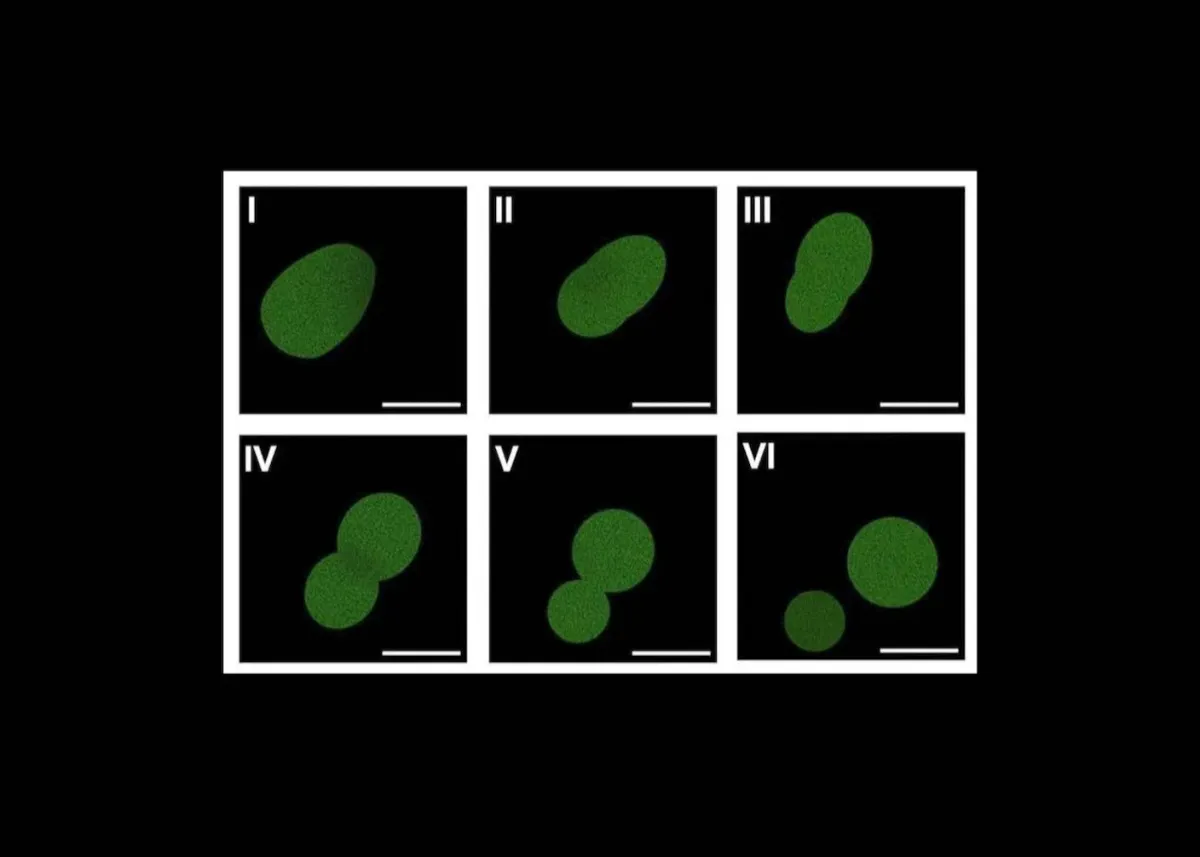
Start Your News DetoxTo test this, Professor Barontini used a cloud of 24,000 ultracold atoms. These atoms were cooled to near absolute zero. He sealed them in an isolated system, separated by a thin barrier made of two laser beams. This created two areas: one "bright" (observed) and one "dark" (unobserved).
Inside this tiny universe, the bright area repeatedly grew and shrank. This was like a simplified Big Bang followed by a Big Crunch. Since the system was completely isolated, researchers could figure out the order of events using only information from inside the mini universe. They didn't need an outside lab clock.
The results showed that time could come from changes within the quantum system. It didn't need to be an independent background that always moves forward.
How Disorder Created Time
The experiment showed that "time" came from changes in the disorder, or entropy, of the atoms. This happened as they moved between the bright and dark regions. Other than this movement, the system stayed isolated.
As the number of particles in the bright region went up or down, the system effectively moved forward in time. When the particle distribution stopped changing, time itself seemed to stop.
Professor Barontini calls this "entropic time." In the experiment, this type of time:
- Flows in one direction, creating a clear "arrow of time."
- Correctly orders events, even as the mini universe expands and contracts.
- Can speed up or slow down depending on how entropy changes.
Professor Barontini explained that in some theories, especially quantum gravity, time isn't a built-in feature. Yet, in daily life, time moves from past to future. This study is the first controlled experiment to show that "time" can be defined by changes within a system. It offers new insights into the nature of time in quantum gravity.
Testing Quantum Gravity in the Lab
The researchers also found that a version of the Schrödinger equation can be written using entropic time. This means scientists can still predict how a quantum system's "probability cloud" changes. This is true even when time is defined by internal changes, not an external clock.
This work addresses a long-standing problem in physics. If some theories are right and the universe has no built-in clock, how can events be put in the correct order? The experiment suggests the answer might be in the system's own changes.
Professor Barontini showed that the miniature universe follows standard quantum mechanics laws. This allows ideas about time, usually only discussed for the entire universe, to be tested in a lab.
This mini universe offers a valuable way to test ideas in quantum cosmology and quantum gravity. Instead of just using math, scientists might now be able to study concepts related to the early universe through lab experiments.
The team believes this approach could be used for more complex quantum systems. This could lead to experiments exploring the physics of the Big Bang, the "Big Crunch," simulated black holes, and different theories about how time itself emerges.
Deep Dive & References
Testing the problem of time with cold atoms - Physical Review Research, 2026