Scientists have found that a special magnetic quantum material can naturally create unusual quantum behaviors. These behaviors were previously only seen in complex, specially built systems.
This discovery could lead to new sensors and quantum devices. These devices could do things that regular electronics cannot.
A Natural Quantum Platform
The team used a magnetic topological material to study non-Hermitian physics. This is a new field that looks at systems with unusual behaviors. Their findings show that the material itself can create these effects. It does not need complex artificial setups.
We're a new kind of news feed.
Regular news is designed to drain you. We're a non-profit built to restore you. Every story we publish is scored for impact, progress, and hope.
Start Your News DetoxNon-Hermitian physics is gaining interest because it predicts behaviors that standard physics cannot easily explain. Some systems become very sensitive to tiny changes, which is good for sensing technology. Others make electrical or quantum states gather in specific spots instead of spreading out.
Researchers showed these effects using a quantum anomalous Hall (QAH) insulator. This material is magnetic and blocks electricity inside. However, it lets electrons travel along its edges in only one direction.
This one-way movement creates natural directional electrical paths. Regular electronics usually work the same in both directions. The QAH material breaks this rule, letting signals move differently depending on their direction.
Morteza Kayyalha, a professor at Penn State, said they wanted to show these phenomena can happen naturally in a quantum material. He noted this work sets up a way to create non-Hermitian systems using quantum materials, rather than just optical or circuit designs.
Edge States Reveal Physics
The research team made ring-shaped devices from thin films. These films were made of bismuth antimony telluride with magnetic elements. Unlike older quantum Hall devices, these materials do not need an outside magnetic field after they are magnetized. This makes experiments much easier.
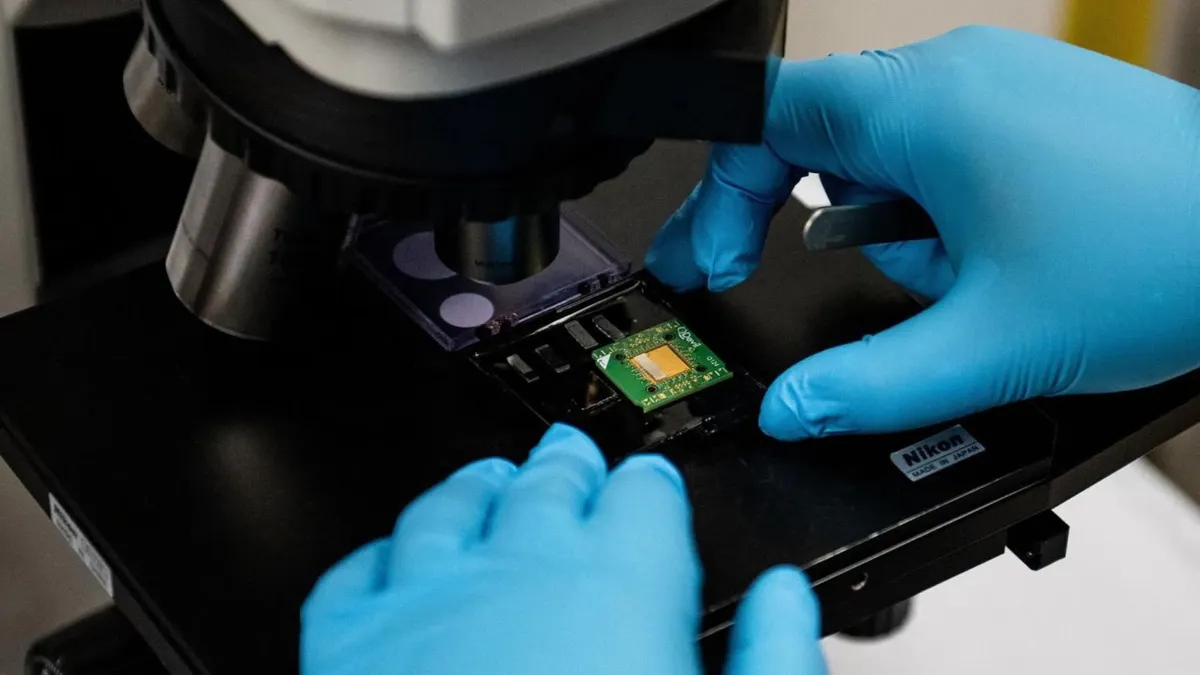
Kayyalha explained that a key benefit of this QAH platform is that the one-way edge state can be studied without an applied magnetic field once the material is magnetized. He added that this makes it a promising way to study non-Hermitian behavior in electronic quantum materials.
Scientists put electrical contacts around each tiny ring. They watched how electrical signals moved between them. These measurements helped them understand the material's electrical network. They compared it to the known Hatano-Nelson model.
The experiments showed signs of the non-Hermitian skin effect. This is where quantum states gather near one end of the system instead of spreading evenly. This effect has been seen before in engineered platforms. But showing it inside a topological quantum material is a big step forward.
Moving Toward Practical Devices
The team also found they could change the material's behavior using gate voltage. This gives researchers another way to study how electricity affects non-Hermitian dynamics. While this work focuses on basic physics, it could have wider uses.
Combining topological quantum materials with non-Hermitian physics might lead to very sensitive detectors. These could respond to tiny electric, magnetic, and other environmental signals.
Kayyalha said magnetic topological insulators offer a flexible way to answer basic questions about quantum transport and topology. He also noted that the way they make these materials already supports large-scale manufacturing. The next step is to find practical sensing uses for these new quantum effects.