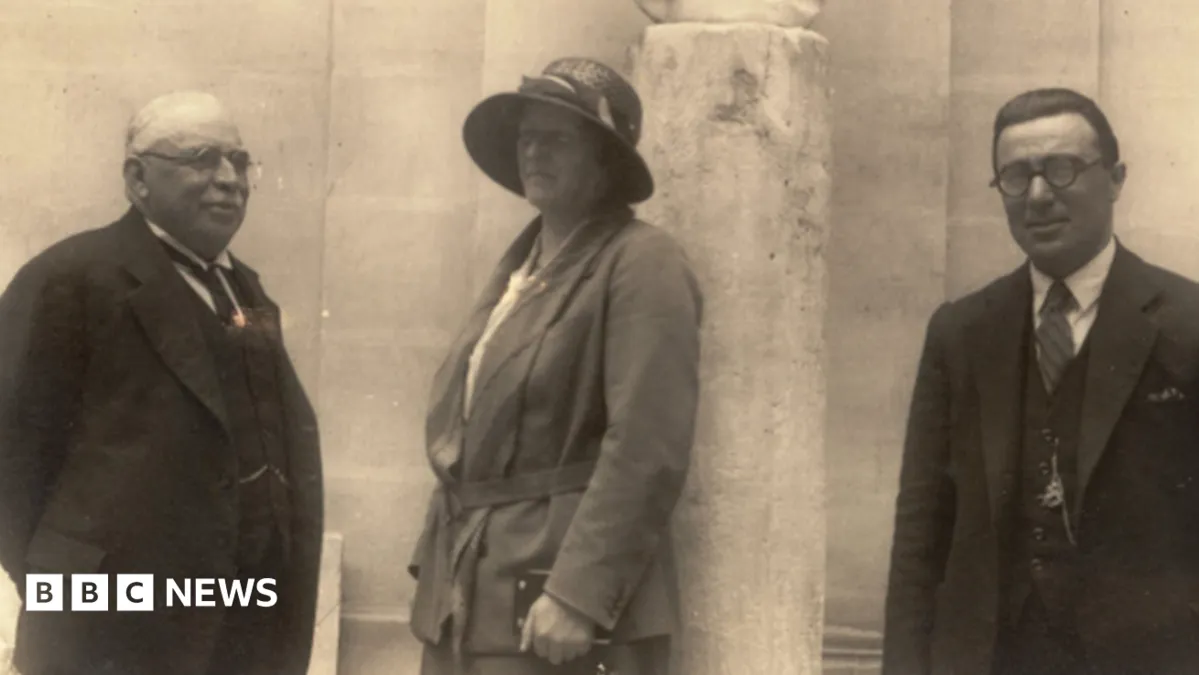
A name you might not know, but absolutely should: Dorothea Bate. This pioneering fossil hunter, who basically wrote the book on prehistoric animals, just got a national blue plaque. It's a fitting tribute to a woman who started working at the Natural History Museum when women in science were, shall we say, a bit of a novelty.
Bate, who left us in 1951 at the ripe old age of 72, "transformed our understanding of prehistoric animals and ancient environments," according to Historic England. The plaque now sits proudly at the Natural History Museum in Tring, Hertfordshire, noting her rather impressive title as "Officer-in-Charge of this museum from 1948." Because apparently, even groundbreaking fossil hunters still had to deal with bureaucracy.
Unearthing the Past
Born in Carmarthen, Wales, in 1878, Dorothea spent her childhood doing what any self-respecting future paleontologist would: exploring caves and collecting fossils. Formal schooling? Mostly optional. She was too busy teaching herself the good stuff.
We're a new kind of news feed.
Regular news is designed to drain you. We're a non-profit built to restore you. Every story we publish is scored for impact, progress, and hope.
Start Your News DetoxBy 1900, she decided the Natural History Museum in London needed her, and her sheer determination apparently convinced them. She landed an assistant role, kicking off a five-decade-long relationship with the institution. A year later, she published her first scientific paper, which, for someone with "little formal schooling," is a flex.
Then came the adventures. Bate embarked on solo expeditions across the Mediterranean, fearlessly venturing into remote caves to unearth ancient secrets. In Cyprus, she casually discovered a new species of dwarf elephant. Yes, a dwarf elephant. Because why not? And in 1909, in the Balearic Islands, she found the myotragus, an extinct goat-like antelope. Because one groundbreaking discovery just isn't enough.
She published over 80 scientific papers, a truly staggering feat considering she spent most of her career without a permanent paid job. Which, if you think about it, is both impressive and slightly infuriating. (She got another blue plaque in her birthplace back in 2017, just to be clear.)
Cracking the Glass Ceiling with a Geologist's Hammer
Historic England's co-CEOs, Claudia Kenyatta and Emma Squire, put it best: Bate's "life was defined by her intense curiosity and desire to understand the natural world." They also pointed out that as one of the very first women employed by the Natural History Museum, she wasn't just finding fossils; she was cracking open doors for every woman in science who came after her. This plaque isn't just for her; it's a giant, stone-cold reminder of her impact.
Heritage minister Baroness Twycross chimed in, noting that Bate's achievements "helped break through the glass ceiling and paved the way for women in palaeontology." Dr. Sandra Knapp, director of research at the Natural History Museum, highlighted how often women scientists' work gets overlooked. Dorothea Bate's work with fossil mammals, she added, was not only groundbreaking but also set a new course, despite the challenges she faced.
So, next time you're contemplating ancient life, spare a thought for Dorothea Bate. The woman who found tiny elephants and goat-antelopes, all while proving that curiosity, not a formal degree, is often the best path to rewriting history.