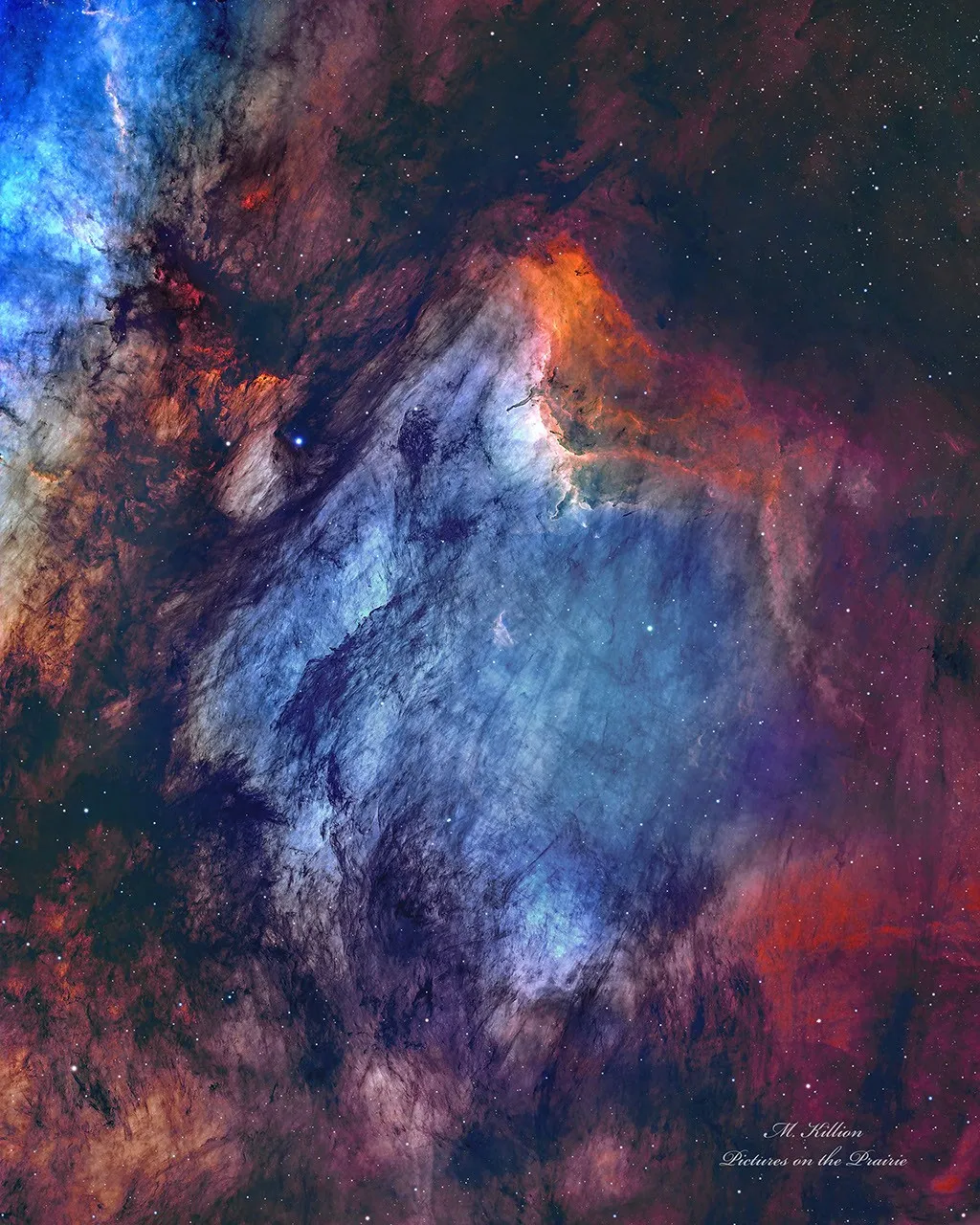
Imagine a pelican, but instead of fish, it's devouring cosmic gas and dust. Now imagine that pelican is also slowly, inexorably, morphing into something else entirely. That's the vibe of the Pelican Nebula, officially known as IC 5070, and it's putting on a show.
Separated from its equally famous neighbor, the North America Nebula, by a truly impressive dark molecular cloud, the Pelican is a stellar nursery in flux. New stars are being born, which is always a dramatic event, and their intense light is literally transforming cold gas into hot, ionized plasma. Think of it as a cosmic glow-up, happening on an unimaginable scale.
The Pelican's Extreme Makeover
A recent image, painstakingly captured over 25 hours of exposure time from Utah, offers a ridiculously detailed peek into this celestial drama. It reveals intricate filaments of dust and gas, all part of the nebula's slow, agonizing transformation.
We're a new kind of news feed.
Regular news is designed to drain you. We're a non-profit built to restore you. Every story we publish is scored for impact, progress, and hope.
Start Your News DetoxThe boundary where this gas-to-plasma conversion happens shows up as a bright orange line, a vivid ionization front that looks like a neon sign against the deeper cosmic backdrop. But not everything is giving in to the energetic young stars. There are still dense, stubborn "tentacles" of cold gas hanging on, resisting the change.
Millions of years from now, this cosmic pelican might not resemble a pelican at all. Its stellar arrangement will shift, the gas clouds will reconfigure, and the whole thing will be a completely different spectacle. The universe, it turns out, is not big on static portraits. It prefers a good time-lapse.