Scientists cannot drill 1,800 miles to Earth's core-mantle boundary. Instead, they study this deep region using seismic waves from earthquakes. A new study in JGR Solid Earth used deep learning to analyze a large set of these waves.
This analysis uncovered six continuous bands of irregularities at the core-mantle boundary (CMB). These had previously only appeared as scattered patches.
Using Seismic Waves to Explore Earth's Interior
The research team used PKP precursors, which are faint seismic waves. These waves arrive a few seconds before stronger seismic waves. They help scientists understand what is happening at the CMB. The CMB controls heat flow, mantle circulation, and the rise of volcanic plumes. Learning about this area helps researchers understand how Earth's deep interior works and changes.
We're a new kind of news feed.
Regular news is designed to drain you. We're a non-profit built to restore you. Every story we publish is scored for impact, progress, and hope.
Start Your News DetoxThe CMB has large features, but also smaller, hidden patches with different temperatures or chemical makeups. PKP precursors are especially good for studying these small details.
Normally, PKP precursors are weak and hard to find manually in earthquake records. Researchers often use techniques to improve the signal and find where waves scatter. However, to be effective, a scalable method was needed to analyze millions of seismic recordings consistently. Doing this by hand would take too long.
Last year, another team successfully used a neural network to find over 30,000 PKP precursor signals. This was done using seismic data. That study relied on dense seismic arrays, which limited the area covered. Still, it showed that deep learning could help analyze PKP precursors that are usually too hard to isolate.
Deep Learning Reveals Belts of Deep-Mantle Differences
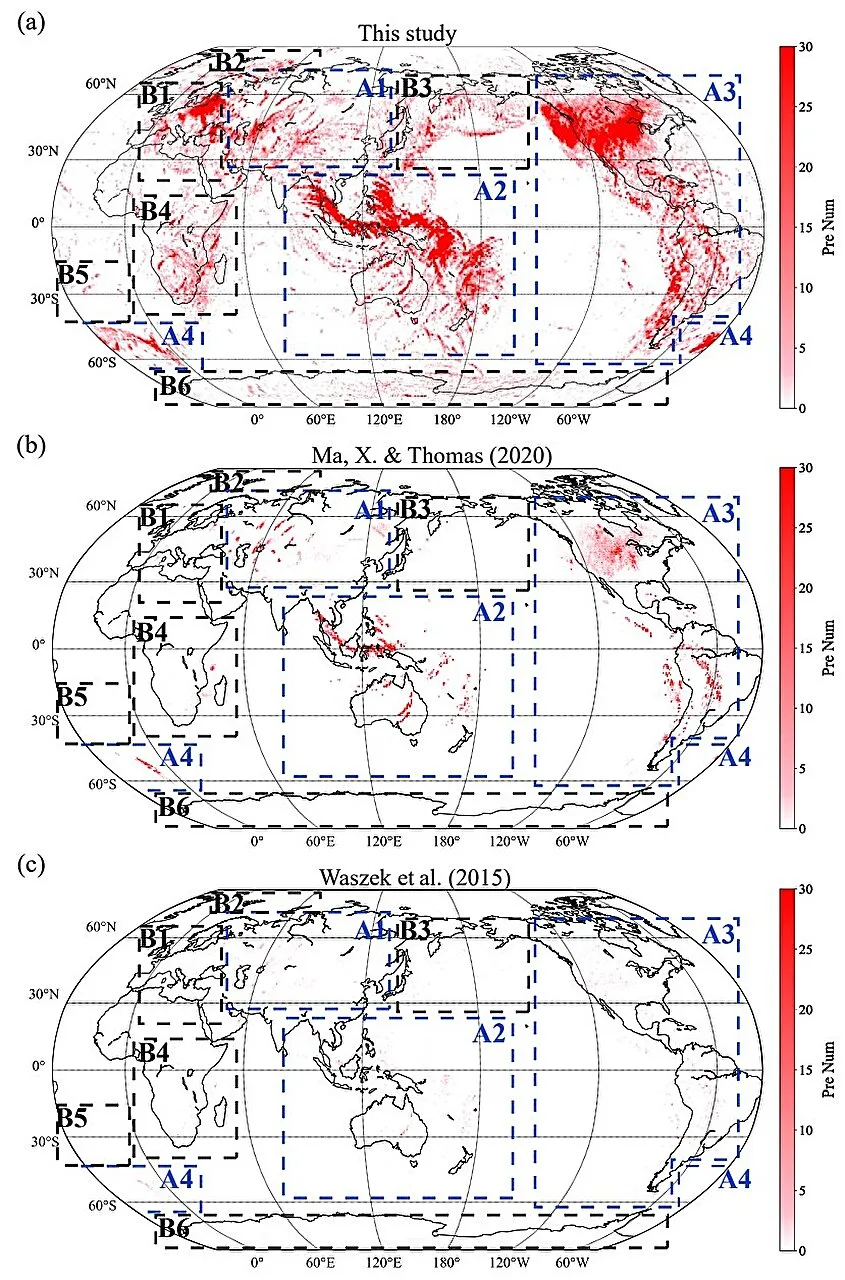
To better investigate PKP precursor signals and map deep-mantle differences, researchers analyzed over 2 million seismic recordings. These recordings were collected worldwide from 1990 to 2024. They used a deep learning system for this. The system filtered out poor-quality records and identified waveforms containing a PKP precursor. The team manually checked and corrected samples to improve the AI. This created two probability maps: one showing how often precursors appear and another showing where strong scatterers are likely located.
The system found 174,929 PKP precursor signals. This is about 10 times more than all previous global precursor data sets combined. This larger data set connected earlier isolated observations into wide, continuous belts of likely deep-mantle differences. The team identified six such regions. These include areas under the North Atlantic, northern Eurasia, the South Atlantic, Southern Africa, the Pacific, and around Antarctica.
The researchers say their results provide the most complete and dense global map of CMB scattering to date. Several high-probability scattering areas match independently known ultra-low-velocity zones, which supports their findings. The patterns suggest that the lowermost mantle is shaped by old subducted slabs, chemical separation, and localized melting.
The researchers note that the maps show probable scattering regions, not exact outlines of hidden structures. Precursor signals cannot precisely locate a scatterer from a single seismic station. Also, PKP signal coverage is uneven because seismic stations and earthquakes are not spread evenly worldwide.
Future work could combine this new catalog with other types of seismic waves. This could create sharper images of the core-mantle boundary. Dense seismic arrays could also help pinpoint the exact locations of these structures.
The study authors believe that as the catalog grows, its detailed coverage will help characterize changes in CMB differences. It will also improve models of the lowermost mantle and offer more information to understand Earth's deep interior.
Deep Dive & References
Global Distribution of PKP Precursors Derived From Three Decades of Seismic Data With Deep Learning - Journal of Geophysical Research: Solid Earth, 2026