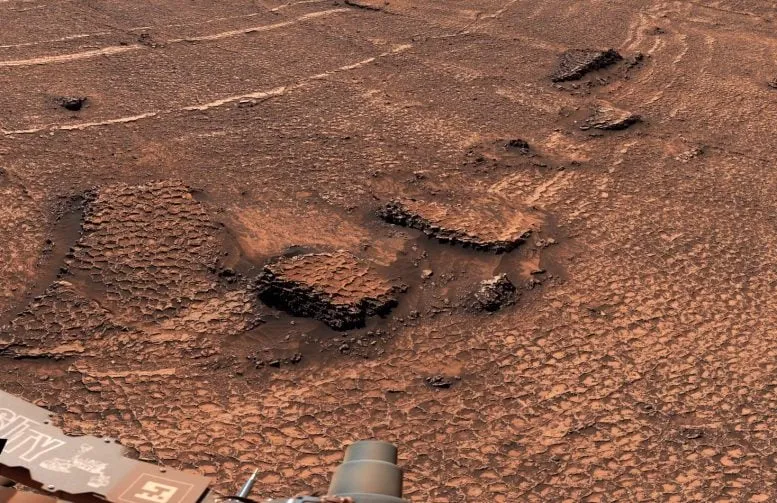
NASA's Curiosity rover, our plucky little explorer on Mars, just beamed back images of something truly wild: a landscape covered in strange, polygon-shaped patterns. Think of it as a giant, cosmic honeycomb. Scientists are buzzing because these aren't just pretty pictures; they're strong evidence that Mars once had actual cycles of rain, drought, and cracking mud. Yes, mud.
Mars, bless its heart, mostly just sits there. Unlike Earth, it lacks the constant geological fidgeting of plate tectonics, volcanoes, or even much flowing water to erase its past. Dust storms happen, sure, but they're more like a gentle dusting than a full-on makeover. This means Mars's surface is a beautifully preserved time capsule, billions of years old, just waiting for a rover to roll by and snap some pics. And Curiosity just found a big piece of that ancient puzzle.
The Great Martian Mud Puzzle
Curiosity isn't the first to spot these polygonal features on Mars, but it's the first time it's gotten this up close and personal with them. The prevailing theory, bolstered by a 2023 study in Nature, is that these patterns are fossilized mud cracks. Specifically, mud cracks formed by intense wet and dry cycles in Gale Crater, where Curiosity has been diligently trundling along.
We're a new kind of news feed.
Regular news is designed to drain you. We're a non-profit built to restore you. Every story we publish is scored for impact, progress, and hope.
Start Your News DetoxWe're talking about events that likely happened 3.8 to 3.6 billion years ago, during a period when Mars might have had a climate that, dare we say, was a bit more Earth-like. These newly found polygons are tiny, only about 4 to 8 centimeters (1.5 to 3 inches) across. Dr. Ashwin Vasavada, a Curiosity mission scientist, put it rather eloquently: "We’ve seen a lot of fascinating landscapes through Curiosity’s eyes, but this sea of polygons took our breath away." Which, if you think about it, is a pretty strong endorsement from someone who spends their days looking at rocks on another planet.
While orbiters like NASA's HiRISE camera have spotted much larger polygons (up to 350 meters wide!) from above, Curiosity's ground-level view gives scientists a crucial, detailed look at these smaller features. This close-up perspective allows them to study the shapes and chemistry, hoping to unlock precisely how these ancient mudscapes formed. It's one thing to see a giant crack from orbit; it's another to see the intricate network of a dried-up puddle from the ground.
Today, Mars is a desolate, frozen world. But these polygonal reminders of a wetter, warmer past are a powerful testament to just how much a planet can change. And for scientists, every mud crack is a clue in the ongoing quest to understand Mars's history, and perhaps, its potential for past life. Because if there was mud, there was water. And where there's water, well, you know the drill.